
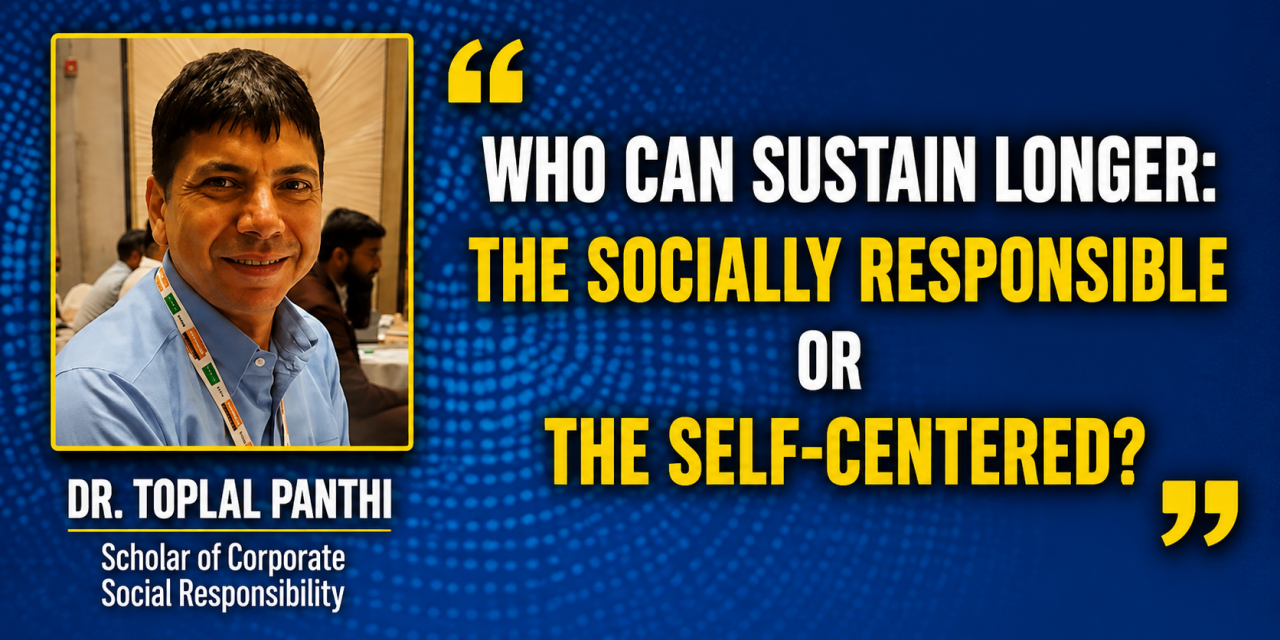
Dr. Toplal Panthi
“The true value of a person is felt not only while they are alive, but also after they have left this world. Their profession, wealth, position, or achievements may fade with time, but their contributions to society can remain alive for generations. A nation does not become great merely because it has successful mountaineers, politicians, doctors, teachers, soldiers, or businesspeople. A nation becomes great when those individuals understand their social responsibilities alongside their personal success.
Mountaineering provides a powerful example. Mountaineers are not respected merely because they reach the summit. They demonstrate courage, determination, discipline, and the will to rise beyond the limits of human capability. In 1953, Sir Edmund Hillary and Tenzing Norgay made the historic ascent of Mount Everest as part of the British Mount Everest expedition, supported by institutions including the Royal Geographical Society. Then, in 1980, Reinhold Messner climbed Everest alone without supplemental oxygen, demonstrating another dimension of mountaineering.
These examples show that different people can have different purposes behind their achievements. Some climb mountains because of personal ambition, while others become symbols of something greater than themselves. Therefore, the important question is not only, “Who reached the summit?” but also, “What did that achievement give to humanity and the nation?” A mountain may be conquered in a single day, but a meaningful legacy can endure for centuries.
The same principle applies to education. A teacher’s responsibility should not end when a student receives a degree. Professors may teach subjects, conduct examinations, and complete curricula, but the purpose of education goes beyond these activities. The real question is whether students can stand independently after graduation. Can they find meaningful employment? Can they contribute to society? Can they create opportunities for others?
In 2024, Dr. Ruth Gottesman’s one-billion-dollar donation to Albert Einstein College of Medicine became a remarkable example of viewing education as a form of social investment. Her contribution made tuition-free education possible for current and future medical students, giving generations of students the opportunity to pursue medical education without the burden of tuition costs.
This raises an uncomfortable question for Nepal: Are we educating people merely to give them certificates, or are we preparing them to build a better society? Teachers and educational institutions need to think beyond graduation. Student success should not be measured only through marks or degrees. Whether a person can live a meaningful life and contribute to others should also be considered a measure of success.
Politics provides another important example. Politicians often make ambitious promises about transforming the nation and even reaching the moon. But the true measure of political leadership should be how close leaders remain to ordinary citizens. A leader’s success should not be visible only during elections. It should be reflected in public service, infrastructure, accountability, integrity, and improvements in citizens’ daily lives.
India’s second Prime Minister, Lal Bahadur Shastri, is remembered for his simplicity, integrity, and famous slogan, “Jai Jawan, Jai Kisan.” His legacy demonstrates that political power becomes meaningful only when it is connected to service rather than personal status.
The medical profession also carries a profound social responsibility. Doctors should not view medicine merely as a means of livelihood. Because medicine is directly connected to human life, it requires compassion and responsibility alongside technical knowledge.
Transplant nephrologist Dr. Aji Djamali demonstrated an extraordinary sense of responsibility in 2022 when he donated a kidney to his former patient, John Jartz. Djamali had treated Jartz years earlier and later became his kidney donor. This does not mean that every doctor must make such a personal sacrifice. Rather, it demonstrates that the deeper meaning of a profession is to serve people, not merely to serve oneself.
Society, however, also has responsibilities toward healthcare professionals. It is wrong to automatically blame or attack healthcare workers when a patient dies. Patients and their families also have responsibilities—to seek treatment on time, follow medical advice, and take reasonable care of their health. If medical negligence occurs, healthcare professionals should be held accountable, but this must be done through evidence and legal procedures, not anger or violence. A healthy society protects both patients and healthcare workers.
Business is another area in which Nepal needs to rethink its approach. Many people want to be recognized as successful entrepreneurs, but being a businessperson is not simply about owning a company, making money, or enjoying an expensive lifestyle. Businesses have responsibilities toward their employees, customers, communities, the environment, and the nation.
The purpose of human resource management should not be to treat people like machines. Employees are human beings with emotions, families, ambitions, dignity, and dreams. Organizations need to understand a simple principle: Love people and use things; do not use people and love things.
Responsible organizations ensure fair treatment, necessary agreements, insurance and benefits, safe working environments, opportunities for professional development, and respect. When organizations deliberately violate labor laws, fail to provide appointment letters, deny legally mandated benefits, or exploit employees, they may make short-term profits. In the long run, however, such practices weaken society.
Organizations around the world have demonstrated that employee well-being and business success can coexist. For example, Amazon ranked tenth on Glassdoor’s 2025 list of companies with the happiest employees, with 96 percent of more than 2,400 employee reviews being positive. This does not mean that Nepali companies must adopt exactly the same model. The broader lesson is that employees can be treated as valuable human beings rather than merely as resources.
A business can also become a social institution. No company can exist independently of society. It depends on customers, employees, infrastructure, laws, communities, and the national economy. Therefore, it also has a responsibility to return value to society.
Panthi founder George Joseph provides another example of long-term commitment. At the age of 104, he was recognized by Forbes as America’s oldest billionaire and remained connected to the company he founded. His story raises an important question for Nepali entrepreneurs: Do we simply want to be remembered as businesspeople, or do we want to build institutions capable of lasting longer than ourselves?
Nepal’s recent experience also forces us to think about institutional responsibility. During the widespread violence of Bhadra 24, 2082, government buildings, police offices, businesses, private residences, and other public and private properties were damaged. Subsequent public reports showed extensive damage to police infrastructure and raised questions about the protection of important public institutions and the state’s response.
In learning from this event, it is not enough to ask only, “Who was responsible for the wrongdoing that day?” A deeper question is: Why were our institutions so weak that such destruction could occur? Responsibility belongs to everyone—political leaders, government agencies, security institutions, businesses, civil society, and ordinary citizens. For a nation to function effectively, everyone must fulfill their respective roles.
So, who is responsible for Nepal’s development?
The answer is not only the government. It is not only politicians, teachers, doctors, soldiers, businesspeople, or ordinary citizens. The responsibility belongs to everyone. A country develops only when every individual and institution understands and honestly fulfills its social responsibilities.
Nepal does not lack intelligent people. It does not lack talented professionals. It has entrepreneurs, teachers, doctors, politicians, soldiers, and ambitious young people in abundance. What Nepal needs is a stronger culture of responsibility.
A person who asks only, “What can I gain?” may achieve success for a while. But a person who asks, “What can I contribute?” is more likely to create a lasting legacy.
A mountaineer should leave behind not only footprints on the mountain but also inspiration. A teacher should leave behind a capable generation. A politician should leave behind strong institutions. A doctor should leave behind a healthier community. A businessperson should leave behind an institution that respects people. A soldier should leave behind a secure nation. And every citizen should strive to hand over to future generations a society better than the one they inherited.
Ultimately, the success that lasts the longest is social success. Wealth can disappear. Positions can change. Businesses can close. Even great people eventually leave this world. But the positive impact they create in the lives of others can continue.
Therefore, Nepal’s question should not only be, “How can we move forward?” It should also be, “What kind of society do we want to sustain for the long term?”
A nation moves forward when its citizens begin to measure success not only by what they have received, but also by what they have contributed. Nepal’s future does not depend only on how high a summit we can reach. It also depends on what we leave behind for society and for future generations.”
The author is a scholar of Corporate Social Responsibility.