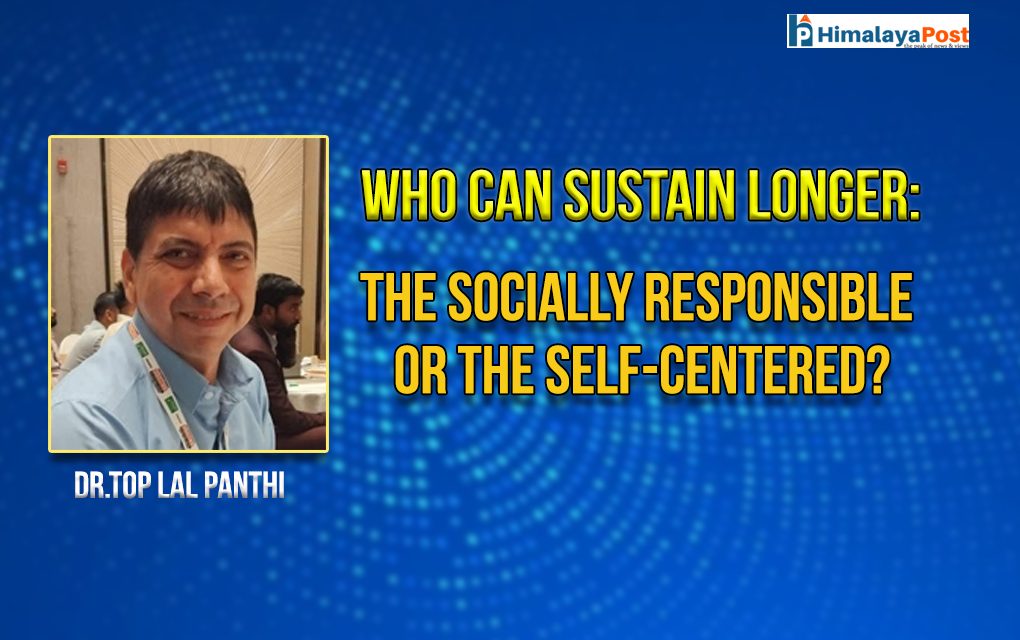
Kathmandu- Corporate Social Responsibility scholar Dr. Top Lal Panthi has argued that a person’s true success should not be measured only by wealth, position, profession or personal achievements, but by the contribution they make to society.
In his article on social responsibility, Dr. Panthi states that wealth, power and professional achievements may disappear with time, while meaningful contributions to society can continue for generations.
He argues that a nation does not become great simply because it has successful mountaineers, politicians, doctors, teachers, soldiers or businesspeople. Rather, national progress depends on whether people understand that their individual success comes with a responsibility toward society.
Using mountaineering as an example, Panthi notes that reaching a mountain summit is not merely a personal achievement. The courage, discipline, determination and willingness to overcome human limitations demonstrated by mountaineers can also inspire society. The achievements of Sir Edmund Hillary and Tenzing Norgay, as well as Reinhold Messner’s solo ascent of Mount Everest without supplemental oxygen, demonstrate different dimensions of achievement and human ambition.
According to Panthi, the more important question is not simply who reached the summit, but what that achievement contributed to humanity and the nation. A mountain may be conquered in a day, he argues, but a meaningful legacy can survive for centuries.
He applies the same principle to education. A teacher’s responsibility should not end when students receive degrees or certificates. The real success of education should be measured by whether graduates can build independent and meaningful lives, find productive employment, contribute to society and create opportunities for others.
Panthi cites Dr. Ruth Gottesman’s $1 billion donation to the Albert Einstein College of Medicine in 2024 as an example of education being treated as a social investment. The donation made tuition free for current and future medical students, reducing the financial burden on generations of students.
He questions whether Nepal’s education system is focused merely on producing certificate holders or on preparing young people to build a better society. He argues that educational institutions should look beyond graduation and measure success through the long-term contribution of their students.
Panthi also highlights the social responsibility of political leaders. Political success, he says, should not be judged only by election campaigns or promises but by public services, infrastructure, accountability, integrity and the quality of citizens’ daily lives.
He cites former Indian Prime Minister Lal Bahadur Shastri as an example of leadership based on simplicity, integrity and public service. Shastri’s famous slogan, “Jai Jawan, Jai Kisan,” reflected the importance of soldiers and farmers and demonstrated how political power can become meaningful when connected to service rather than personal status.
The medical profession, according to Panthi, carries an equally significant social responsibility. Doctors deal directly with human life, and therefore technical knowledge must be accompanied by compassion and accountability.
He refers to transplant nephrologist Dr. Aji Djamali, who donated a kidney to his former patient John Jartz in 2022, as an extraordinary example of professional responsibility. Panthi clarifies that such personal sacrifice cannot be expected from every doctor, but says the example illustrates the deeper purpose of a profession—serving people rather than merely serving oneself.
At the same time, he stresses that society also has responsibilities toward healthcare workers. When a patient dies, medical professionals should not automatically be blamed or attacked. Medical negligence must be investigated through evidence and due process, while patients and families also have responsibilities, including seeking timely treatment and following medical advice.
Panthi argues that a healthy society must protect both patients and healthcare professionals.
Turning to business, he says Nepal needs a fundamental change in the way business success is understood. Owning a company, making money or maintaining an expensive lifestyle should not be considered sufficient evidence of business success.
Businesses, he argues, have responsibilities toward employees, customers, communities, the environment and the country. Human Resource Management should treat employees as human beings with dignity, emotions, families, ambitions and dreams—not simply as resources.
Responsible organizations should ensure fair treatment, proper employment contracts, required benefits, safe working conditions, professional development and respect for workers. Companies that deliberately avoid labour laws or exploit employees may achieve short-term profits, but ultimately weaken society and their own institutions.
Panthi also argues that businesses should aspire to become social institutions capable of surviving beyond their founders. Entrepreneurs should therefore ask whether they merely want to be remembered as successful businesspeople or whether they want to build organizations that can continue creating value after they are gone.
He further connects social responsibility with Nepal’s recent institutional challenges. Referring to the destruction of government buildings, police facilities, businesses, residences and other public and private property during the violence of Bhadra 24, 2082, Panthi argues that the discussion should go beyond identifying who failed on that particular day.
The deeper question, he says, is why Nepal’s institutions became vulnerable enough for such destruction to occur. Political leaders, government institutions, security agencies, businesses, civil society and ordinary citizens all share responsibility for maintaining a functioning and resilient nation.
Panthi concludes that Nepal’s development cannot be the responsibility of the government alone. Politicians, teachers, doctors, businesspeople, soldiers, professionals and ordinary citizens all have social responsibilities.
Nepal does not lack talented people, he says. What the country needs is a stronger culture of responsibility.
A person who constantly asks, “What can I get?” may achieve temporary success, while someone who asks, “What can I contribute?” has a greater chance of creating a lasting legacy.
Mountaineers should leave behind more than footprints on mountains. Teachers should leave capable generations, politicians stronger institutions, doctors healthier communities, businesspeople organizations that respect people, soldiers a safer nation and citizens a society better than the one they inherited.
Ultimately, Panthi argues, the longest-lasting form of success is social success. Wealth can disappear, positions can change and businesses can collapse, but the positive impact created in other people’s lives can continue long after an individual is gone.
For Nepal, therefore, the most important question is not only how to move forward, but what kind of society the country wants to sustain for future generations.