
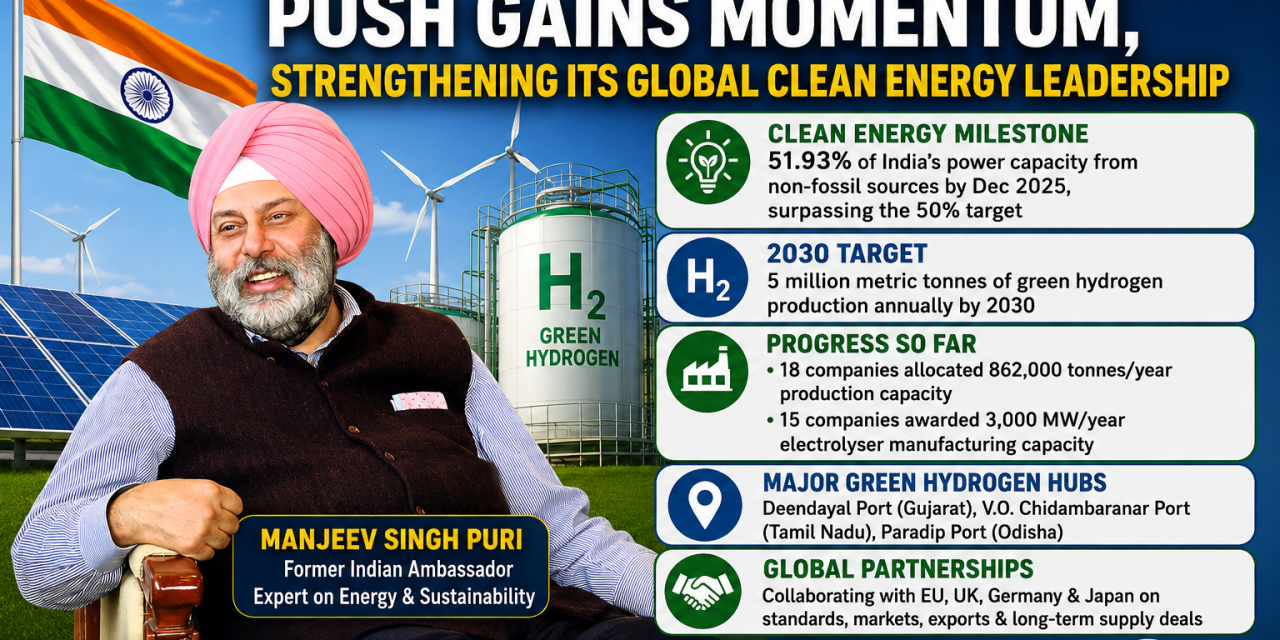
kathmandu- India is rapidly strengthening its position as a global clean energy leader, with green hydrogen emerging as a key pillar of its transition towards a low-carbon economy.
By the end of December 2025, non-fossil fuel sources accounted for 51.93 per cent of India’s installed power capacity, surpassing the 50 per cent target set under the country’s Nationally Determined Contribution.
India’s green hydrogen strategy is particularly focused on sectors where direct electrification remains challenging, including steel, fertiliser production, petroleum refining and long-distance transport. Green hydrogen can replace fossil fuel-based inputs in these hard-to-abate sectors while helping reduce carbon emissions.
Under the National Green Hydrogen Mission, India has set an ambitious target of producing 5 million metric tonnes of green hydrogen annually by 2030. Production capacity of 862,000 tonnes per year has already been allocated to 18 companies, while 15 firms have been awarded 3,000 MW of annual electrolyser manufacturing capacity.
The country has also identified three major green hydrogen hubs at Deendayal Port in Gujarat, V.O. Chidambaranar Port in Tamil Nadu and Paradip Port in Odisha. Meanwhile, pilot projects are being developed to explore the use of green hydrogen in steel production and other industrial applications.
India is also expanding its international partnerships in the hydrogen sector, working with the European Union, United Kingdom, Germany and Japan on hydrogen standards, market mechanisms, exports and long-term supply agreements.
According to TERI researchers Ishita Srivastava and Ambassador Manjeev Singh Puri, India’s proactive approach to green hydrogen could not only accelerate domestic decarbonisation but also position the country to play a major role in shaping future global clean energy markets, supply chains and low-carbon trade.
With its growing investments, industrial applications and international partnerships, India’s green hydrogen push could also create a positive demonstration effect across the Global South, much like its earlier leadership in promoting solar energy.