Ms Bandana Karki
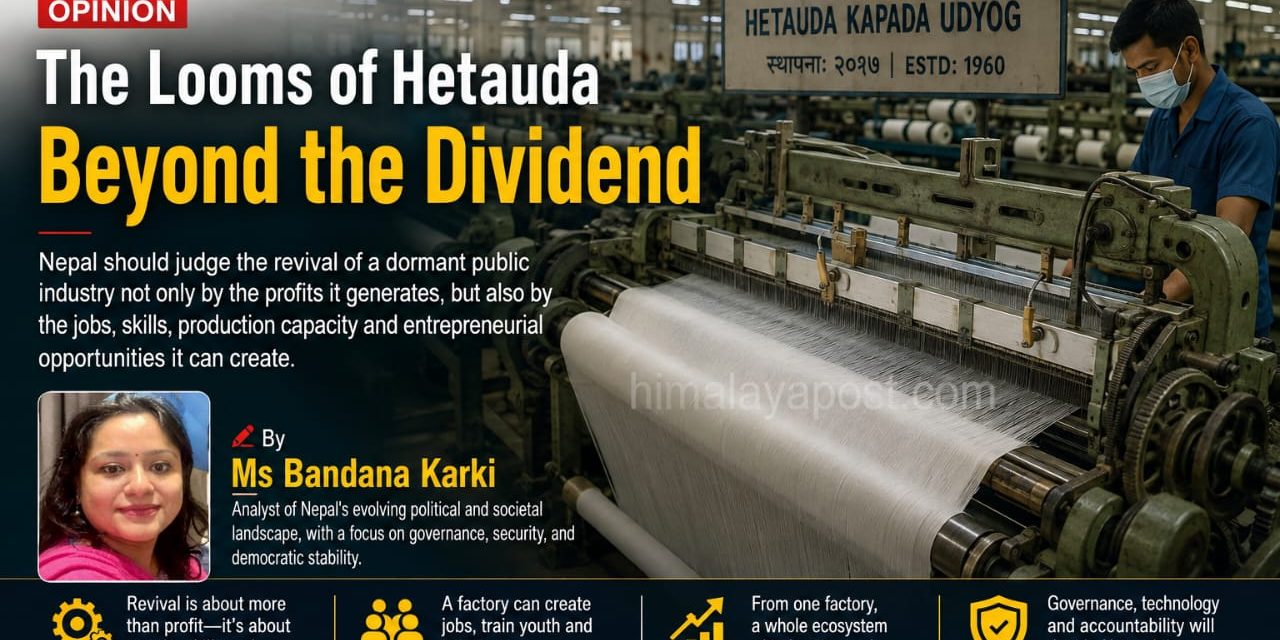
Nepal should judge the revival of a dormant public industry not only by the profits it generates, but also by the jobs, skills, production capacity and entrepreneurial opportunities it can create.
The looms of HetaudaKapada Udyog have begun moving again. After more than two decades of inactivity, the government has taken steps to revive the state-owned textile factory. The premises have been cleaned, machinery inspected and repaired, and trial production has begun. At the same time, a feasibility study is underway to determine what is required to make the factory productive and sustainable. The government has said that the results of the trial production and technical assessment will inform decisions on further investment and modernisation.
The revival of HetaudaKapada Udyog is therefore about more than bringing an old factory back to life. It raises a broader question about how Nepal should think about dormant public assets, industrial policy and the role of the state in creating employment and productive capacity. There are already sceptics. They ask whether a factory operating with ageing technology can compete with modern textile producers. They question whether it can generate sufficient returns and, ultimately, whether it will pay dividends to the government.
These are legitimate questions. Any public investment must be subjected to financial scrutiny, professional management and measurable performance.
But there is another question that deserves equal attention:
Should the success of a public industrial institution be judged only by the dividend it pays to the Treasury?
The answer should be no. Profit matters. Financial discipline matters. Sustainability matters. But the public value of an industrial institution can extend beyond its balance sheet. A government also has a responsibility to create conditions in which citizens can work, acquire skills, establish businesses and contribute to productive economic activity.
For Nepal, that broader perspective is particularly important. A different Nepal needs a different economic approach Nepal today is not the Nepal of several decades ago. In the past, a large part of the population lived in rural areas and depended on agriculture, traditional occupations, small enterprises and family-based skills. Young people often learned by working alongside parents and relatives. A child might learn farming, carpentry, weaving or trading simply by becoming part of the family’s economic life.
That social and economic structure has changed.
Nepal’s young people are better educated, more connected to the outside world and more ambitious about their future. They are looking for opportunities that match their aspirations. Yet the domestic economy has struggled to create enough productive employment.
The result is visible everywhere: large numbers of Nepalis leave the country in search of work. Foreign employment and remittances have become indispensable parts of Nepal’s economy. They have supported households, improved living standards and provided foreign currency. There is no reason to portray overseas employment as inherently negative. But a country cannot build its long-term economic future only by exporting its labour.
A young Nepali should have a choice. He or she should be able to go abroad for opportunity, but should also have a reasonable chance of building a career, acquiring skills or starting a business at home. That requires an economy capable of producing—not merely consuming.
It requires more enterprises, more technical skills, more domestic employment and more value creation within Nepal. This is where the revival of Hetauda becomes relevant. The question is not whether the old factory should return to the past The strongest argument for reviving Hetauda is not nostalgia. Nepal should not reopen an old factory simply because it once played an important role. Nor should it preserve obsolete technology merely because replacing it would be expensive.
The more sensible approach is the one now being attempted: assess the asset, test its productive capacity, identify its weaknesses and determine what can realistically be modernised. Trial production provides evidence before the government commits itself to larger investment. Together, the feasibility study and trial production can help answer a more important question:
What can Hetauda become?
That is different from asking whether Hetauda can simply return to what it was.
The objective should be to revive the institution while modernising its technology, improving its management and making its operations commercially and socially productive. In other words, Nepal should not attempt to recreate the past. It should use the existing asset as a foundation for something more relevant to the present. Nepal must learn from why Hetauda failed There is another reason to approach the revival with caution: Hetauda’s earlier failure cannot be ignored.
The factory did not close simply because the idea of a state-owned textile industry was inherently wrong. Its problems accumulated over time. Political interference weakened professional management. Employment expanded beyond operational requirements. Production costs were not adequately controlled. Technology was not sufficiently modernised. At the same time, cheaper textile products from India, China and elsewhere placed increasing pressure on a factory already struggling with high costs and ageing machinery.
These are not merely historical details. They are lessons.
Reviving Hetauda should not mean reviving the practices that destroyed it. A new Hetauda cannot be built around political appointments, unnecessary staffing, outdated equipment or permanent dependence on government subsidies. If the government is serious about revival, it must be equally serious about governance. There should be professional management, clear performance targets, transparent procurement, modern production systems, financial discipline and regular independent review.
The lesson from the past is therefore not that public industry cannot work. The lesson is that public industry cannot survive without competent management, technological adaptation, market discipline and accountability. A factory produces more than cloth
The conventional assessment of an industrial enterprise is straightforward: How much does it produce? What does it earn? What does it cost? How much profit does it generate?
All of these questions are important.
But an industrial institution can generate another form of value that is harder to measure in a balance sheet: skills. Consider a young Nepali who enters Hetauda as a trainee. Over time, that person can learn machine operation, equipment maintenance, production management, quality control, workplace discipline and supply-chain processes. Those skills do not disappear when the worker leaves the factory.
The person may eventually establish a tailoring enterprise, a garment workshop, a textile business or a machinery-repair service. That enterprise may initially employ a handful of people and gradually grow.
This is how industrial ecosystems develop.
A factory can therefore become more than an employer. It can become a training ground for an industrial workforce and, potentially, a source of future entrepreneurs. Nepal needs machine operators, electricians, mechanics, technicians, supervisors and quality-control specialists. It needs people who understand production systems and supply chains. These are not merely jobs. They are productive capabilities that an economy can build upon. Seen in this way, the real dividend of an industrial institution may extend well beyond the dividend paid to the government.
Employment should be seen as an investment in productive capacity There is a legitimate concern that governments sometimes keep inefficient institutions alive simply to protect jobs. Nepal has experienced enough of this to know the danger. The answer, however, is not to conclude that every public-sector job is inherently a burden.
There is an important distinction between unproductive employment and productive employment. A worker engaged in meaningful production earns an income, supports a household and contributes to demand in the local economy. Suppliers receive orders. Transport operators find business. Repair and maintenance services benefit. Shops and other local enterprises gain customers.
The economic impact of a productive workplace therefore extends beyond its payroll. This does not mean that the government should subsidise losses indefinitely. It means that employment generated through productive economic activity should be understood as part of the wider economic value of an enterprise. For a country struggling to retain its young workforce, that consideration cannot simply be dismissed.
Old technology does not have to mean an old future The weaknesses of Hetauda should not be romanticised. Its technology is old. That is a serious constraint. Modern textile production is competitive, technology-intensive and sensitive to cost, quality and efficiency. But an ageing factory is not necessarily a worthless asset. Hetauda has land, buildings, industrial infrastructure, machinery and institutional experience. It also has a history of textile production and an existing industrial base that can potentially be upgraded. The question, therefore, is not whether every existing machine should continue operating.
It is whether the government can determine, through technical and financial assessment, what should be repaired, what should be replaced, what should be modernised and what should be discarded. That is precisely why the current assessment and trial production matter. The government is, in effect, testing before committing itself to a larger course of action. That is a more responsible approach than either blindly pouring money into an old institution or abandoning it without examining whether the asset can still serve a useful purpose.
Profit should matter—but it should not be the only measure There is a danger at both extremes. One extreme is to say that Hetauda must generate an immediate commercial return or the project has no value.
The other is to argue that because the factory creates employment or has strategic importance, financial performance no longer matters.
Neither position is satisfactory. A modern public industrial policy should apply several tests. First, commercial viability: Can the factory produce efficiently, compete on cost and quality and eventually sustain a substantial part of its operations through its own revenues?
Second, economic value: How many jobs and skills can it generate? Can it stimulate suppliers, transport, services and small businesses? Can it contribute to domestic production?
Third, strategic value: Does maintaining domestic production capacity serve a wider national purpose?
These questions should be considered together. A public enterprise should not be allowed to accumulate losses forever simply by invoking social benefits. At the same time, the state should not abandon a potentially valuable productive capability merely because its first years do not produce a large dividend. The real test is whether public investment can create long-term productive capacity. Some industries matter beyond their balance sheets This brings us to a larger question about the role of the state.
The argument for government involvement in Hetauda should not be that the government is better at running businesses than the private sector.
Usually, it should not be.
The stronger argument is that some productive capabilities may have wider economic or strategic significance. Textiles are not a strategic industry in the same sense as defence or energy. But domestic textile production can contribute to supply security, technical skills, uniform production, industrial know-how and the development of related enterprises. The government has already identified security agencies and other public institutions as potential initial markets for Hetauda’s products. It has also discussed expanding production beyond those institutions.
That creates a potential anchor market while the factory rebuilds its production capacity.
But this should be used carefully.Government procurement should provide a pathway to competitiveness, not a permanent shelter from competition. If Hetauda can produce quality uniforms and other textile products at competitive prices, public institutions can support its early market development. If it cannot, procurement should not become an excuse to purchase expensive or inferior products indefinitely.
The state can create demand. The factory must ultimately earn the right to retain that demand. From one factory to an industrial ecosystem
The most interesting possibility may lie beyond Hetauda itself.
A textile industry does not begin and end at the factory gate. It can form part of a larger industrial chain, in which cotton is produced locally, converted into yarn, processed into fabric and eventually turned into garments and uniforms for domestic markets. Such a chain would create opportunities at every stage—from farmers and factory workers to technicians, transporters, designers and small manufacturers. Over time, the growth of these connected activities could create a wider ecosystem of skilled workers and small businesses, allowing the benefits of one industrial enterprise to spread well beyond the factory itself. Nepal has previously imagined such a chain. The government has also discussed the possibility of reviving the Butwal Yarn Factory, promoting cotton farming and developing an integrated textile industry.
If pursued intelligently, Hetauda could become one part of such an industrial network. Cotton farmers create raw materials. Spinning mills produce yarn. Textile factories produce fabric. Garment manufacturers turn fabric into finished products. Small businesses provide tailoring, repair, design, logistics and other services. The value is therefore not confined to the number of people directly employed inside Hetauda.
It lies in the economic activity that can grow around it. This is how an industrial policy should ideally work: not by creating one large government employer, but by creating the conditions for many connected businesses to emerge.
The state does not have to do everything Reviving Hetauda should not be interpreted as a return to an era in which the government attempts to own and operate every part of the economy.
There is a more productive model available. The government can provide the institutional foundation and initial support. Professional managers can be given operational responsibility. Private companies can contribute technology, investment and market knowledge. Training institutions can help develop workers. Small and medium-sized enterprises can emerge around the factory. Private-sector participation will be particularly important if the factory is to become sustainable over the long term. Industry representatives have also stressed the need for private involvement, modern technology and reliable markets.
The objective should therefore be to create an industrial ecosystem rather than merely maintain a government factory. The principle is simple: The state can create the platform; the private sector and citizens can build upon it. That also means that government ownership should not automatically be treated as the final destination. The government may need to lead at the beginning because the asset is already public and because an initial market and investment framework need to be created. But over time, different ownership and management models could be considered if they produce better results. The important thing is not who owns the factory.
The important thing is whether the factory produces value.
Hetauda can become a test for a wider policy
The significance of Hetauda extends beyond one factory.
Nepal has several public assets that are either underused or have remained inactive for years. They should not all be treated alike.
Some may have commercial potential. Some may require modernisation. Some may be suitable for private participation or public-private partnerships. Others may no longer have a viable economic future.
The government does not need a single ideological answer for all of them.
Instead, each asset can be assessed on its own merits: its infrastructure, market potential, employment impact, strategic importance, investment requirement and prospects for long-term sustainability.
Such an approach would move Nepal beyond the old argument between state ownership and privatisation.
The real question should be more practical:
What ownership and management model can make the best use of an existing national asset?
Sometimes the answer may be government ownership. Sometimes private participation. Sometimes a partnership. And sometimes closure may be the most sensible option.
What matters is that the decision is based on evidence rather than ideology.
From remittance dependence to productive capacity
Nepal’s economic challenge is larger than Hetauda.
For years, the country has relied heavily on a familiar cycle: young people leave, earn abroad, send money home, and households use that income for consumption, education, housing and other needs.
That cycle has brought enormous benefits. But it cannot, by itself, be the final destination of Nepal’s economic development.
The country must gradually strengthen domestic production.
That means creating businesses, developing skills, supporting entrepreneurship and expanding opportunities for value creation within Nepal.
The government cannot create every job. Nor should it try.
But it can create the conditions under which businesses emerge and workers acquire the capabilities required by a modern economy. It can use public assets more intelligently. It can support strategically important industries. It can encourage technology transfer and vocational training. It can bring private capital and expertise into projects where they add value.
Hetauda can be one small part of that larger effort.
Give the government a chance—but measure the results
The revival of Hetauda deserves neither blind celebration nor premature dismissal.
The government should be judged by what happens next.
There must be professional management, transparent decision-making, clear production and financial targets, regular performance reviews and accountability for results.
There should also be milestones.
The first question is whether the existing machinery can support viable trial production. The next is what level of investment is required to modernise the plant. Then comes the question of whether the modernised factory can produce competitively.
The government should be prepared to change the model if the evidence demands it.
If professional management works, it should be strengthened.
If private participation adds value, it should be welcomed.
If new technology is required, investment decisions should be based on evidence.
And if, after reasonable investment and reform, the factory still cannot become viable, the government should have the courage to reconsider the model.
Supporting revival does not mean supporting permanent subsidies.
The objective should not be to keep Hetauda alive at any cost.
The objective should be to give it a credible opportunity to become productive, competitive and increasingly self-sustaining.
Government ownership can be a starting point. It should not automatically become the destination.
The government should be allowed to prove the idea
For years, the machines were silent. The buildings remained underused. An industrial asset that once represented Nepal’s manufacturing ambitions became a symbol of institutional decline.
Now the machines are moving again.
That is not, by itself, proof of success.
But it is a beginning.
And beginnings matter.
The present government’s approach is significant precisely because it has started with assessment and trial production rather than immediately committing to a large-scale investment. That provides an opportunity to learn before expanding the project.
The government should therefore be given the opportunity to prove whether a dormant public asset can become a productive national asset.
But it should also be held to a higher standard than simply reopening the gates.
The new Hetauda must be different from the old Hetauda.
It must be professionally managed.
It must use appropriate technology.
It must control costs.
It must develop skills.
It must build markets.
It must work with the private sector.
And, ultimately, it must demonstrate measurable value.
Beyond the dividend
So, will HetaudaKapada Udyog eventually pay a dividend to the government?
We do not know.
And perhaps that should not be the only question.
We should also ask whether it can create productive employment, train young Nepalis, develop technical skills, encourage entrepreneurship, strengthen domestic production, support selected national requirements and eventually become financially sustainable.
Those outcomes are not substitutes for financial discipline. They are part of the broader public value that a strategic industrial institution can create.
The government has now chosen to test whether a dormant public asset can become a productive national asset.
It should be given the opportunity to demonstrate that model—but it must also be held to clear standards of performance.
If Hetauda succeeds, it could offer lessons for other dormant industries and public assets.
If it fails, the government will at least have evidence on which to base its next decision.
Either way, testing, learning and improving is preferable to allowing potentially valuable public assets to decay without examination.
Nepal needs to move from a culture of waiting to a culture of doing; from an economy that primarily seeks employment abroad to one that also creates employment at home; from consumption towards production; and from exporting skilled workers to also creating opportunities for skilled workers within the country.
HetaudaKapada Udyog cannot achieve all of this on its own.
But it can become a beginning.
The looms have started moving again.
The real test now is not simply how much cloth they produce, or how much dividend they eventually return to the state.
It is how many skills, jobs, entrepreneurs and businesses they help create.
Because the greatest dividend from Hetauda may ultimately be measured not in the money it returns to the government, but in the economic possibilities it creates for Nepali citizens.
About the Author: The author is an analyst of Nepal’s evolving political and societal landscape, with a focus on governance, security, and democratic stability. She regularly contributes analytical commentary to national and international platforms on issues shaping Nepal’s domestic transformation and its positioning within broader regional and global dynamics.