
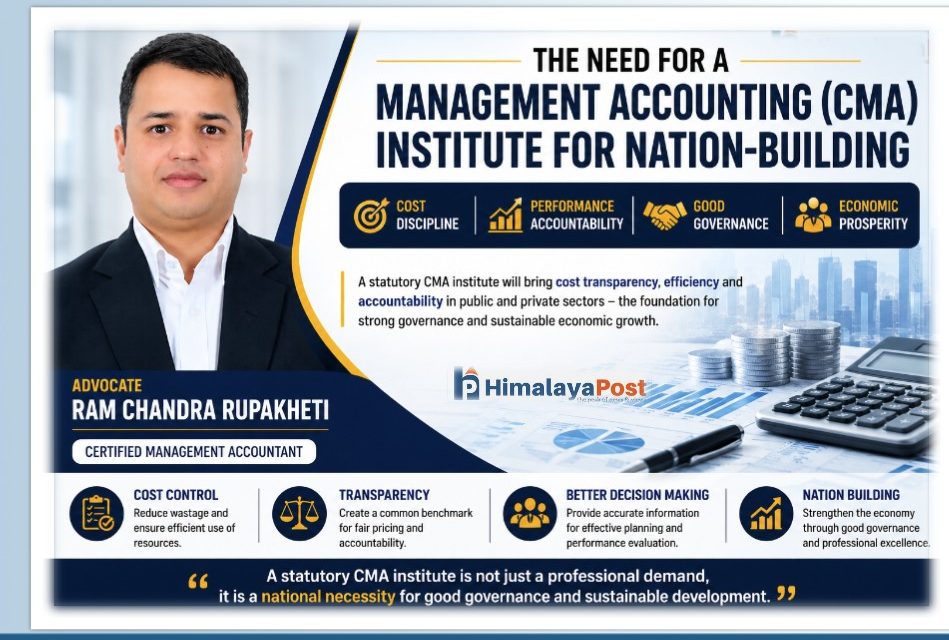
Advocate Ram Chandra Rupakheti, Kathmandu- One institution that Nepal’s economy needs today more than almost any other is a statutory body for Cost and Management Accounting (CMA). From India, Sri Lanka, Pakistan, and Bangladesh to the United Kingdom, the United States, and Australia, countries around the world established such institutions decades ago, using them to instill cost discipline and performance accountability across industry, public spending, and the service sector. Nepal has yet to take this path. Nepal’s economy today rests on remittances, imports, tourism, construction, agriculture, and hydropower. Yet problems such as project cost overruns, inefficiency in public expenditure, and a lack of transparency in pricing across both private and public sectors have recurred year after year.
These problems share a common root: Nepal has no statutory body to professionally regulate cost analysis and management accounting.
Institutions overseeing financial auditing and legal compliance such as ICAN, the Nepal Bar, or the Financial Intelligence Unit (FIU) are doing important work within their own domains. But their scope is different: financial statements, legal justice, or financial crime control. Cost accounting and management accounting are an entirely separate discipline, focused on production cost, pricing, budget discipline, efficiency, and project performance measurement. It would therefore be a mistake to view a dreamed CMA institute as a competitor or rival to these existing regulatory bodies rather, it should be seen as a foundational pillar of the economy.
In India, the Institute of Cost Accountants of India (ICMAI) was established in 1944 and has functioned as a statutory body under the Cost and Works Accountants Act since 1959, with the authority to mandate cost audits in specific industries. In Sri Lanka, CMA Sri Lanka began in 2000 and received recognition as the national management accounting institute through an act of parliament in 2009. Similarly, Pakistan (ICMAP established 1951, made statutory in 1966) and Bangladesh (ICMAB 1977) have institutionalized the CMA profession through their own statutory acts.
Among developed nations, the UK’s CIMA (established 1919, granted a Royal Charter in 1975) and the US’s IMA (established 1919) have spent more than a century institutionalizing the management accounting profession through education, codes of conduct, and certification. Active chapters of ICMA in Australia and IMA/CIMA in China follow the same pattern. The common lesson from all of these examples is the same: no economy can achieve sustainable industrial discipline without granting cost and management accounting a distinct statutory identity.
In Nepal, complaints have become almost routine public and private sector projects alike are reported to show costs inflated beyond their actual value, and even substandard services are priced expensively. If Nepal were to establish a statutory CMA institute, following the model of India or Sri Lanka, and implement mandatory cost audits, it could deliver several benefits. The gap between actual project cost and budget would become clearly visible in public projects. A common benchmark would be established for both government and private companies. Consumers would be able to access services at competitive, fair prices. Opportunities for corruption and irregularities would naturally shrink. This would function as a form of internal control one that external financial auditing alone cannot provide.
For a Nepal that holds the potential for thousands of megawatts of hydropower, an expanding tourism and digital economy, and is in the process of graduating from Least Developed Country (LDC) status, international-standard cost discipline and professional capacity have become indispensable. In this context, the demand for a CMA institute is not a narrow professional interest it is a national need, tied directly to the country’s economic management, public financial discipline, and the future of its young professionals.
The path that India and Sri Lanka took to bring cost transparency to their industries and public sectors is the same path Nepal must now adopt without further delay. What is required is a dedicated act, a clear regulatory framework, and cost and management accounting standards tailored to Nepal’s own needs and this is an urgent priority today.