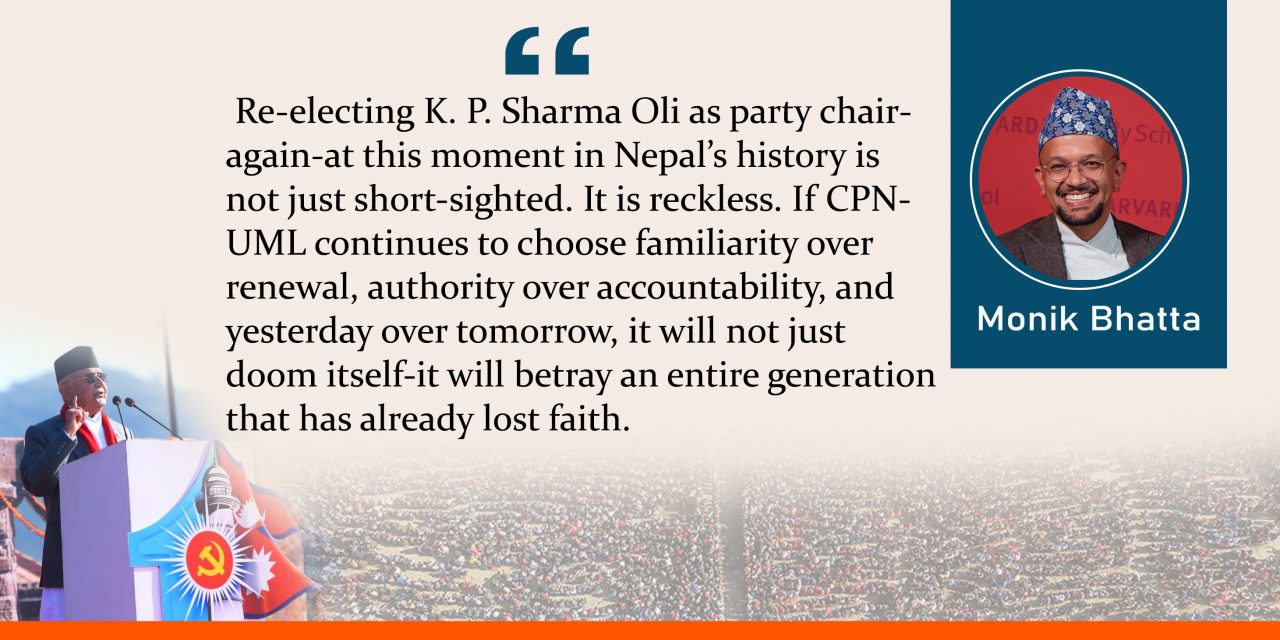
– Monik Bhatta
I cannot tell whether the CPN-UML leadership is desperate, oblivious, or simply indifferent. Perhaps it is all three. But re-electing K. P. Sharma Oli as party chair—again—at this moment in Nepal’s history is not just short-sighted. It is reckless.
This decision comes as young Nepalis take to the streets, not out of fashion or foreign influence, but out of exhaustion. Exhaustion with leaders who recycle themselves while the country bleeds talent, dignity, and time. Exhaustion with a political class that speaks endlessly of nationalism while presiding over an economy so hollow that survival depends on exporting its youth. And exhaustion with parties that claim to represent the future while clinging stubbornly to the past.
CPN-UML voters and cadres must ask themselves a hard question: do you care about winning the next internal contest, or do you care about whether your party—and more importantly, the country—will still matter 15 or 20 years from now? Oli may know how to survive politically. That is not leadership. That is endurance without direction.
His rhetoric does not attract young voters, his politics does not inspire confidence, and his record offers no credible vision for the future. Betting the party’s future on a man whose political lifespan is nearing its end is not strategy; it is denial.
A Record of Instability, Not Stewardship
This is not a debate about temperament, tone, or political style. It is about record. And **K. P. Sharma Oli’s tenure is defined by a series of concrete decisions that repeatedly pushed Nepal toward institutional breakdown.
Monik Bhatta
In December 2020, he dissolved the House of Representatives, triggering a full-blown constitutional crisis that forced the Supreme Court to step in and ultimately remove him from office—an act that constitutional experts and international observers have widely recognized as unlawful and deeply destabilizing.
This was not a one-off error or a momentary lapse in judgment. The dissolution fractured his own party, ignited protests across the country, and injected profound uncertainty into Nepal’s democratic trajectory. Observers and governance experts have long pointed out that while Nepal had begun to experience relative political stabilization after the adoption of the 2015 Constitution, this single act abruptly reversed that progress, plunging the country into a crisis that raised serious doubts about whether democratic norms would hold.
What followed matters. The protests were widespread but overwhelmingly peaceful. Nepalis did not turn to violence. They placed their faith in institutions. They trusted the courts. They trusted constitutional process. And in that critical moment, the Supreme Court upheld its responsibility—reinstating Parliament, restoring constitutional order, and clearing the path for Sher Bahadur Deuba to form a government and stabilize the country ahead of the 2022 elections.
That episode defines Oli’s legacy more clearly than any campaign speech ever could. It is not a legacy of decisive leadership or strength. It is the record of a leader whose actions crossed a line—and who had to be stopped for the system to survive.
Voters Sent a Warning; Leaders Ignored It
The 2022 elections sent a message that could not have been clearer. Public frustration with the political establishment had reached a breaking point. Independent candidates surged across the country, many of them with no prior party backing or political pedigree. The Rastriya Swatantra Party emerged far stronger than anyone had anticipated, tapping directly into a mood of anger, impatience, and deep disappointment. Voters, especially younger Nepalis, made it unmistakably clear that inherited loyalties and familiar party symbols were no longer enough to earn their trust.
This was not a protest vote born of confusion. It was a conscious rejection of business as usual. Young voters, first time voters, and even longtime party supporters were signaling that they wanted accountability, renewal, and leaders who spoke to the realities of their lives rather than the grievances of past decades. The election results were a warning flare, not just to one party but to the entire political class. And yet, instead of pausing to reflect on what those results meant, the political establishment did what it knows best. It closed ranks.
Old parties reshuffled coalitions behind closed doors. Familiar faces rotated back into positions of power. Promises of reform were replaced with tactical maneuvering. Nothing fundamental changed.
The Economy Beneath the Anger
What spilled onto the streets this year was not driven by political anger alone. It was fueled by economic despair that had been building quietly for years.
Nepal’s economy rests on an extremely fragile foundation. Remittances account for more than a quarter of national GDP, creating the illusion of stability while masking a deep and persistent failure to generate jobs at home. This dependence leaves the country dangerously exposed to forces it cannot control. Any slowdown in Gulf economies, any tightening of labor migration policies, or any regional shock immediately translates into lost income for millions of households. It is an economy built on export of labor rather than creation of opportunity.
When political instability returned, that fragility was laid bare. The economic impact was swift and brutal. Analysis from the Atlantic Council estimates that recent unrest caused losses of roughly $22.5 billion, nearly half of Nepal’s GDP. Tourism collapsed during what should have been a peak season. Investor confidence evaporated. Growth projections plunged below one percent, signaling not just a slowdown but a near stall of economic momentum
For ordinary Nepalis, this translated into more than abstract numbers. It meant canceled jobs, shuttered businesses, and the sense that even basic economic security could no longer be taken for granted. Graduates already struggling to find work saw opportunities disappear overnight. Families dependent on tourism or small trade watched their livelihoods vanish with no safety net to catch them.
A Generation Is Leaving. And Not Coming Back.
Nepal is bleeding its youth at a scale that should alarm every serious policymaker. Over the past three decades, nearly 6.8 million Nepalis have taken labor approval for overseas employment, with roughly 1,700 people leaving the country every single day. At the same time, more than 100,000 students depart Nepal each year in search of education abroad, many of whom never return. For those who remain, the outlook is grim. Youth unemployment has climbed to 22.7 percent among people aged 15 to 24, according to the Nepal Living Standards Survey 2024.
This is not migration driven by curiosity or ambition alone. It is a form of economic flight. Young people are leaving because the system at home offers too little opportunity and too much exclusion. Jobs are scarce, wages are low, and advancement is often determined not by skill or effort but by who one knows. A labor market structured around patronage rather than merit leaves little room for hope, especially for those without political or economic connections.
Inequality has deepened this sense of abandonment. Income and wealth have become increasingly concentrated at the top, while the majority struggle to keep pace. The richest 10 percent of Nepalis now earn more than three times the income of the poorest 40 percent and control over 26 times their wealth. Economists have warned that this imbalance is not just widening but becoming entrenched, locking large segments of the population out of meaningful economic mobility. These trends point to a system that increasingly serves a narrow elite while leaving the rest behind.
For many young Nepalis, the decision to leave is not about chasing luxury or status. It is about preserving self respect. It is about finding work that values their education, effort, and time. It is about security, predictability, and the simple belief that hard work will lead somewhere. When a country cannot offer its youth dignity, it should not be surprised when they look for it elsewhere.
Governance Has Stagnated—and Oli Owns the Era
Global governance data from the World Bank confirms what many Nepalis experience in their daily interactions with the state. Across all six World Governance Indicators, Nepal continues to perform below the global median. Government effectiveness remains weak. Rule of law is fragile. Regulatory quality is inconsistent. Control of corruption is limited. Political stability is shallow. Accountability exists in form, but not in substance. The pattern that emerges is not one of dramatic collapse, but of prolonged stagnation, where weak institutions have become normalized rather than corrected.
When these trends are examined alongside K. P. Sharma Oli’s periods in office, first from 2015 to 2016, then from 2018 to 2021, and again from 2024, the picture becomes even clearer. His most powerful mandate came during a period when political stability at the top should have enabled reform and institutional strengthening. Instead, it coincided with growing centralization of authority, the marginalization of Parliament, politicized appointments across key institutions, and ultimately an attempt to override constitutional limits.
Rather than using stability to build durable systems, leadership during this period relied on concentration of power and transactional politics. The opportunity to convert electoral strength into governance reform was missed. The data reflects this failure. There is no meaningful improvement in state capacity, no sustained progress in accountability, and no credible reduction in corruption. Stability under Oli did not translate into strength. It bred complacency, and that complacency continues to shape Nepal’s political and institutional landscape today.
This Is About the Country, Not One Man
Let us be honest. Oli is not doing this for the party. He is doing it for himself. His ego, bruised by removal and court rulings, demands relevance. But Nepal cannot afford leadership driven by personal survival.
Parties are temporary. Leaders are mortal. The country is not.
If CPN-UML continues to choose familiarity over renewal, authority over accountability, and yesterday over tomorrow, it will not just doom itself—it will betray an entire generation that has already lost faith.
Nepal will outlive Oli. The question is whether its politics will grow up in time to deserve its youth.
(Monik Bhatta has worked in international development for over a decade across multiple countries and is a recent graduate of the Harvard Kennedy School of Government. He can be reached at [email protected])