Ms Bandana Karki
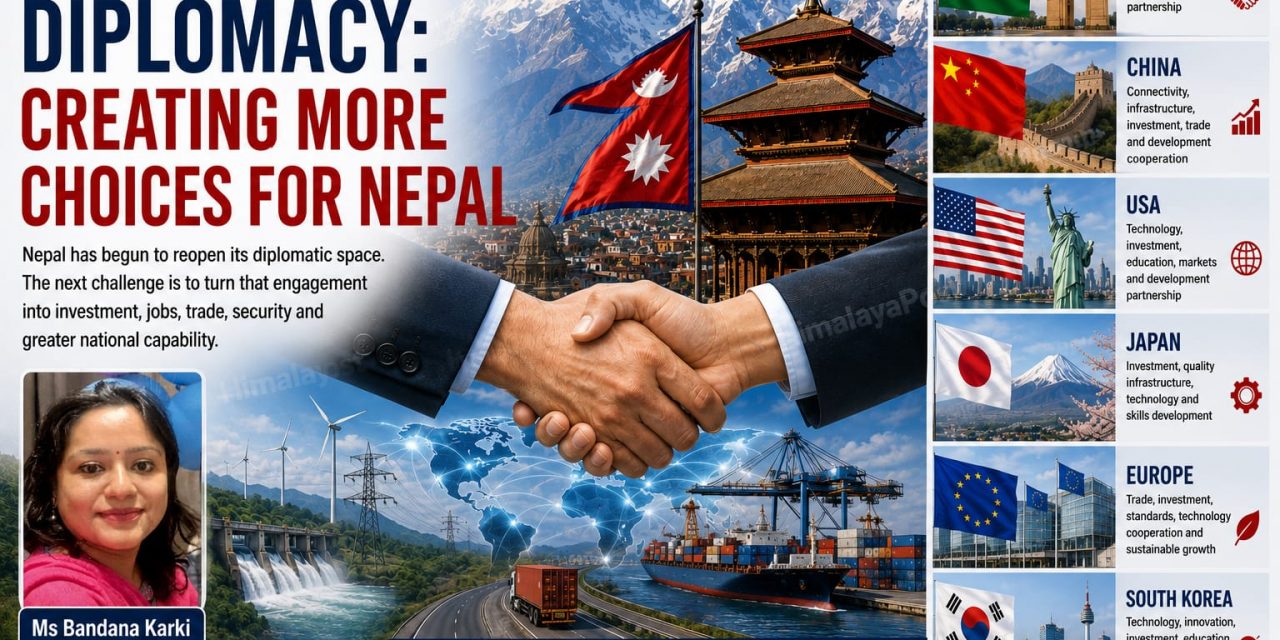
Nepal has begun to reopen its diplomatic space. The next challenge is to turn that engagement into investment, jobs, trade, security and greater national capability.
Prime Minister Balendra Shah’s recent one-to-one meetings with the ambassadors of India and China mark an important opening in Nepal’s diplomatic engagement. After several months of avoiding individual meetings with resident ambassadors, Shah met Indian Ambassador Naveen Srivastava and Chinese Ambassador Zhang Maoming on August 10.
These meetings do not necessarily signal a change in Nepal’s foreign-policy alignment. They are better understood as a return to direct and regular diplomatic engagement. For Nepal, that is important in itself.
Nepal needs such engagement. We are a small country between two major powers. We cannot afford unnecessary distance from either India or China. At the same time, our foreign relations cannot be limited to our two neighbours. The United States, Japan, South Korea, the European Union and the Gulf countries are also important to Nepal’s economy and development.
The important question now is not whether Nepal should engage with these countries.
It is what Nepal should get from that engagement.
The timing matters
The timing of the recent diplomatic opening is significant.
The Prime Minister has now resumed direct engagement with foreign representatives. India has also reiterated its invitation to Prime Minister Shah to visit New Delhi, although no date has been announced.
At the same time, Indian Army Chief General Dhiraj Seth begins his Nepal visit today, August 16. His visit is part of the long-standing practice under which the serving Indian Army Chief is conferred the honorary rank of General of the Nepali Army.
This is not a new arrangement. It is a tradition that reflects the depth of Nepal-India military relations.
Nepal and India have maintained close military-to-military relations for decades. Training, professional exchanges, humanitarian assistance and the honorary-general tradition are established parts of that relationship.
These long-standing institutional links are important. But they should also be kept separate from day-to-day political differences.
There is no need to look at every engagement through the lens of geopolitical alignment.
A meeting with India does not mean moving away from China. Engagement with China does not mean moving away from India.
Nepal can work with both. That is simply a matter of national interest.
The real test begins now
Diplomatic meetings are useful. But meetings themselves do not produce national benefit.
The real work begins after the meetings. Can Nepal attract investment, increase exports, open new markets for Nepali products, bring technology and skills into the country, and create more jobs?
These are more important questions than how many meetings the Prime Minister has held.
Nepal has good relations with many countries. What we have often lacked is the ability to turn those relations into economic results.
This is where economic diplomacy needs greater attention.
Foreign policy should not remain separate from Nepal’s economic priorities. Diplomacy should help open markets, attract investment, bring technology, support tourism, develop industries and create opportunities for Nepali businesses.
In simple terms, foreign policy should also work for the Nepali economy.
A good diplomatic relationship is valuable. But its value becomes greater when it produces something tangible for the country.
India: The next step should be economic
India will remain one of Nepal’s most important partners.
The reasons are obvious. The two countries share a long border, deep social and cultural links and extensive economic relations. India is also a major market and an important source of investment, energy cooperation and employment opportunities.
But Nepal should think beyond the traditional question of exports to India.
The bigger opportunity is to become part of larger Indian and regional production chains.
Nepal has potential in hydropower, tourism, agriculture, food processing, tea, coffee, herbs, textiles, garments and information technology.
But potential alone is not enough.
We need reliable electricity, better roads and logistics, efficient customs, good standards, skilled workers and a business environment that encourages investment.
Nepal should also have a clearer idea of what it wants from the Indian market.
Which Nepali products can compete? Which Indian companies could invest in Nepal? Where can Nepali producers become part of Indian supply chains? What infrastructure is required? What rules are holding businesses back?
These are the questions economic diplomacy should help answer.
The relationship should therefore move beyond discussions about trade volumes. Nepal should look for specific sectors where Indian investment, technology and market access can help Nepali production grow.
China: Engagement without unnecessary suspicion
The same approach should apply to China.
Nepal does not have to choose between India and China.
Our relationship with China has its own importance. It covers connectivity, infrastructure, tourism, trade, investment and development cooperation.
Nepal should engage China where our interests meet.
But the focus should remain on practical results.
Connectivity should make trade easier. Infrastructure should support economic activity. Investment should increase Nepal’s productive capacity. Technology cooperation should help Nepali institutions and businesses develop.
Agreements are useful only when they eventually produce something on the ground.
Nepal should therefore judge every major project by a simple question: How does it benefit Nepal?
This should not be an India-versus-China calculation. The same test should be applied to both: does the relationship strengthen Nepal’s economy, infrastructure, institutions and national capacity?
Defence diplomacy is also changing
The visit of the Indian Army Chief comes at a time when Nepal’s security environment is changing.
Traditional military relations remain important. But new areas are becoming equally relevant.
Drones, cyber threats, artificial intelligence, electronic warfare, disaster response and new forms of technology are changing the security environment.
Nepal needs to build its own capacity in these areas.
This does not mean depending on one country.
Nepal can continue its established defence relationship with India while maintaining appropriate security engagement with China, the United States and other partners.
The objective should be to strengthen Nepal’s own institutions, personnel and capabilities.
That should be the measure of defence diplomacy.
Defence diplomacy should therefore not be viewed only through the traditional exchange of visits and training opportunities. It should also help Nepal understand and prepare for the security challenges that are emerging around us.
Sovereignty means having choices
There is a larger point here.
For a small country, sovereignty does not mean staying away from powerful countries.
It means being able to engage them while protecting national interests.
Nepal should be able to discuss energy and trade with India, connectivity with China, technology and development with the United States, investment with Japan and economic opportunities with Europe and the Gulf.
These relationships do not have to contradict each other.
In fact, having more relationships can give Nepal more choices.
But diversification should not mean signing agreements simply for the sake of signing them.
Nepal already has many agreements, memoranda and understandings.
The bigger challenge is implementation.
A signed agreement is not an achievement by itself.
A factory, a power project, an export order, a new technology partnership, a trained Nepali worker or a new job is a much better measure.
For a country like Nepal, strategic space comes from having options. The more capable our economy and institutions become, the more confidently we can deal with larger countries.
Diplomacy must connect with the economy
This requires a more coordinated approach inside the government.
The Ministry of Foreign Affairs cannot do everything on its own.
It needs to work closely with the ministries responsible for finance, industry, energy, tourism, agriculture, infrastructure and information technology.
The private sector also needs to become a stronger part of Nepal’s foreign economic policy.
Nepali missions abroad can do more than maintain diplomatic relations. They can identify investors, understand foreign markets, connect Nepali businesses with companies abroad and help identify barriers facing Nepali products.
Business organisations should also come prepared with specific proposals.
Instead of simply organising delegations, they should be asking: What can we sell? Who can invest? Which company can partner with us? What needs to change?
This would make economic diplomacy more practical.
The private sector should not be treated simply as a participant in diplomatic visits. It should be part of deciding what Nepal wants to achieve from those relationships.
Not balancing, but expanding choices
Nepal’s foreign policy is often described as a balancing act between India and China.
That description is too limited.
Nepal should not simply try to balance two neighbours.
It should try to expand its choices.
Good relations with India and China are necessary. But Nepal should also strengthen its relations with the United States, Japan, South Korea, Europe and the Gulf.
We should cooperate where our interests are common.
We should negotiate where they are different.
We should avoid unnecessary confrontation.
But we should also avoid unnecessary dependence.
The most important thing is to know what Nepal wants from each relationship.
This is not about playing one country against another. It is about building enough relationships and enough national capacity to make independent choices.
The opportunity before Nepal
The recent diplomatic outreach provides an opportunity.
It allows the government to move beyond the question of whether it should meet foreign representatives and focus instead on what those meetings should achieve.
The next phase should be more specific.
With India, Nepal can focus on energy, trade, investment, tourism, connectivity, manufacturing and regional value chains.
With China, the focus can include connectivity, trade, tourism, investment and infrastructure.
With the United States, Europe, Japan, South Korea and other partners, Nepal can look for opportunities in technology, investment, education, skills, tourism and market access.
The objective should not be to make Nepal’s foreign policy louder.
It should be to make it more useful.
The diplomatic opening has created space.
Now Nepal has to use that space carefully.
The real test will be whether these conversations lead to results that ordinary Nepalis can see and feel: more investment, better market access, stronger industries, more jobs, better technology and stronger national capabilities.
That is what economic statecraft should mean for Nepal.
It is not about choosing sides. It is about creating more choices for Nepal.
About the Author: The author is an analyst of Nepal’s evolving political and societal landscape, with a focus on governance, security, and democratic stability. She regularly contributes analytical commentary to national and international platforms on issues shaping Nepal’s domestic transformation and its positioning within broader regional and global dynamics.