
By Himalayapost
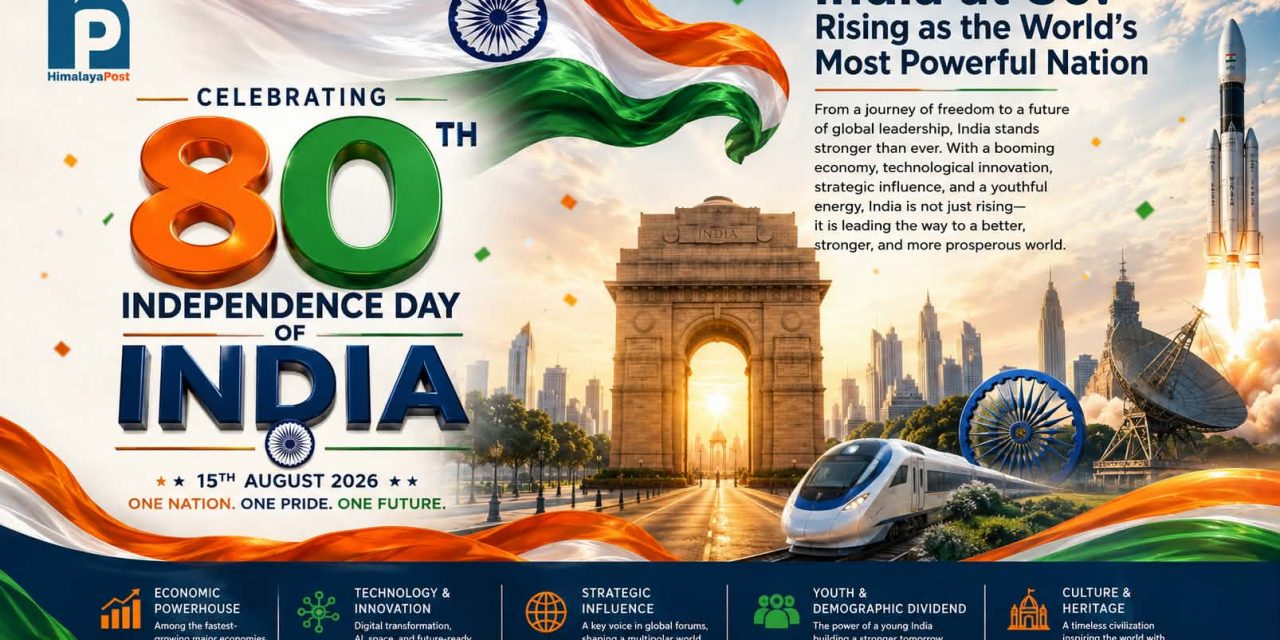
On August 15, 2026, India marks its 80th Independence Day—a moment that is not merely a celebration of freedom from colonial rule, but an opportunity to reflect on one of the most consequential transformations of the modern world.
In 1947, India emerged from colonialism carrying the enormous burdens of poverty, illiteracy, weak industrial capacity, and deep social and economic inequalities. Nearly eight decades later, the country stands at the centre of global economic, technological, and geopolitical change.
The India of 2026 is not the India of 1947. And increasingly, it is not simply a rising power. It is a country positioning itself to become one of the defining superpowers of the 21st century.
From a Poor Nation to a Global Economic Power
Perhaps the most remarkable part of India’s journey has been its economic transformation.
For decades after independence, India struggled with slow growth, limited industrial capacity, and a heavily controlled economic system. Liberalisation in the early 1990s changed the trajectory, opening the economy to global markets and unleashing entrepreneurship, private investment, and international trade.
Today, India is among the world’s largest economies and remains one of the fastest-growing major economies. The International Monetary Fund projects India’s economy to grow by around 6.4 percent in 2026, even as the global economy faces geopolitical tensions, trade disruptions, and slower growth.
This is not simply a number on an economic chart. A rapidly expanding economy gives a nation greater capacity to invest in infrastructure, technology, defence, education, energy, and global diplomacy. Economic weight ultimately becomes strategic weight. India’s economic rise is therefore changing not only its domestic prospects but also the balance of power in Asia and beyond.
The Digital India That the World Cannot Ignore
If India’s economic rise is one pillar of its global ambitions, technology is another.
India has built one of the world’s most ambitious digital ecosystems. Digital payments, public digital infrastructure, Aadhaar, mobile connectivity, and platforms such as UPI have demonstrated that India can build technological systems at a scale few countries can match.
India’s digital transformation is particularly significant because it has not remained confined to elite technology companies. It has increasingly become part of everyday economic life for hundreds of millions of people. That scale creates something more valuable than technological capability alone: technological influence.
India is also investing heavily in artificial intelligence, semiconductors, space technology, telecommunications, and advanced manufacturing. The country’s ambition to develop indigenous capabilities reflects a broader strategic shift—from being primarily a consumer of global technology to becoming a creator and exporter of it.
From “Strategic Autonomy” to Strategic Influence
India’s foreign policy has also evolved dramatically.
During the Cold War, India attempted to preserve strategic autonomy through non-alignment. In today’s multipolar world, that philosophy has taken a new form.
India maintains relationships with the United States, Russia, Europe, Japan, the Gulf states, Africa, and the wider Global South. It participates in platforms such as the G20, BRICS, QUAD, and other multilateral institutions while simultaneously protecting its own strategic interests.
This ability to engage with competing power centres without becoming completely dependent on any one of them is increasingly becoming an important source of Indian influence. India is not seeking merely to choose a side in a great-power rivalry—it increasingly wants to shape the rules of the game.
The Indo-Pacific and the Rise of a Maritime Power
India’s geography gives it a unique strategic advantage. Located at the centre of the Indian Ocean, India sits astride some of the world’s most important maritime trade routes. As global economic and strategic competition increasingly shifts toward the Indo-Pacific, India’s geographical importance is growing.
Its economic ambitions, naval capabilities, space programme, and expanding strategic partnerships are reinforcing one another. For India, the Indian Ocean is no longer simply a geographical space—it is becoming a central theatre of national strategy. This has implications not only for Asia but also for the global economy.
Space, Science, and the Psychology of a Rising Nation
India’s space programme has become another symbol of its transformation.
From a modest beginning, India has developed the capability to undertake sophisticated space missions while maintaining comparatively efficient costs. Its achievements have strengthened national confidence and demonstrated that technological ambition is no longer limited to the traditional powers.
But perhaps the deeper significance lies in the psychology of development. A country that once struggled to feed itself is now attempting to reach the Moon, develop advanced satellites, expand its space capabilities, and participate in the next generation of global technology.
That psychological transformation matters. Great powers are built not only with money and machines, but also with national confidence.
The Road to 2047: A Superpower in the Making
India’s long-term national vision is centred on becoming a developed nation by 2047, the centenary of independence. The symbolism is powerful. India began its independent journey in 1947 by asking how a newly liberated country could survive and develop. In 2026, the question is different: How can a rising India shape the world?
The answer will depend on whether India can combine economic strength with social inclusion, technological innovation with human development, military capability with diplomatic wisdom, and national ambition with global responsibility.
Calling India a superpower today would be premature if the term is understood in its fullest historical sense. The United States remains the world’s dominant comprehensive power, while China possesses enormous economic, industrial, and military capabilities. But the direction of India’s journey is increasingly difficult to ignore.
India has the population scale, economic momentum, technological ambition, strategic geography, military capability, diplomatic reach, and civilisational influence required to become one of the world’s principal power centres. Its trajectory suggests that the 21st century may not be defined by a simple contest between two superpowers. It may instead become a more complex world in which India emerges as one of the central pillars of global power.
That is why India’s 80th Independence Day carries significance far beyond the borders of India. The tricolour flying over the Red Fort is no longer merely a symbol of a nation that won freedom; it is increasingly a symbol of a nation preparing to exercise power.
From colonial subject to sovereign republic, from developing economy to global economic engine, from strategic caution to strategic confidence—the Indian journey is entering a new chapter. India at 80 is not the end of a journey. It may be the beginning of India’s most consequential chapter yet.