
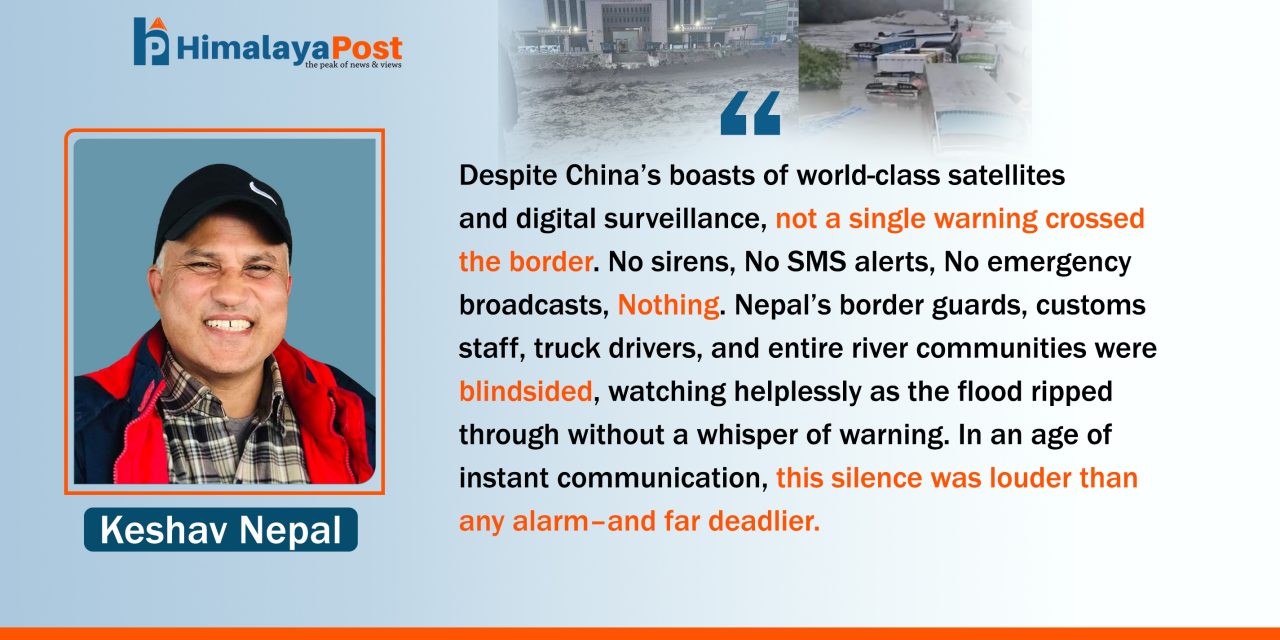
– Keshav Nepal
A sudden and catastrophic flash flood in the Lhende River—locally known as the Bhote Koshi—on July 8, 2025, has caused extensive human casualties and widespread infrastructural devastation in Rasuwa district, a vital Himalayan corridor connecting Nepal with China via the border town of Kerung. The flood, triggered by a glacial lake outburst (GLOF) on the Tibetan side, has exposed dangerous gaps in regional disaster preparedness, cross-border data sharing, and early warning systems.
Unprecedented Human and Economic Losses
At least 20 people, including Nepali and Chinese workers, police officers, and local residents, are confirmed dead or missing. The raging waters demolished entire settlements and swept away dozens of vehicles, commercial containers, and critical infrastructure.
The Miteri (Friendship) Bridge, Nepal’s principal trade link with China, has been destroyed, along with key customs yards, dry ports, and stretches of the Pasang Lhamu Highway. Over 50 container trucks carrying essential festival goods and electric vehicles were lost, exacerbating supply shortages ahead of Nepal’s major religious festivities.
The disaster also disrupted vital hydropower projects like Rasuwagadhi, Chilime, and Trishuli-3A, causing widespread power outages and delaying national energy goals.
Root Cause: The Bursting of Himtal Supraglacial Lake
Scientific assessments confirm that the disaster was caused by the sudden bursting of Himtal supraglacial lake, located roughly 36–40 kilometers upstream in Tibet. A massive surge of water cascaded down the Lhende River with little to no prior rainfall, indicating the event’s origin was cryospheric rather than meteorological.
But what could have been a contained crisis quickly escalated into a humanitarian disaster—largely due to a failure in early warning systems and lack of transboundary data sharing.
Despite China’s boasts of world-class satellites and digital surveillance, not a single warning crossed the border. No sirens. No SMS alerts. No emergency broadcasts. Nothing. Nepal’s border guards, customs staff, truck drivers, and entire river communities were blindsided, watching helplessly as the flood ripped through without a whisper of warning. In an age of instant communication, this silence was louder than any alarm—and far deadlier.
No Warning, No Sirens, No Chance to Escape
Despite China’s global standing in satellite surveillance and digital infrastructure, no alert was issued to Nepali authorities ahead of the flood. Communities along the river, customs officials, police, and transporters had no advance warning—no sirens, no SMS, and no emergency broadcasts. The flood struck without notice, leaving behind a trail of destruction that could, many argue, have been prevented.
Nepal’s hydrology and disaster response agencies only learned of the rising waters after damage was underway.
China’s Silence: A Technological or Political Failure?
The glaring absence of timely satellite or hydrological data from Chinese authorities raises uncomfortable questions. Despite possessing advanced real-time monitoring tools, Chinese agencies reportedly failed to alert their Nepali counterparts of abnormal lake levels or potential hazards upstream.
As Nepal shares a long Himalayan border with China, and many rivers—originating in Tibet—flow into Nepal across the snow-capped ranges, lack of data and information sharing on upstream events makes Nepal extremely vulnerable. Without cooperation, such devastations are likely to continue.
This pattern of silence suggests more than an infrastructural oversight—it points to a policy vacuum or even strategic withholding of data. In a border zone critical for trade, tourism, and energy, this lack of transparency is both diplomatically troubling and humanely unacceptable.
The Consequences for Nepal
Nepal’s fragile economy is reeling:
– Trade routes disrupted at a critical time ahead of festival seasons.
– Power supply affected by damaged hydropower installations.
– Lives lost due to lack of evacuation.
– Goods worth millions
The flood also disrupted the strategic Kerung-Rasuwa trade corridor, a key component in Nepal’s connectivity and supply chains with China.
Call for Regional Reform: Cooperation, Not Isolation
The disaster is a stark reminder that disasters do not respect political boundaries. Experts and civil society voices are calling for:
– Bilateral Data-Sharing Protocols: Nepal and China must establish real-time exchange of satellite and hydrological data on glacial lakes and river discharge.
– Integrated Early Warning Systems: Investment in cross-border alert systems, with automated SMS, sirens, and geofenced community alerts.
– Joint Preparedness Drills: Annual or seasonal transboundary disaster simulations to reduce casualty and economic disruption.
– Independent Monitoring: Multilateral oversight involving third-party institutions to verify data sharing and warning systems.
Final Reflections: A Preventable Tragedy
This was not just a natural disaster—it was a systemic failure. In an era of artificial intelligence, real-time satellite imaging, and global ICT integration, 20 lives lost for lack of a warning is a failure of governance, not just geology.
China’s Belt and Road Initiative (BRI) speaks of “digital silk roads” and mutual prosperity—but that vision rings hollow when data is hoarded and neighbors are left in the dark.
Nepal must push diplomatically for greater transparency and cooperation, and regional actors must treat environmental threats as shared responsibilities, not sovereign secrets.
Conclusion: Toward a Safer Himalayan Future
The flash flood in Rasuwa is a grim testament to how quickly progress can be washed away when transparency and trust are missing. As climate change accelerates the risk of glacial lake bursts, the need for cooperation between Himalayan nations is no longer optional—it is existential.
In a region where every drop of water can be a blessing or a curse, let information flow as freely as rivers—before it’s too late.