
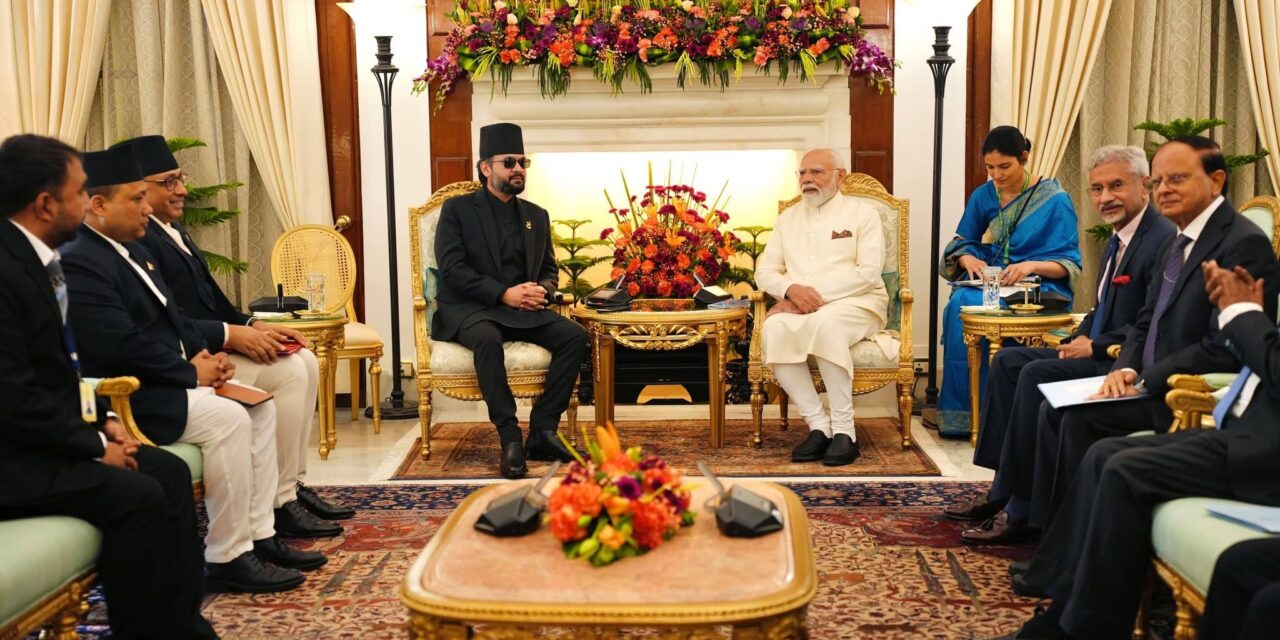
Kathmandu – At the invitation of the Prime Minister of India, Shri Narendra Modi, the Prime Minister of Nepal, H.E. Balendra Shah, paid a State Visit to India from 22 to 23 November 2026.
The two Prime Ministers held cordial, substantial and forward-looking talks in New Delhi and undertook a comprehensive review of the bilateral relationship.
2. The two leaders acknowledged that the age-old, civilisational ties between India and Nepal have developed into a multifaceted partnership that derives strength from deep people-to-people linkages apart from adherence to the principles of mutual respect and benefit.
3. Nepal conveyed its appreciation for India’s prompt humanitarian and search-and-rescue assistance following the floods and debris flows in the Rasuwa–Trishuli basin and elsewhere in August 2026. The leaders agreed to remain engaged on the further support to be provided for Nepal’s reconstruction efforts.
4. The two leaders agreed that the bilateral partnership should reflect contemporary political, economic and technological realities, and should be based on an updated and forward-looking legal framework, where existing bilateral agreements,including the 1950 Treaty of Peace and Friendship, could be reviewed on the basis of mutual consent. All outstanding matters, including those related to water resources, energy, trade & commerce and boundary, are to be resolved through mutual discussion and dialogue.
5. To translate the India-Nepal relationship into a modern and results-oriented partnership that delivers tangible benefits to the people of both countries, the two leaders have adopted this ‘Joint Vision’ that focuses on the aspirations of the people of India and Nepal, especially the youth; and will provide a roadmap for the future of the bilateral partnership with a focus on the following ten pillars:
I. Comprehensive Economic and Development Partnership
India’s national vision of ‘Viksit Bharat 2047’ and Nepal’s national aspiration of ‘Samunnat Nepal’ have several complementarities that could be leveraged to further enhance the extensive economic ties between the two countries. This would include:
i. Reviewing the enabling frameworks/agreements for trade and investment between both countries to facilitate a more comprehensive economic partnership.
ii. To open new transit connectivity and air routes to enable improved access and strengthen connectivity.
iii. Cooperation for the establishment of cross-border special economic zones/parks for export-oriented manufacturing near the India-Nepal border so as to create linkages with supply chains in manufacturing and other processing industries, and co-operate in the development of IT parks.
iv. Indian investments will be encouraged in Nepal’s priority sectors, including through the conclusion of arrangements that enhance investor-confidence and the ease of doing business.
v. India will extend development assistance of INR 15,000 crores (NPR 24,000 crores) comprising a grant assistance of INR 3,500 crores (NPR 5,600 crores) for post-disaster reconstruction and new infrastructure projects in Nepal; and a Rupee-denominated Line of Credit of INR 11,500 crores (NPR 18,400 crores) for energy sector projects. Specific projects as well as modalities for the provision of development assistance will be finalized through mutual consultations.
II. Physical and Digital Connectivity:
Connectivity is a key enabler for deepening of economic cooperation and strengthening people-to-people ties. Recognizing the significant progress made in this area, both leaders welcomed the launch of direct express rail service between Ayodhya (India) and Janakpur (Nepal) and motorable bridge across Mahakali River between Dharchula (India) and Darchula (Nepal). They further agreed to:
i. Expedite the ongoing construction of the ICPs at Bhairahawa (Nepal) and Sunauli (India), and new ICPs at Banbasa (India)and Dodhara Chandani (Nepal).
ii. Expeditiously complete work on final sections of the Jayanagar-Bardibas and Jogbani-Biratnagar railway lines.
iii. Welcoming the finalization of the Final Location Survey (FLS) of Raxaul-Kathmandu Rail Link, they agreed to collaborate on the development of the East-West Rail Link in Nepal to create an interoperable rail network between India and Nepal, prioritising the Bardibas–Nijgadh section and the Birgunj–Nijgadh link.
iv. Further enhance road connectivity between India and Nepal through new motorable bridges and trading points.
v. Augment cross-border petroleum supply infrastructure, including through construction of a new pipeline connecting Siliguri (India) and Jhapa (Nepal), and explore the possibility of a gas pipeline between India and Nepal.
vi. Building on the linkage of India’s UPI with Nepal’s national payment system, the two sides agreed to expedite implementation of cross-border retail payments.
vii. Cooperate in integrated infrastructure planning and connectivity, through platforms such as PM Gati Shakti, which Nepal may consider adapting to its own spatial and development priorities.
viii. Keep the international border between India and Nepal open, secure and well-regulated, and to strengthen cooperation against cross-border crime and illegal activities.
III. Energy, Water Resources and Climate Resilience:
Recognizing the immense potential for India and Nepal to deepen cooperation in the areas of energy, water resources and climate resilience, both sides agreed to strengthen institutional cooperation, promote mutually beneficial partnerships, and advance collaborative efforts towards sustainable, resilient and inclusive development. Towards this end:
i. In keeping with the India-Nepal Joint Vision Document for Power Sector Cooperation, India will encourage more investments in Nepal’s hydropower and transmission infrastructure while Nepal will provide appropriate cooperation and facilitation, including an enabling and mutually-beneficial framework for such investments. The authorities concerned will explore the possibility of further enhancing power trade, based on mutual benefit and market demand, with a view to expanding power trade between India and Nepal.
ii. Both sides will accelerate work on the implementation of on-going and envisaged hydropower and multipurpose projects, including the Pancheshwar and Saptakoshi & Sunkoshi multipurpose projects, to harness water resources for mutual benefit and to mitigate the adverse impacts arising due to floods.
iii. The two sides agreed to a proactive partnership on disaster risk reduction, early warning and post-disaster recovery to protect lives, livelihoods and infrastructure.
iv. They agreed to institutionalize real-time, two-way sharing of hydro-meteorological data, glacial lake monitoring, and early warning. They agreed to enhance cooperation between relevant agencies of both countries in the form of joint HADR exercises, capacity building, training and humanitarian support.
v. They agreed to enhance cooperation within multilateral organisations including the International Solar Alliance, the Coalition for Disaster Resilient Infrastructure, ICIMOD and the International Big Cat Alliance.
vi. Both sides agreed to collaborate in the development of additional energy sources from solar to sub-surface, including through a pilot project on green hydrogen in Nepal.
vii. India will facilitate the training of Nepali youth professionals, officials and experts in areas related to environment such as policy-making, regulation, standards, forestry, risk mapping, and climate resilient agriculture.
viii. India will also share expertise in rejuvenating water bodies and combating groundwater contamination.
IV. Good Governance:
There is considerable affinity between Nepal’s priorities related to good governance and the approach adopted by India, especially in matters related to the adoption of digital technology, and making the citizen-government interface more transparent, convenient and effective. Towards this end:
i. In accordance with globally recognized principles of digital sovereignty and data protection, to enable the implementation of the ‘Digital Nepal Framework’, technical expertise and best practices in digital public infrastructure in digital identity, payments and e-governance will be exchanged.
ii. Training of Nepali civil servants in India will be arranged through the National Centre for Good Governance.
iii. Both sides will share experiences and best practices among legislatures at national and provincial levels.
iv. They will strengthen cooperation in local governance through exchange of visits and training programmes at the relevant agencies of India.
V. Technology, Space and Innovation:
To encourage greater adoption and use of technology, and in accordance with Nepal’s objective of becoming a technology hub, and considering India’s strengths in these areas, the India-Nepal partnership will seek to deliver initiatives such as:
i. Expansion of the Indian-Nepal Startup Partnership Network (IN-SPAN), including through training and mentorship of Nepali startups in India, and setting up a Startup Centre of Excellence in Kathmandu and a Digital Nomads and Innovation Hub in Pokhara.
ii. Development of Digital Parks and data centres in Nepal, including through the facilitation of private investment.
iii. Enhancing bilateral cooperation in AI, including the development of a Large Language Model for the Nepali language, inter-alia, through collaboration with Bhashini.
iv. Strengthening cooperation in the domain of space including through collaboration between the Nepal Academy of Science and Technology and relevant Nepali agencies with ISRO and IN-SPACE for satellite development, earth observation, remote sensing for disaster management, and capacity building.
v. Enhancing cooperation in emerging telecommunication technologies such as 5G/6G and other next-generation networks.
VI. Education and Skill Development:
Recognizing the importance of skill development and capacity building, both countries will work to achieve stronger cooperation in training, human resource development, and academic exchanges, including through the following:
i. Opening of branches/campuses of reputed Indian higher educational institutions in Nepal will be explored, beginning with an IIT.
ii. Building on the highly successful ongoing scholarship schemes, scholarships and training opportunities in newer disciplines such as law, technology, and AI will be added for Nepali students.
iii. Exchanges of faculty and experts will be encouraged and institutionalized apart from stronger collaborations between academic and training institutions.
iv. A vocational training institute will be established through Indian assistance for imparting skills and training to the youth of Nepal in areas relevant for manufacturing, services and entrepreneurship.
VII. Sports:
To strengthen Nepal’s emphasis on the growth of sports and development of relevant infrastructure, India and Nepal will work together on the following main initiatives:
i. India will support the establishment of a national cricket coaching/training academy in Nepal apart from supporting the development of cricket infrastructure at the national and provincial levels.
ii. Players from provincial cricket teams of Nepal will be provided the opportunity to train in India at national training academies.
iii. Similar opportunities in other sports such as badminton, tennis, shooting, and athletics will also be explored, including for development of modern multi-sports centers in Nepal.
iv. Collaboration in mountain sports will be explored, including by undertaking joint expeditions.
v. Encouraging the concerned sporting bodies/authorities in both countries to explore opportunities for players from India and Nepal to participate in each other’s sporting leagues in games such as cricket, football and others.
VIII. Culture and Tourism:
Cultural linkages between both countries have been among the most important pillars of the bilateral relationship. To further enrich this vibrant interaction:
i. India and Nepal will partner to develop religious tourism circuits and new destinations. This will include development of Ramayana, Buddhist and Shiv–Shakti circuits by linking Janakpur–Ayodhya, Lumbini–Bodhgaya–Sarnath–Kushinagar and Kathmandu (Pashupatinath)–Varanasi, and through sister-city agreements.
ii. They agreed to hold an annual youth cultural festival alternately in Nepal and India, and to expand training and exchanges for artists in film-making, theatre and the fine arts.
iii. Collaboration between Nalanda University and Lumbini Buddhist University (LBU) will be strengthened through the establishment of a Nalanda Centre at LBU.
iv. They agreed to facilitate collaboration among young entrepreneurs in tourism and hospitality, and encourage familiarization visits of social media influencers and content creators to promote two-way tourism.
IX. Health:
Government of Nepal’s emphasis on an integrated model of basic healthcare across the country has considerable synergy with India’s approach towards health. In view of the existing complementarities and to nurture stronger cooperation in this domain, both sides will:
i. Strengthen healthcare infrastructure by continuing to undertake projects, under the High-Impact Community Development Project (HICDP) modality, for the construction of health posts, birthing centres, and hospitals as per the needs of Government of Nepal.
ii. Collaborate for upgrading the National Medical Laboratory of Nepal.
iii. Establish India–Nepal Jan Aushadhi Kendras to improve access to affordable quality medicines.
iv. Organize customized training programmes in health-related fields under the Indian Technical and Economic Cooperation Programme (ITEC) for capacity building of healthcare professionals of Nepal.
v. Foster linkages between premier medical institutions of both countries and encourage student and faculty exchanges.
vi. Strengthen research collaboration between Indian Council of Medical Research (ICMR) and Nepal Health Research Council (NHRC), and the drug regulatory authorities of India (CDSCO) and Nepal (Department of Drug Administration).
X. Agriculture:
India and Nepal enjoy considerable interaction in this domain including experience sharing, training and the conclusion of framework documents. In order to further enhance forward looking engagement in this sector, the two sides will:
i. Establish an Agro-Industrial Park in Chitwan with India’s grant assistance to provide value addition to Nepali agricultural products.
ii. Expedite implementation of the Work Plan for 2026-2030 between Indian Council of Agricultural Research (ICAR) and Nepal Agricultural Research Council (NARC).
iii. Organize customized training programmes in agriculture and livestock-related fields for capacity building of officials, farmers and other agriculture-related professionals of Nepal.
iv. Establish an ICAR Centre of Excellence in Nepal, link leading agricultural universities, and organise tailored training for Nepali officials, farmers and entrepreneurs in agriculture and livestock.
Implementation Modalities
6. The two Prime Ministers decided to activate the High-Level Monitoring Group, led by the Foreign Secretary of Nepal and the Ambassador of India. This Monitoring Group will meet at least once in six months and ensure expedited implementation of envisaged projects, ideas and initiatives, and facilitate relevant clearances/approvals.
7. Both leaders agreed that the High-Level Monitoring Group will submit its report to the India-Nepal Joint Commission, co-chaired by the Foreign Ministers of both countries. The leaders decided that the next meeting of the India-Nepal Joint Commission will be held in 2027.
8. The Prime Ministers expressed confidence that this Joint Vision document provides the blueprint for an aspirational, modern and mutually-beneficial partnership between two friendly countries, and directed officials from both India and Nepal to work towards the realisation of this shared vision.