
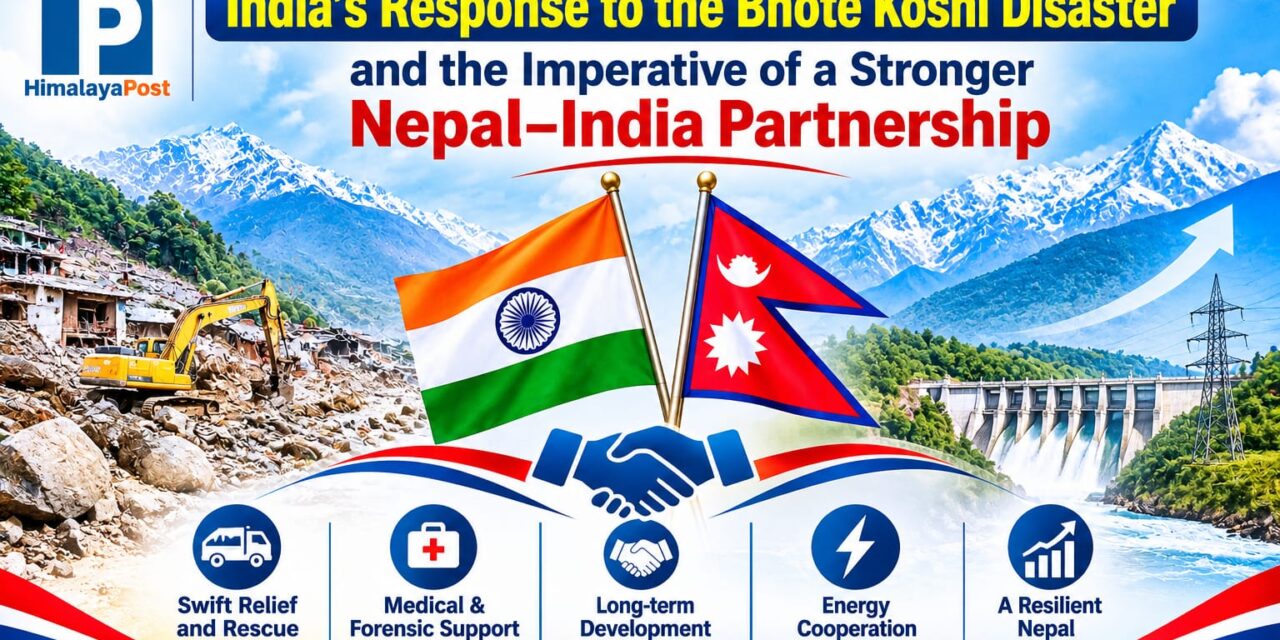
Kathmandu- India’s Response to the Bhote Koshi Disaster and the Imperative of a Stronger Nepal–India Partnership
When disaster strikes, a bilateral relationship’s strength is measured not by diplomatic declarations but by the speed, scale, and sincerity of assistance. India’s response to Nepal’s devastating Bhote Koshi disaster of 26 August 2026 demonstrated the practical significance of geographical proximity, strategic interdependence and enduring bilateral cooperation. As Nepal seeks to rebuild and strengthen its resilience, its Finance Minister’s recent visit to India and its Prime Minister’s forthcoming visit offer an opportunity to turn humanitarian solidarity into a long-term development partnership.
When a Himalayan Disaster Becomes a Shared Regional Concern
The devastating Bhote Koshi disaster of 10 Bhadra 2083 (26 August 2026) provided another compelling illustration of the strategic importance of Nepal–India relations.
A catastrophic outburst and debris-laden flood surge originating near the Nepal–China border swept through the Bhote Koshi corridor, devastated settlements and infrastructure, and affected communities across Rasuwa, Nuwakot, Dhading and other downstream districts. The scale of destruction, the loss of lives and the large number of people reported missing transformed the tragedy into a national humanitarian emergency.
The precise geological mechanism was still being assessed by the concerned authorities, but the disaster exposed the extraordinary vulnerability of Himalayan communities to sudden glacial, ice-and-rock avalanche and river-system hazards.
The tragedy was not merely a domestic emergency for Nepal. Its implications extended across the Himalayan river systems, affecting downstream communities, infrastructure, livelihoods and regional connectivity. It reinforced the reality that natural disasters do not respect political boundaries and that effective disaster management requires close cooperation among neighbouring countries.
In this context, India’s response emerged as a significant demonstration of regional solidarity.
India’s Swift and Substantial Humanitarian Response
India’s response was swift, multifaceted and operationally significant.
On the very day the disaster struck, Indian Prime Minister Narendra Modi spoke with Nepal’s Prime Minister, conveyed condolences and assured Nepal of India’s solidarity and all possible humanitarian assistance. India’s External Affairs Minister subsequently remained in contact with his Nepali counterpart, while the Indian government coordinated with Nepal’s authorities to identify and address urgent requirements.
The Indian Air Force immediately mobilised aircraft to airlift emergency relief.
The initial consignment, delivered on 26 August, included approximately 10 tonnes of essential supplies, such as temporary shelters, blankets, hygiene kits, solar lamps and medicines.
A second major airlift on 27 August carried approximately 37.5 tonnes of assistance, including tents, blankets, hygiene materials, solar lighting, dewatering pumps, kitchen sets, generators, medicines and food items.
Further consignments followed. By early September, official diplomatic reporting indicated that India had delivered more than 130 tonnes of relief material through eight special flights and deployed 54 expert personnel.
These figures demonstrate the scale and speed of India’s logistical mobilisation during a period when immediate assistance was indispensable.
The response was particularly significant because the affected region presented formidable geographical and operational challenges. The rugged Himalayan terrain, damaged infrastructure and difficult access routes made conventional relief delivery extremely challenging. India’s airlift capabilities and geographical proximity therefore proved especially valuable.
Beyond Relief Supplies: Rescue, Medical and Forensic Cooperation
India’s contribution extended well beyond conventional relief supplies.
Recognising that several people could be trapped in tunnels and other difficult locations, India deployed specialised tunnel-rescue personnel to work alongside the Nepali Army. Indian medical personnel also joined the emergency response.
Particularly significant was the arrival, on 29 August, of an 18-member Indian forensic team specialising in DNA analysis to assist Nepal Police in identifying recovered human remains.
India further facilitated DNA profiling by making its central and state forensic science laboratories and National Forensic Sciences University facilities available for examining samples from first-degree relatives of missing persons.
Such assistance addressed one of the most painful dimensions of the disaster: enabling families to establish the identities of their missing loved ones and, where possible, perform their final rites with dignity.
The forensic dimension of India’s assistance deserves particular recognition. It demonstrated that humanitarian cooperation is not confined to delivering food, medicines and temporary shelters. It also encompasses specialised scientific expertise, institutional coordination and support for families confronting the emotional trauma of uncertainty and loss.
India also remained attentive to the safety of its own citizens affected by the catastrophe. Its diplomatic mission issued emergency contact arrangements, coordinated assistance and supported efforts to trace and assist Indian nationals in Nepal.
Meanwhile, Indian authorities placed border administrations and rescue teams on heightened alert because the flood surge had implications for downstream river systems in India as well.
Finance Minister’s Visit: Humanitarian Gratitude Meets Economic Diplomacy
An important subsequent development was the three-day official visit of Nepal’s Finance Minister Dr Swarnim Wagle to India from 17 to 19 September 2026, at the invitation of the Government of India.
The visit was especially meaningful because it represented the first high-level engagement from Nepal following the devastating August disaster.
Finance Minister Wagle met his Indian counterpart, Nirmala Sitharaman, and India’s External Affairs Minister, Dr S. Jaishankar. He also participated in a high-level diplomatic dialogue, interacted with representatives of the India Trade Promotion Organisation, addressed an event organised by the Confederation of Indian Industry and attended an academic discussion at the Delhi School of Economics.
During the visit, Nepal expressed appreciation for India’s assistance in rescue and relief operations following the Bhote Koshi disaster. It also sought further Indian support and cooperation for post-disaster reconstruction.
This engagement represented an important transition from immediate humanitarian assistance to economic recovery and reconstruction diplomacy.
Nepal’s requirements extend far beyond emergency relief. Damaged infrastructure must be rebuilt, disrupted livelihoods restored, affected businesses supported and vulnerable communities equipped to withstand future disasters.
India’s financial resources, technical expertise, industrial capabilities and geographical proximity make it an exceptionally important partner in this undertaking.
The visit also provided an opportunity to broaden discussions beyond disaster recovery to encompass trade, investment, energy, infrastructure and wider economic cooperation.
Energy Security: Another Demonstration of Practical Interdependence
One particularly significant dimension of Nepal–India cooperation emerged in the energy sector.
The Bhote Koshi disaster damaged hydropower infrastructure and disrupted electricity generation in Nepal. In September 2026, India approved electricity exports of up to 654 MW to Nepal through December 2026, helping Nepal address immediate energy shortages.
This development illustrates the practical value of bilateral energy interdependence.
Nepal has enormous hydropower potential, while India possesses a large electricity market, extensive transmission infrastructure and substantial energy-sector investment capabilities.
The long-term power trade agreement signed in 2024 envisages Nepal exporting up to 10,000 MW of electricity to India over the following decade. By the 2025 wet season, Nepal had already achieved approximately 1,150 MW of electricity exports to India.
The relationship is therefore evolving beyond a conventional electricity-importing and electricity-exporting arrangement into a mutually beneficial energy partnership.
The disaster demonstrated that cross-border electricity trade can also serve as an emergency stabilisation mechanism when one country experiences unexpected production disruptions.
A stronger bilateral energy framework should consequently encompass not only commercial transactions but also emergency power-sharing arrangements, resilient transmission infrastructure, grid security and coordinated energy planning.
India’s Broader Contribution to Nepal’s Reconstruction and Development
The humanitarian assistance extended during the Bhote Koshi disaster should also be understood within the broader context of India’s longstanding development partnership with Nepal.
India’s contribution to Nepal’s reconstruction following the devastating earthquake of 25 April 2015 provides an important precedent. Following the disaster, which claimed nearly 9,000 lives, India committed US$1 billion towards reconstruction assistance.
The programme included the construction of 50,000 houses, 70 schools and a library, 125 health facilities, and numerous cultural heritage projects.
More recently, following the September 2024 floods and landslides, India provided 25 tonnes of humanitarian assistance and ten prefabricated steel bridges as grant assistance. Following heavy rainfall in October 2025, India also committed ten bridges of 70-metre and longer spans for eastern Nepal.
According to the Embassy of India’s July 2026 bilateral brief, 598 High Impact Community Development Projects, with a combined estimated value of approximately NPR 15.83 billion, have been undertaken across Nepal.
These initiatives demonstrate that India’s development engagement is not confined to high-profile national infrastructure projects. It reaches schools, hospitals, rural communities, drinking-water systems, roads, bridges and other facilities that directly affect people’s everyday lives.
The broader economic relationship is equally significant. Bilateral merchandise trade reached approximately US$9.39 billion in FY 2025–26, while Indian investment in Nepal is estimated at approximately US$800 million.
Such economic linkages create a foundation for more comprehensive reconstruction cooperation, including industrial investment, employment generation, technology transfer and private-sector participation.
The Forthcoming Prime Ministerial Visit: An Opportunity to Convert Solidarity into a Strategic Partnership
Following Finance Minister Wagle’s recent visit, the forthcoming visit of Prime Minister Balendra Shah to India offers an important opportunity to consolidate the bilateral relationship.
As preparations for the proposed visit progress, post-disaster reconstruction is expected to remain an important element of the agenda, alongside trade, investment, energy, infrastructure and connectivity.
The Prime Minister’s visit should be used to establish a comprehensive reconstruction and resilience partnership with India.
Several areas deserve particular attention:
1. Reconstruction financing: Mobilising financial assistance, concessional funding and technical cooperation for rebuilding damaged roads, bridges, hydropower installations and public infrastructure.
2. Disaster preparedness: Establishing more effective real-time hydrological and meteorological data-sharing mechanisms, early-warning systems and coordinated emergency-response arrangements.
3. Scientific and technical cooperation: Strengthening joint research into glacial lakes, upstream hazards, river behaviour, geological vulnerabilities and climate-related disasters.
4. Resilient infrastructure: Developing bridges, roads, tunnels, transmission lines and other critical infrastructure capable of withstanding increasingly severe climatic and geological hazards.
5. Emergency logistics: Institutionalising arrangements for rapid airlifts, rescue personnel, medical assistance, forensic support and cross-border humanitarian operations.
6. Economic recovery: Encouraging Indian investment in affected regions, supporting local enterprises, restoring employment and rebuilding tourism and commercial activities.
7. Energy cooperation: Strengthening cross-border electricity trade and emergency power-sharing mechanisms to minimise disruptions during natural disasters.
The objective should be to transform ad hoc emergency assistance into a predictable, institutionalised and technologically advanced framework of bilateral cooperation.
Himalayan Rivers Require Shared Responsibility
The Bhote Koshi catastrophe also reinforces the need for a more systematic approach to transboundary disaster management.
Nepal and India share several major river systems, including the Koshi, Gandaki and Mahakali. Their management requires continuous communication, scientific cooperation, hydrological monitoring and effective flood forecasting.
The Himalayan region is increasingly vulnerable to climate-related disasters, including flash floods, landslides, glacial lake outburst floods, river erosion and extreme rainfall.
India’s disaster-response capabilities, including the National Disaster Response Force, armed forces, specialised medical teams and extensive airlift infrastructure, can complement Nepal’s national disaster-management institutions.
The devastating earthquake of 2015 provided a defining illustration of this cooperation. Under Operation Maitri, India mobilised military aircraft, helicopters, search-and-rescue personnel, medical teams and emergency supplies to support Nepal’s rescue and relief operations.
The Bhote Koshi disaster has added another compelling chapter to this history of humanitarian cooperation.
Both countries should now move towards joint disaster-response exercises, interoperable emergency communication systems, shared scientific databases, coordinated evacuation protocols and integrated river-basin management.
Such cooperation would protect not only vulnerable Himalayan communities but also the extensive infrastructure, industries and agricultural economies situated downstream.
Humanitarian Solidarity as the Foundation of Strategic Trust
The significance of India’s response to the Bhote Koshi disaster lies not merely in the quantity of relief materials delivered but in the diversity of assistance mobilised.
Diplomatic engagement, air logistics, emergency supplies, technical rescue, medical support, forensic science, consular coordination and cross-border disaster monitoring collectively demonstrated the practical value of an established bilateral relationship.
The assistance also reinforced an important truth: the prosperity and security of Nepal and India are closely interconnected.
A disaster affecting Nepal’s infrastructure can disrupt regional trade and energy supply. Similarly, flooding in shared river systems can threaten communities and economic assets on both sides of the border.
Cooperation, therefore, is not simply an expression of goodwill. It is an essential component of shared regional security and economic stability.
Nevertheless, humanitarian assistance should not create an expectation of permanent dependence. It should strengthen Nepal’s institutional capacity, technological preparedness and national resilience.
The most effective partnership is one that enables Nepal to become increasingly capable of preventing, managing and recovering from disasters while benefiting from India’s experience, expertise and resources.
Conclusion: From Emergency Assistance to a Shared Future
The Bhote Koshi disaster was a devastating humanitarian tragedy, but India’s response demonstrated the importance of dependable neighbours and practical regional cooperation.
The swift mobilisation of more than 130 tonnes of relief materials through eight special flights, the deployment of 54 expert personnel, specialised tunnel-rescue assistance, medical support and the 18-member forensic team collectively represented a substantial humanitarian contribution.
The subsequent visit of Finance Minister Dr Swarnim Wagle to India provided an opportunity to acknowledge this support and seek further cooperation for reconstruction. The forthcoming visit of Prime Minister Balendra Shah should build upon that diplomatic momentum and translate it into a long-term framework for economic recovery, infrastructure development and disaster resilience.
India’s contribution to Nepal extends well beyond emergency relief. It encompasses trade, investment, hydropower, infrastructure, education, tourism, technological cooperation and grassroots development. Its geographical proximity, vast economic resources, market access and institutional capabilities make it Nepal’s most consequential external development partner.
The challenge before both governments is to convert this strategic interdependence into a more predictable, equitable and result-oriented partnership.
For Nepal, the priority is to strengthen national resilience, rebuild affected communities and accelerate economic transformation. For India, supporting a stable, prosperous and resilient Nepal is both a humanitarian responsibility and a long-term strategic investment in regional peace and prosperity.
The Bhote Koshi tragedy has reminded both countries that the Himalayas are not merely a geographical boundary; they are a shared ecological, economic and humanitarian space.
When disaster strikes, neighbours must stand together. When recovery begins, they must work together. And when prosperity is pursued, they must recognise that the progress of one can strengthen the future of the other.