– Seshraj Bhattarai
Indian Foreign Secretary Vikram Misri’s recent two-day visit to Kathmandu has drawn significant attention in Nepali media. Much of the discussion, especially online, focused on a photograph of Misri with Prime Minister KP Sharma Oli. While such images capture public interest, they should not overshadow the substantive diplomatic purpose of the visit.
High-level diplomatic exchanges like this are a routine part of Nepal–India relations. However, the timing and context of Misri’s visit make it more significant than protocol alone. Prime Minister Oli is preparing for an official visit to India next month, an engagement that could shape the trajectory of bilateral ties. This occurs at a time when South Asia and the wider global order are undergoing rapid transformation.
Globally, the recent meeting between U.S. President Donald Trump and Russian President Vladimir Putin in Alaska has drawn attention. Western media largely focused on gestures and optics, but for South Asia, the implications are far more substantial. Any sustained connection between Washington and Moscow represents a notable shift in post–Cold War geopolitics. For Nepal, a country whose independent foreign voice emerged later, these developments carry particular significance.
Trump’s second term has added unpredictability to the region. His preferential engagement with Pakistan, including the ceremonial reception for Army Chief Asim Munir, combined with trade measures affecting India, signals a shift in Washington’s regional priorities. For Nepal, this underscores the need for strategic clarity. What may appear routine or symbolic could quickly become a test of balance if not handled thoughtfully.
India itself faces multiple external pressures. The recent India–Pakistan conflict, codenamed Operation Sindoor, ended swiftly but raised questions in New Delhi about the perception of external mediation. Trump’s public claim of credit for preventing escalation added pressure on India to assert control over its strategic neighborhood. For the first time since 2014, Prime Minister Modi faced perceptual challenges in diplomatic circles. The carefully crafted global image of India under the BJP government, shaped by Modi and Foreign Minister S. Jaishankar, was affected by Trump’s statements and actions, raising questions about India’s capacity to independently manage regional and global affairs.
In this context, Modi’s upcoming visit to Japan on August 30 is strategically important. It will determine how the group of the United States, Japan, India, and Australia addresses regional security, trade, and strategic coordination—especially at a time when India–U.S. relations are under strain.
Immediately after Tokyo, Modi will attend the Shanghai Cooperation Organization (SCO) summit in China from August 31 to September 1. The SCO meeting carries additional significance this year. Despite historical rivalries, India and China share concerns about the unpredictability of U.S. policy. Their willingness to maintain dialogue amid competition demonstrates that cooperation and rivalry can coexist—a lesson for smaller nations like Nepal navigating complex regional dynamics.
For Nepal, these developments are both a challenge and an opportunity. Policymakers must recognize that the global environment is shifting rapidly, leaving little room for error.
Prime Minister Oli’s upcoming visit to India will carry greater value if it is guided by these regional and global shifts. If engagements are reduced to photographs and handshakes, Nepal risks reinforcing the perception that its diplomacy is symbolic rather than strategic. Careful planning, informed decision-making, and a focus on long-term outcomes can turn these opportunities into tangible gains.
Misri’s visit is also an opportunity for Nepal to understand India’s broader global ambitions. India is working to strengthen its influence in the Indo-Pacific, consolidate Quad cooperation, and maintain engagement with China and Russia through the SCO. Recognizing these ambitions allows Nepal to align its own foreign policy with national priorities while fostering constructive relationships.
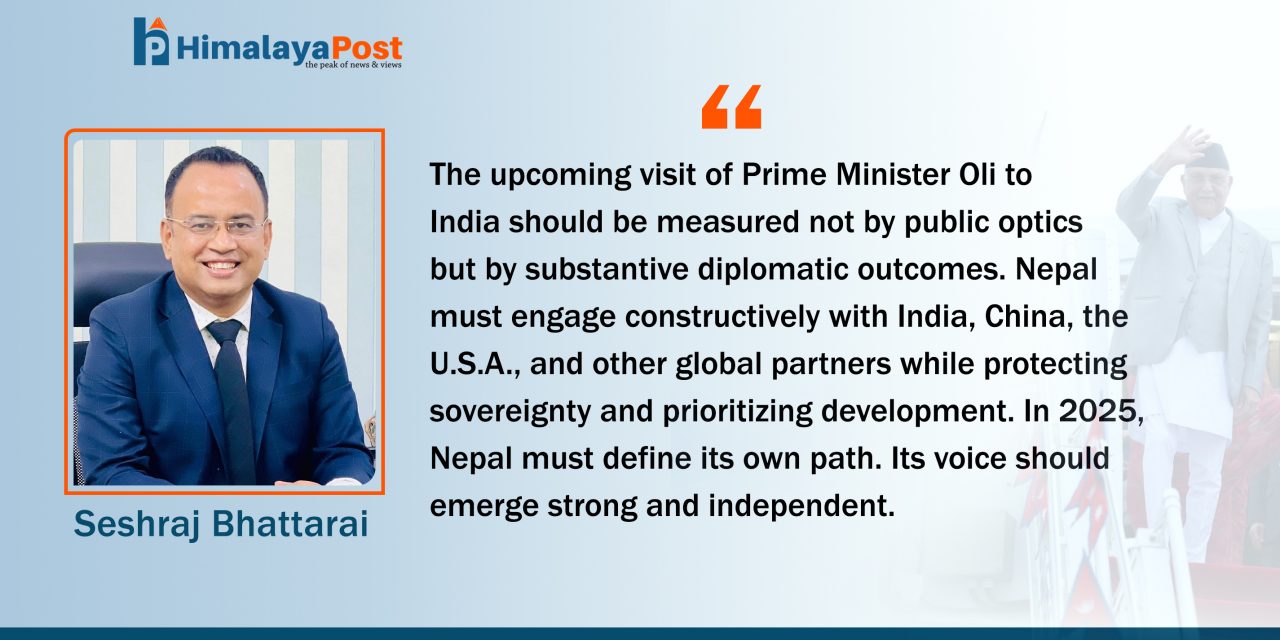
The upcoming visit of Prime Minister Oli to India should be measured not by public optics but by substantive diplomatic outcomes. Nepal must engage constructively with India, China, the United States, and other global partners while protecting sovereignty and prioritizing development.
In 2025, Nepal must define its own path. Its voice should emerge strong and independent. By leveraging a knowledge economy, AI, global talent, diaspora, and strategic geography, Nepal can turn potential constraints into opportunities. Prime Minister Oli’s engagement in India, and Nepal’s broader diplomatic strategy, will be most effective if the country combines awareness of external shifts with active use of its internal strengths to achieve sustainable growth and global recognition.
Prime Minister Oli’s upcoming visit to India is unlike previous visits. This time, the opportunity for Nepal goes beyond ceremonial engagements or routine protocol. Our primary objective should be to assert Nepal’s interests clearly and confidently, demonstrating that we engage as a sovereign partner rather than as a passive neighbor. The current regional and global dynamics make Nepal more significant for India than in the past, and it is essential that our diplomatic team focuses on what Nepal seeks: be it trade, investment, infrastructure, or strategic cooperation rather than allowing the visit to be framed as a display of India’s power. By prioritizing Nepal’s agenda and negotiating from a position of clarity and preparation, the country can maximize tangible benefits while reinforcing its standing as an independent actor in regional diplomacy.