Keshav Nepal- On the intricate chessboard of South Asian geopolitics, the relationship between India and Nepal occupies a singular and irreplaceable square. It is not merely a diplomatic partnership shaped by treaties, commerce, or strategic calculations. Rather, it is a civilizational relationship rooted in shared faiths, intertwined histories, cross-border kinship, and centuries of cultural continuity. Between the Himalayas and the Gangetic plains exists a bond that transcends the modern idea of nation-states.
Yet history alone cannot sustain a relationship indefinitely. Beneath the rhetoric of “Roti-Beti ka Rishta” — the enduring bond of bread and marriage — lie mounting tensions, unresolved territorial disputes, diplomatic distrust, and widening economic anxieties. In recent years, especially following Nepal’s dramatic political transition of early 2026, the relationship between Kathmandu and New Delhi has entered one of its most delicate phases in decades.
At the heart of this relationship lies an undeniable civilizational anchor. The spiritual geography connecting the two nations is unparalleled in South Asia. From Lumbini, the birthplace of Lord Buddha, to Pashupatinath Temple and the sacred pilgrimage networks stretching into India’s Char Dhams, religion and culture continue to bind millions of people across borders. Similarly, the Janakpur–Ayodhya Ramayana circuit reinforces shared mythology and emotional continuity between the two societies. Geography may divide political territories, but mythology often unites civilizations.
Recognizing the strategic importance of this cultural capital, both governments have invested heavily in religious diplomacy. India’s support for the International Centre for Buddhist Culture and Heritage in Lumbini symbolizes New Delhi’s effort to deepen soft-power engagement with Nepal. Millions of pilgrims, tourists, students, and workers continue to move freely across the open border, a rare arrangement in contemporary international politics.
However, cultural proximity has not insulated the relationship from political turbulence. In fact, the paradox of India-Nepal relations lies precisely here: the closer the societies are socially and culturally, the sharper political disagreements often become. This contradiction became evident in the diplomatic unease surrounding Indian Foreign Secretary Vikram Misri’s postponed visit to Kathmandu. The visit was intended to formally convey an invitation from Indian Prime Minister Narendra Modi to Nepal’s newly elected Prime Minister Balendra Shah. However, reports emerged that Shah declined to meet Misri, citing a “stature-gap” policy that discouraged meetings with officials below ministerial rank.
Although the policy was reportedly applied uniformly to foreign dignitaries, including American officials, the diplomatic symbolism carried enormous weight in New Delhi. For India, which has historically maintained deep political access within Nepal’s leadership circles, the episode was interpreted as an unusual and deliberate distancing. The optics were especially significant because India had previously assumed that Nepal’s new political establishment would maintain continuity in bilateral engagement.
Instead, Prime Minister Shah has emerged as a nationalist figure seeking to recalibrate Nepal’s engagement with India on more assertive and independent terms. His political rise reflects a broader shift in Nepal’s domestic discourse, where younger voters increasingly advocate reducing dependency on external powers and asserting stronger national sovereignty.
The diplomatic chill has been further intensified by the revival of the long-standing territorial dispute surrounding Kalapani, Lipulekh, and Limpiyadhura. The dispute traces its origins to differing interpretations of the 1816 Sugauli Treaty signed between Nepal and British India. Nepal maintains that territories east of the Mahakali River belong to Nepal, while India asserts administrative and historical control over the strategically important region.
Tensions escalated again after India announced the continuation of the Kailash Mansarovar pilgrimage route through the Lipulekh Pass. Kathmandu swiftly objected, arguing that India was conducting activities in disputed territory without Nepal’s consent. India, in turn, dismissed Nepal’s claims as untenable and reiterated that Lipulekh has long functioned as a recognized route for the pilgrimage.
The territorial issue has evolved beyond cartography into a powerful symbol of nationalism within Nepal. The controversy intensified in 2020 when Nepal amended its constitution to incorporate the disputed territories into its official map. Since then, the issue has become politically sensitive, limiting space for compromise on both sides. For Nepal’s leadership, defending territorial claims carries immense domestic political value; for India, conceding strategic ground near the Himalayan frontier is equally improbable.
Alongside political and territorial disputes, economic frictions have emerged as another source of strain. Nepal’s tea industry recently faced severe disruption after India introduced stricter testing regulations for Nepali tea imports. Under the revised procedures, every individual shipment must undergo mandatory laboratory testing, significantly increasing costs, delays, and logistical uncertainty.
For Nepal, whose tea exports rely overwhelmingly on the Indian market, the consequences have been severe. Producers and exporters have described the policy as an “undeclared blockade,” arguing that the measures disproportionately burden Nepali businesses. The frustration is compounded by the perception that India continues importing raw tea leaves from Nepal at low prices while restricting higher-value processed exports.
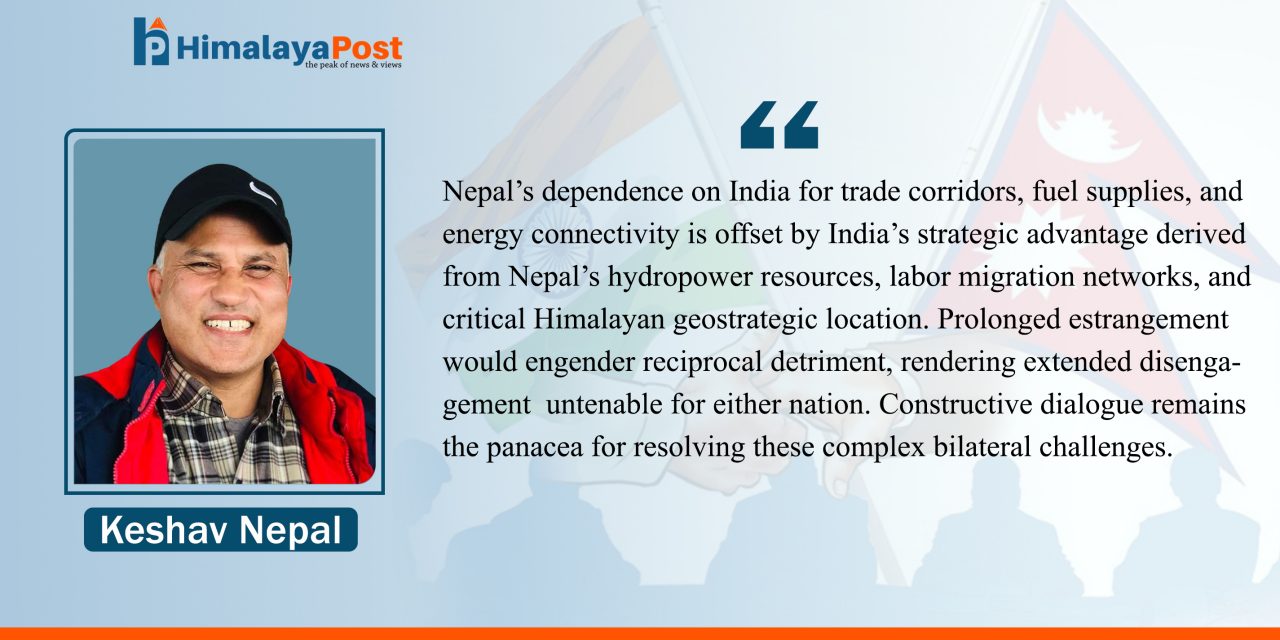
Although India has framed the regulations as quality-control measures rather than political retaliation, the timing has fueled suspicion within Nepal that economic tools are increasingly being used as instruments of geopolitical pressure. Yet economic interdependence cuts both ways. Nepal remains deeply dependent on India for trade access, fuel supplies, transit infrastructure, and energy connectivity. At the same time, India benefits from Nepal’s hydropower potential, labor migration networks, and its strategic position in the Himalayan region. Neither side can afford prolonged estrangement without incurring significant costs.
Despite the present tensions, the India-Nepal relationship is not beyond repair. The open border, deep people-to-people linkages, educational exchanges, and economic interdependence continue to provide resilience that many bilateral relationships lack. However, preserving this partnership will require political maturity and diplomatic restraint from both governments. First, both sides must restore consistent and respectful diplomatic engagement. Symbolic gestures and protocol disputes should not overshadow substantive cooperation. Quiet diplomacy, rather than public confrontation, remains essential in managing sensitive bilateral issues. Second, territorial disputes must return to institutional negotiation mechanisms instead of being amplified through media rhetoric and nationalist mobilization. Sustainable solutions can emerge only through patient dialogue grounded in historical evidence and mutual sensitivity.
Third, economic disagreements should be handled transparently through bilateral trade frameworks. Sudden regulatory actions that resemble coercive measures risk deepening mistrust and damaging long-term commercial confidence.
Ultimately, the future of India-Nepal relations will depend on whether the two neighbors can balance sovereignty with sensitivity, and nationalism with pragmatism. Shared civilization alone cannot guarantee stable diplomacy, but neither can temporary political tensions erase centuries of interconnected history.
For both Kathmandu and New Delhi, the challenge now is not whether they remain neighbors — geography has already decided that. The real question is whether they can evolve into mature partners capable of navigating disagreements without undermining the deeper foundations that continue to bind them together.