– Top Lal Panthi
In the modern era, the world is rapidly transforming into a global village, where resources can be exchanged among countries through import and export activities. These transactions are recorded in the balance of payment accounts and directly or indirectly affect the Gross Domestic Product (GDP) and Gross National Product (GNP) of each nation. A balanced and strong GDP is essential for maintaining economic stability, as an imbalanced GDP leads to rising unemployment, inflation, and weak competitiveness in the global market. Thus, achieving a balanced GDP is a prerequisite for attaining competitive advantage and sustainable development.
Currently, Nepal’s GDP composition reveals a notable structural imbalance, with the service sector contributing 62.01 percent, agriculture 25.16 percent, and industry only 12.83 percent. This overdependence on the service sector underscores the urgent need to strengthen both the agricultural and industrial sectors to ensure a more balanced and sustainable economic structure.
Among the three major contributors to GDP—agriculture, industry, and services—the agricultural sector holds the most significant role, especially for developing nations like Nepal. A country that prioritizes agriculture and promotes the export of agro-products enjoys several competitive advantages. These advantages include environmental sustainability, shorter investment gestation periods, improved public health through the consumption of natural products, and overall balanced economic growth. Furthermore, agriculture supports the ecosystem, increases greenery, enhances the average life expectancy of citizens, and strengthens food security.
Agriculture is diverse in nature, encompassing various types of crops, livestock, and horticultural activities that directly contribute to the sustainability of human life. Through multiple forms of planting, the environment becomes greener, cleaner, and healthier. This environmental benefit is something that the industrial and service sectors cannot easily replicate. Moreover, agriculture serves as the backbone of the economy by providing raw materials for industries, employment opportunities for the rural population, and export earnings for the country.
One of the greatest strengths of the agriculture sector is its short gestation period. Unlike the service sector, which requires long-term training, education, and skill development, or the industrial sector, which demands huge capital investment and long preparation periods, agriculture offers quicker returns on investment. A farmer can experience and enjoy profits within a single season or year. Additionally, the risks associated with agriculture are comparatively lower than those in the industrial or service sectors, as nature itself supports production when managed properly.
Although modern farming increasingly involves mechanization and automation, human labor remains essential in agricultural activities. Working in the field not only enhances productivity but also benefits the physical and mental health of farmers. Contact with the soil provides natural minerals and energy that help maintain bodily balance and immunity. Thus, agriculture not only contributes to economic progress but also to human well-being.
Furthermore, agriculture is a source of self-employment, ensuring that people can earn and sustain their livelihood within a short time. It reduces dependency on foreign employment and helps retain youth within the country. By promoting agrobusiness, Nepal can transform its agricultural potential into a modern, profitable, and sustainable enterprise.
The performance of import and export activities also plays a crucial role in shaping the agricultural economy and GDP. In 2024, global trade saw a mixed performance, with a strong export surge in Nepal and overall global exports growing by 1.5% in Q4. Meanwhile, global imports remained stable in Q4, but countries like Nepal experienced double-digit import growth, widening their trade deficit. This situation emphasizes the need to increase domestic production and export of agro-based goods to balance trade and strengthen the economy.
Agriculture also plays a vital role in achieving a balanced GDP by maintaining equilibrium among the three economic sectors—agriculture, industry, and services. A robust agricultural foundation ensures the supply of raw materials to industries, food to citizens, and exports to global markets. This integration supports overall economic stability, increases the average life expectancy of people, and promotes long-term sustainable growth.
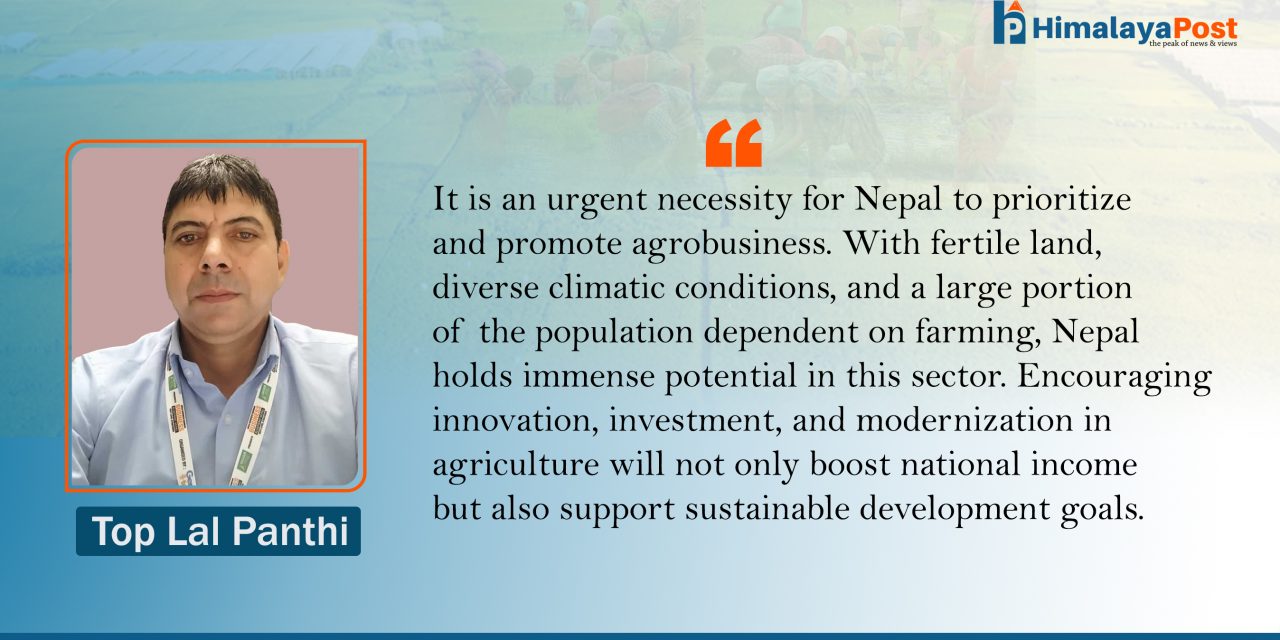
Therefore, it is an urgent necessity for Nepal to prioritize and promote agrobusiness. With fertile land, diverse climatic conditions, and a large portion of the population dependent on farming, Nepal holds immense potential in this sector. Encouraging innovation, investment, and modernization in agriculture will not only boost national income but also support sustainable development goals. Agrobusiness is not merely a traditional occupation—it is the lifeline of the nation and a foundation for a prosperous and sustainable future.
About Author: Dr. Top Lal Panthi is the first Corporate Social Responsibility consultant in Nepal.