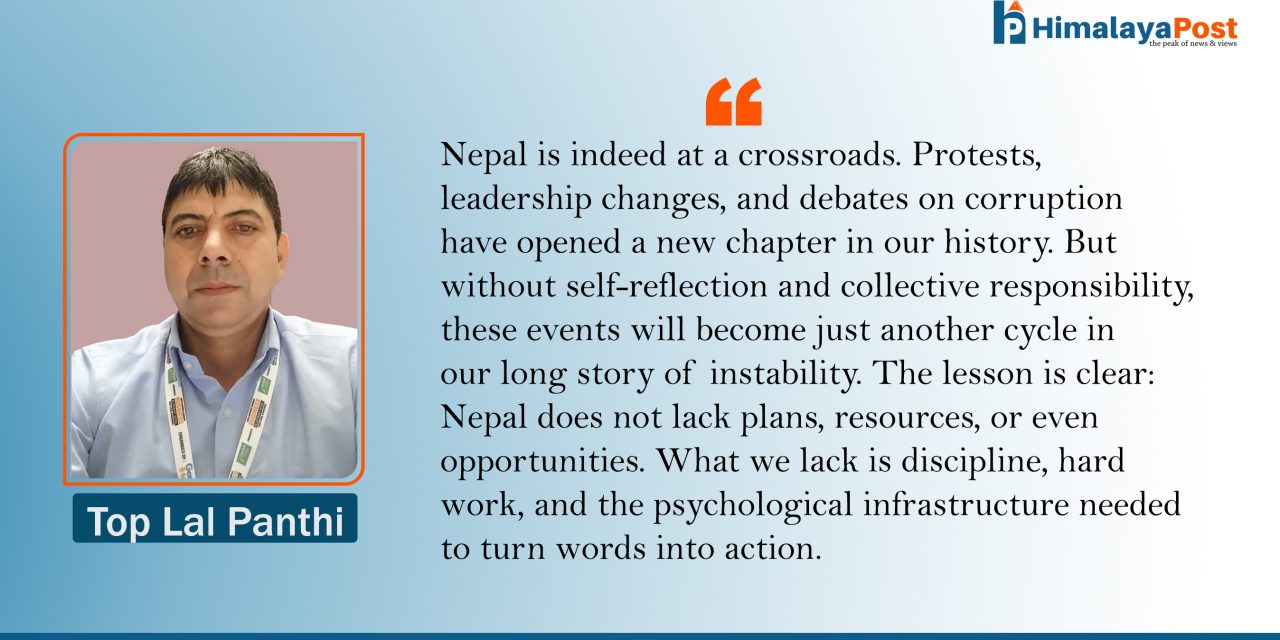
– Dr. Top Lal Panthi (PhD) (Consultant: Corporate Social Responsibility)
This week became more memorable in Nepal as the government suddenly changed. The shift appears to have been triggered by Gen Z protests against the KP Oli government, fueled by widespread corruption among existing leaders and the controversial decision to ban social media platforms like Facebook. The movement gained momentum with strong calls for an anti-corruption campaign supported by the new leaders.
However, the protests also left behind scars. Many government and private infrastructures were damaged by unknown groups. Political leaders were threatened and, in some cases, mistreated by protestors. As a result, people no longer feel secure, and in many areas, there is a noticeable lack of police presence and surveillance. This growing insecurity has raised serious concerns about law and order in the country.
At the same time, conversations across Nepal have become louder. People are now debating the constitution, governance systems, corporate governance, unemployment, the growing trend of youth leaving abroad for study and work, geopolitics, and failed leadership. These issues are not new, but the protests have magnified them and brought them into sharper focus.
From my perspective, Nepal today is moving backward instead of forward when compared to other economies. The irony is striking: in this globalized world, countries are becoming stronger through the development of technology, physical infrastructure, and psychological progress, yet Nepal is struggling to find its footing. Technology has made building physical infrastructure easier than ever, but the real challenge lies in developing “psychological infrastructure.”
Our people seem educated but often behave as if illiterate. We prioritize money over careers, luxury over labor, and comfort over contribution. This mindset has become one of our greatest obstacles. People in developed nations do not succeed merely because of technology or wealth; they succeed because of their work ethic, discipline, and commitment to productivity. In contrast, we spend much of our time in big talk and planning, but fail to implement those plans.
Different groups in Nepal see development challenges through different lenses. Some argue that instability in government is the root cause. Others point to corruption among politicians, geopolitical pressures, or weak leadership. All these arguments carry some truth, but I believe our deeper problem lies in our cultural mindset. We are too quick to copy the culture, fashion, and technology of other nations, but too reluctant to embrace the values of hard work, perseverance, and sacrifice that made those countries prosperous in the first place.
Until and unless we Nepalese develop the habit of working hard, saving more, speaking less, and producing more, the future of both individuals and the nation will remain uncertain. Developed countries are not rich by accident. Their prosperity is the result of decades, sometimes centuries of consistent public output and disciplined work. In Nepal, we remain satisfied with grand speeches, endless discussions, and lofty plans, but rarely follow through.
What we need today is a transformation in behavior. People must change how they act, how they think, and how they live. We need to read differently not just for degrees, but for knowledge and application. We need to speak differently not with empty words, but with meaningful commitments. We need to eat and consume differently not just seeking luxury, but balancing needs with sustainability. Most importantly, we need to work differently with dedication, honesty, and a focus on productivity.
Blaming the government or parliament has become a national pastime. Yet we must remember: government and parliament are merely representatives of the public. If our representatives are corrupt, it is because society tolerates or even encourages corruption. If leaders are unproductive, it is because citizens fail to demand accountability. True change will not come from the top; it must begin with every individual.
Nepal is indeed at a crossroads. Protests, leadership changes, and debates on corruption have opened a new chapter in our history. But without self-reflection and collective responsibility, these events will become just another cycle in our long story of instability. The lesson is clear: Nepal does not lack plans, resources, or even opportunities. What we lack is discipline, hard work, and the psychological infrastructure needed to turn words into action.
If we, as citizens, can cultivate the habits of labor, savings, productivity, and accountability, then Nepal has a chance to move forward. Otherwise, despite all the noise, we will continue to move backward while the rest of the world advances.