
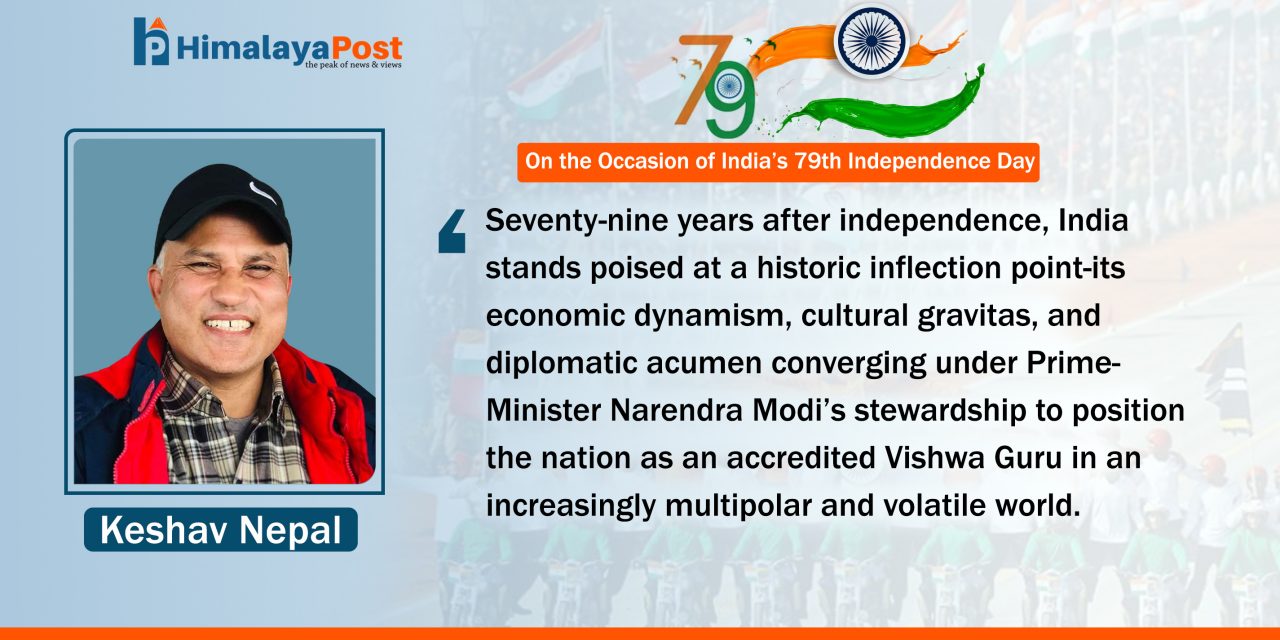
– Keshav Nepal
Seventy-nine years after the midnight of August 15, 1947, when the tricolour first fluttered proudly over a free India, the nation today stands at a decisive crossroads of history. What was once a newly independent state, battling poverty, illiteracy, and the deep scars of partition, is now an inevitable global player—visible and influential in every significant international affair.
This transformation has not been a sudden leap, but a steady, determined march. Over the decades, India has weathered wars, economic crises, natural disasters, and political upheavals, emerging stronger each time. Today, under the dynamic leadership of Prime Minister Narendra Modi, India has gained a new level of assertiveness and confidence on the world stage, positioning itself as a future Vishwa Guru—a global teacher and guide for the 21st century.
From Struggle to Strategic Leadership
In the early years of independence, India was primarily focused on nation-building—industrialization, agricultural reforms, infrastructure development, and strengthening democratic institutions. Foreign policy was rooted in non-alignment, advocating for peace and neutrality in the Cold War era.
However, the 21st century has demanded a different approach. In an interconnected and increasingly competitive world, passive diplomacy is often insufficient. India’s emergence as a nuclear power, an IT hub, and a vibrant economy has naturally propelled it into the frontlines of global decision-making.
Prime Minister Narendra Modi’s tenure since 2014 has accelerated this momentum. His governance style—characterized by decisiveness, pragmatic nationalism, and a results-oriented vision—has redefined India’s global image. Modi is widely regarded as a tough yet fair negotiator, balancing economic growth with security, and domestic welfare with strategic diplomacy.
The Modi Doctrine: Tough Negotiator, Visionary Leader
One of Modi’s most notable achievements has been reshaping India’s diplomatic strategy. Unlike earlier decades when India’s voice on global platforms was occasionally overlooked, today it commands attention. Modi has cultivated strong bilateral and multilateral relationships across the spectrum—from strategic partnerships with the United States, to deepening ties with Russia, to pragmatic engagement with China despite differences.
His attempts to bring together Russia, China, and India into a cooperative bloc reflect his understanding of the shifting global order. In a world where US policy—especially under leaderships like that of Donald Trump—can be unpredictable, Modi has worked to create alternate power centres, ensuring that India’s interests are safeguarded. This alliance-building is not about confrontation but about ensuring balance and fairness in international decision-making.
Domestically, his firm stance against terrorism has been widely appreciated. The containment of terrorist activity largely to certain districts in South Kashmir—once a hotbed of unrest spreading across India—has been a significant security achievement. Improved intelligence, infrastructural development, and strong political will have restored relative peace to large parts of the nation.
India’s Unprecedented Global Presence
The Modi era has also seen India’s visibility soar to unprecedented heights. From addressing the United Nations General Assembly in Hindi to leading the International Day of Yoga celebrations worldwide, Modi has successfully linked cultural diplomacy with statecraft. Initiatives like the International Solar Alliance and digital partnerships with African nations have placed India at the forefront of global problem-solving—whether in climate action, renewable energy, or technology sharing.
India’s presidency of the G20 in 2023 further underscored its capacity to mediate between developed and developing nations. Its ability to bring consensus on issues like debt relief, sustainable development, and digital inclusion showcased India as a bridge-builder in a fragmented world.
A Nation Ready for the Role of Vishwa Guru
The idea of Vishwa Guru—the world’s teacher—has deep roots in India’s civilizational history. Ancient India was a hub of knowledge, philosophy, and innovation, influencing cultures from Southeast Asia to the Middle East. Today, with its growing economic clout, technological advancements, and democratic vibrancy, India is poised to reclaim this role—not in a hegemonic sense, but as a moral and intellectual guide.
India’s strengths are not only in GDP growth or military power, but in its cultural resilience, its commitment to democracy, and its pluralism. In a time when many parts of the world face polarization and instability, India offers a model of unity in diversity, where hundreds of languages, faiths, and traditions coexist within one constitutional framework.
79th Independence Day: Commemorating the Spirit of Freedom
The 79th Independence Day of India in 2025 is not merely a ceremonial occasion—it is a reaffirmation of the values that have guided the nation since independence. This year, the Ministry of Defence, in collaboration with MyGov, is spearheading the Independence Day Celebrations – 2025 campaign, aimed particularly at the youth.
The initiative seeks to foster patriotic pride, unity, and civic responsibility through creative and engaging activities. A series of nationwide contests are being organized, encouraging citizens to express their reflections on India’s journey—through essays, art, photography, and digital media.
These contests are more than recreational—they are opportunities for introspection and connection with the nation’s heritage. By honouring the sacrifices of freedom fighters and celebrating the nation’s progress, they remind every citizen of their role in shaping India’s future.
Looking Forward: India in the Coming Decade
If the current trajectory continues, the coming decade could see India solidify its role as one of the key shapers of the global order. With its youthful population, technological capabilities, and strategic location, India can influence issues ranging from climate change and energy security to trade policy and peacebuilding.
As Modi himself often emphasizes, India’s development story is not just about GDP growth—it is about empowering every citizen, ensuring dignity, and contributing positively to humanity. The vision is clear: an India that is self-reliant (Atmanirbhar), technologically advanced, environmentally responsible, and globally respected.
Conclusion: The March Toward Leadership
Almost eight decades after independence, India’s journey from a colonized nation to a confident global player is a testament to the courage and vision of its leaders and people. Prime Minister Narendra Modi’s tenure has marked a decisive phase in this journey—turning aspirations into tangible influence on the world stage.
The road ahead may be complex, but India has the resilience, resources, and resolve to navigate it. As the nation celebrates its 79th Independence Day, it stands not only as a free, sovereign, and prosperous state, but as a rising force ready to guide the world.
The tricolour today flutters not just as a symbol of independence, but as a beacon of possibility—for India, and for the global community it seeks to lead.