
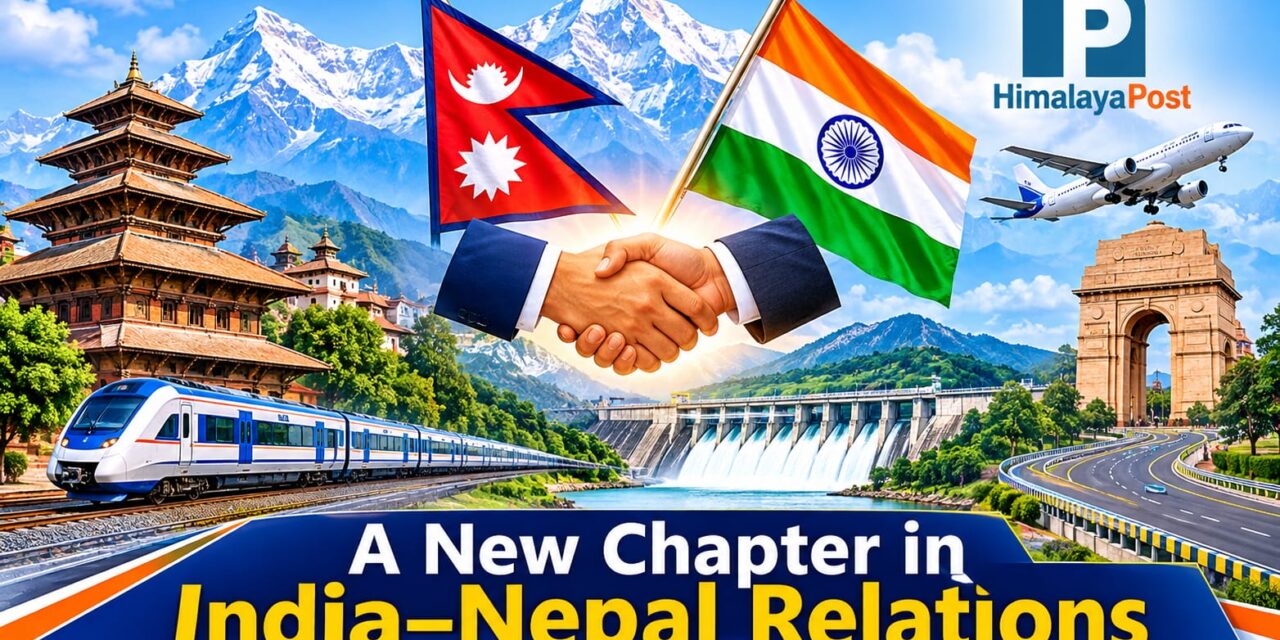
KATHMANDU : Prime Minister Balendra Shah’s upcoming two-day official visit to India is expected to provide fresh momentum to Nepal–India relations, with both countries preparing to discuss key areas of bilateral cooperation, including air connectivity, cross-border infrastructure, hydropower, trade, investment and technological partnership.
Prime Minister Shah is scheduled to visit New Delhi on November 22–23, 2026, at the invitation of Indian Prime Minister Narendra Modi. The visit will mark Shah’s first official bilateral foreign engagement since assuming office in March 2026.
The high-level engagement comes at a significant time for Nepal, as the country seeks to strengthen its economy, accelerate post-disaster reconstruction, attract foreign investment and expand regional connectivity.
According to the proposed agenda, the two prime ministers are expected to hold bilateral discussions on November 23, followed by delegation-level talks and a joint communication outlining areas of cooperation and future commitments.
Preparatory discussions involving Nepal’s Foreign Minister Shisir Khanal, Indian Ambassador to Nepal Sudhakar Dalela and Indian Foreign Secretary Vikram Misri have helped establish the diplomatic groundwork for the visit.
Air Connectivity Among Key Priorities
Improving international air connectivity through Indian airspace is expected to be one of the major priorities of Nepal during the visit.
Nepal has been seeking additional international air-entry routes through Mahendranagar, Bhairahawa, Nepalgunj and Janakpur to improve access to its international airports and support tourism development.
The proposed Mahendranagar corridor has reportedly received a positive response from Indian authorities, although technical and operational arrangements are still under discussion.
The proposed Bhairahawa route is also significant for improving international flight operations at Gautam Buddha International Airport.
A Nepali technical delegation comprising Joint Secretary Jay Narayan Acharya, Joint Secretary Gehendra Rajbhandari and Civil Aviation Authority of Nepal Director General Mukesh Dangol has held discussions with Indian counterparts on the proposed routes.
The talks have also explored reciprocal airspace cooperation, with India expressing interest in using designated portions of Nepal’s eastern airspace to improve connectivity towards Bagdogra Airport in West Bengal.
Around $2 Billion Development Assistance Under Discussion
Economic cooperation and development partnership are also expected to feature prominently in the discussions.
A proposed financial assistance package estimated at approximately US$2 billion in grants and lines of credit is among the significant matters under consideration, particularly in view of Nepal’s reconstruction requirements following the devastating Himalayan floods of August 2026.
The final size and composition of the package will depend on bilateral negotiations.
Prime Minister Shah is also expected to address a gathering of Nepali and Indian business representatives, where investment opportunities, trade facilitation and economic cooperation are likely to be discussed.
Hydropower, manufacturing, agricultural processing, tourism, information technology, pharmaceuticals and hospitality have been identified as potential sectors for expanding Indian investment in Nepal.
Janakpur–Ayodhya Railway and Cross-Border Projects
Several important connectivity and infrastructure initiatives are also expected to gain momentum during the visit.
Among the proposed highlights is the inauguration of a weekly railway service connecting Janakpur Dham in Nepal with Ayodhya Cantt in India. The approximately 604-kilometre railway connection is expected to strengthen religious tourism and cultural exchanges between the two countries.
The formal inauguration or handover of the newly constructed Nepal Police Academy building in Panauti, supported by India, is another initiative expected to feature in the programme.
Similarly, the operationalisation of the Integrated Check Post in Bhairahawa is expected to facilitate cross-border trade, improve customs administration and ease cargo movement.
The inauguration of a motorable bridge in Darchula is also among the anticipated outcomes.
In addition, discussions are expected to cover the Integrated Check Post at Dodhara Chandani, the Lower Arun Hydropower Project and the Siliguri–Charali petroleum pipeline.
Energy Cooperation and Hydropower Exports
Energy cooperation remains one of the strongest pillars of the Nepal–India partnership.
With Nepal possessing substantial hydropower potential and India having a growing demand for electricity, both countries have significant opportunities to expand cross-border energy trade.
The Shah government aims to increase Nepal’s annual electricity exports to India beyond 1,650 megawatts while also expanding electricity exports to Bangladesh through India’s transmission infrastructure.
The existing trilateral electricity trade arrangement involving Nepal, India and Bangladesh, initially covering 40 megawatts, provides a foundation for further regional energy cooperation.
Indian public and private sector companies, including the National Hydroelectric Power Corporation (NHPC), have also been playing an increasingly important role in Nepal’s hydropower development.
The Pancheshwar Multipurpose Project on the Mahakali River is another important issue expected to remain on the bilateral agenda. Differences concerning water allocation, project costs and benefit-sharing have delayed its implementation.
Technology, Education and Disaster Management
Beyond traditional infrastructure and energy cooperation, the two countries are also exploring opportunities in emerging sectors.
Potential areas of collaboration include artificial intelligence, digital public infrastructure, information technology, space research, pharmaceutical innovation and entrepreneurship.
Academic partnerships involving India’s prestigious Indian Institutes of Technology (IITs) and Indian Institutes of Management (IIMs) have also been identified as possible areas of cooperation.
Sports development, particularly cricket, could provide another opportunity for technical assistance, coaching, training and institutional capacity-building.
Given the increasing climate-related risks in the Himalayan region, cooperation in satellite-based monitoring, flood forecasting, early-warning systems and disaster response is also considered important.
Sensitive Bilateral Issues Remain on the Agenda
Despite expanding economic and development cooperation, several longstanding issues continue to require diplomatic attention.
The boundary disputes involving Kalapani, Limpiyadhura and Susta remain sensitive matters in Nepal–India relations. Both countries need sustained diplomatic engagement to address these concerns through established bilateral mechanisms.
The substantial trade imbalance between Nepal and India, as well as the suspension of recruitment of Nepali Gorkhas into the Indian Army under the changed Agniveer recruitment framework, are other outstanding issues requiring consultation.
The Pancheshwar Multipurpose Project also remains an important area where sustained political and technical dialogue is necessary.
A New Phase of Nepal–India Partnership
The upcoming visit is expected to provide an opportunity for both governments to strengthen their longstanding relationship through practical cooperation and measurable development outcomes.
For Nepal, closer engagement with India offers opportunities to expand access to markets, attract investment, strengthen infrastructure and accelerate economic transformation.
For India, stronger economic cooperation with Nepal would reinforce its Neighbourhood First policy and contribute to regional economic integration.
The success of the visit, however, will ultimately depend on the implementation of agreements, timely completion of infrastructure projects, increased investment and tangible benefits for citizens of both countries.
With connectivity, energy, trade and technology emerging as major areas of common interest, the November 22–23 engagement could mark an important step towards a more dynamic and mutually beneficial Nepal–India partnership.