
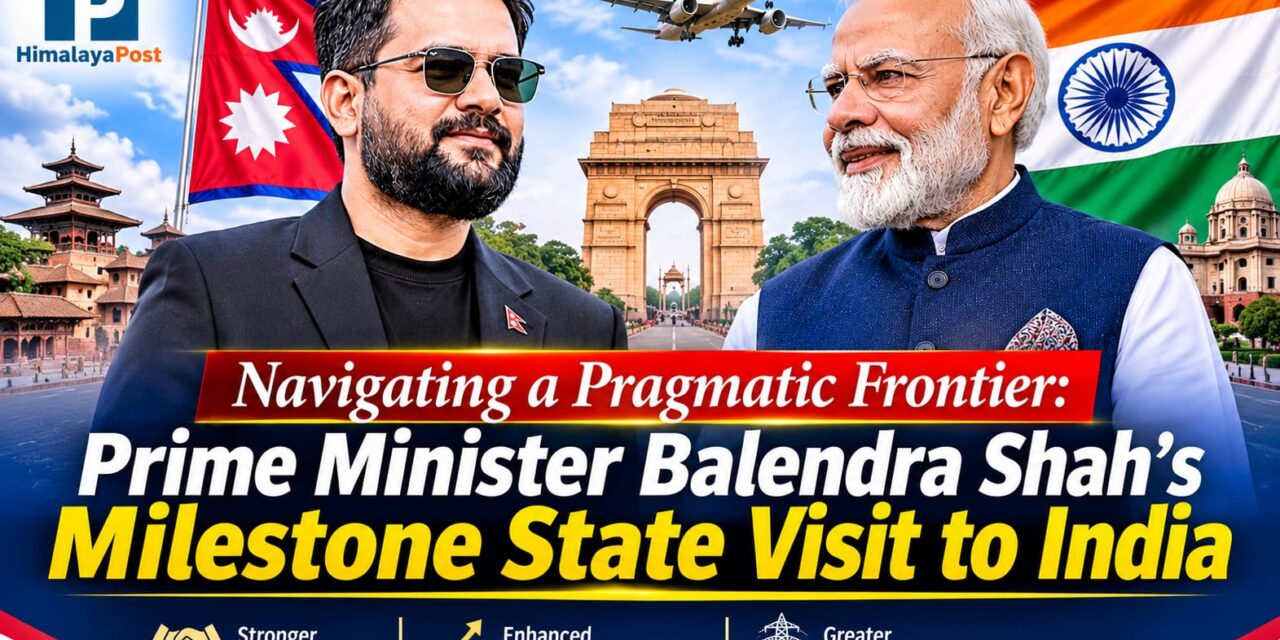
KATHMANDU : Prime Minister Balendra Shah’s upcoming two-day state visit to India is expected to focus on strengthening bilateral ties through concrete agreements on air connectivity, energy cooperation, cross-border infrastructure and technological partnerships.
Shah is scheduled to visit India from November 22 to 23 at the invitation of Indian Prime Minister Narendra Modi. The visit will be his first official bilateral foreign trip since assuming office in March 2026.
Unlike previous high-profile visits that included tours to different Indian cities, Shah has opted for a focused diplomatic engagement in New Delhi, prioritizing policy discussions and tangible outcomes.
The programme is expected to include a 30-minute one-on-one meeting between Shah and Modi, followed by delegation-level talks involving four Nepali cabinet ministers and a 36-member delegation.
Air Connectivity Among Key Priorities
Improving cross-border air connectivity is expected to be one of the major issues on the bilateral agenda.
Nepal has long been seeking additional air entry routes through Mahendranagar, Bhairahawa, Nepalgunj and Janakpur to improve international flight operations, particularly for Gautam Buddha International Airport and Pokhara International Airport.
Progress on the proposed Mahendranagar and Bhairahawa entry points is expected during the discussions. Nepal and India are also exploring technical arrangements concerning airspace access, including India’s interest in routes through eastern Nepal and the Raxaul corridor.
Major Infrastructure Projects on the Agenda
Several infrastructure and connectivity projects are expected to receive attention during the visit.
The proposed inauguration of a weekly cross-border railway service connecting Janakpurdham in Nepal with Ayodhya Cantt in India is among the major highlights. The 604-kilometre railway connection is expected to strengthen religious tourism and cross-border connectivity.
Other projects expected to feature in the programme include the newly rebuilt Nepal Police Academy in Panauti, the operationalization of the Integrated Check Post in Bhairahawa and the inauguration of a motorable bridge in Darchula.
Shah is also scheduled to address a gathering of Nepali and Indian business leaders on November 23, highlighting opportunities for investment, trade and private-sector cooperation.
Energy Cooperation and Power Exports
Energy cooperation is another important component of the visit.
Nepal is seeking to expand electricity exports to India beyond 1,650 megawatts annually and strengthen its position in regional energy trade.
The two sides are also expected to discuss expanding electricity exports to Bangladesh through India’s transmission infrastructure, building on the existing 40-megawatt arrangement.
Facilitating greater Indian public and private sector investment in Nepal’s hydropower sector, including projects involving India’s state-owned National Hydroelectric Power Corporation (NHPC), is also expected to feature in the discussions.
Cooperation in AI, Education and Sports
Beyond traditional infrastructure and energy, the visit is expected to explore new areas of technological cooperation.
Artificial intelligence, joint research, technical training and institutional partnerships are among the proposed areas of collaboration.
Nepal is also looking for Indian technical and logistical support to develop sports infrastructure, particularly cricket facilities.
Discussions may also cover the possibility of establishing campuses of India’s premier educational institutions, including the Indian Institutes of Technology (IITs) and Indian Institutes of Management (IIMs), in Nepal.
Cooperation in disaster preparedness, flood early-warning systems and climate-resilient infrastructure is also expected to be part of the broader agenda.
Sensitive Issues May Remain Outside the Immediate Agenda
Despite the wide-ranging agenda, several longstanding bilateral issues are unlikely to be resolved during the short visit.
The boundary disputes involving Kalapani, Limpiyadhura and Susta, Nepal’s trade deficit with India, the suspension of Nepali Gorkha recruitment under India’s Agniveer scheme and differences surrounding the Pancheshwar Multipurpose Project remain significant challenges requiring further diplomatic engagement.
The two-day visit is therefore expected to prioritize achievable economic and infrastructure-related outcomes while laying the groundwork for broader cooperation.
The outcome of Shah’s discussions with Modi will be closely watched as Nepal and India seek to strengthen their longstanding partnership amid evolving regional economic and geopolitical dynamics.