
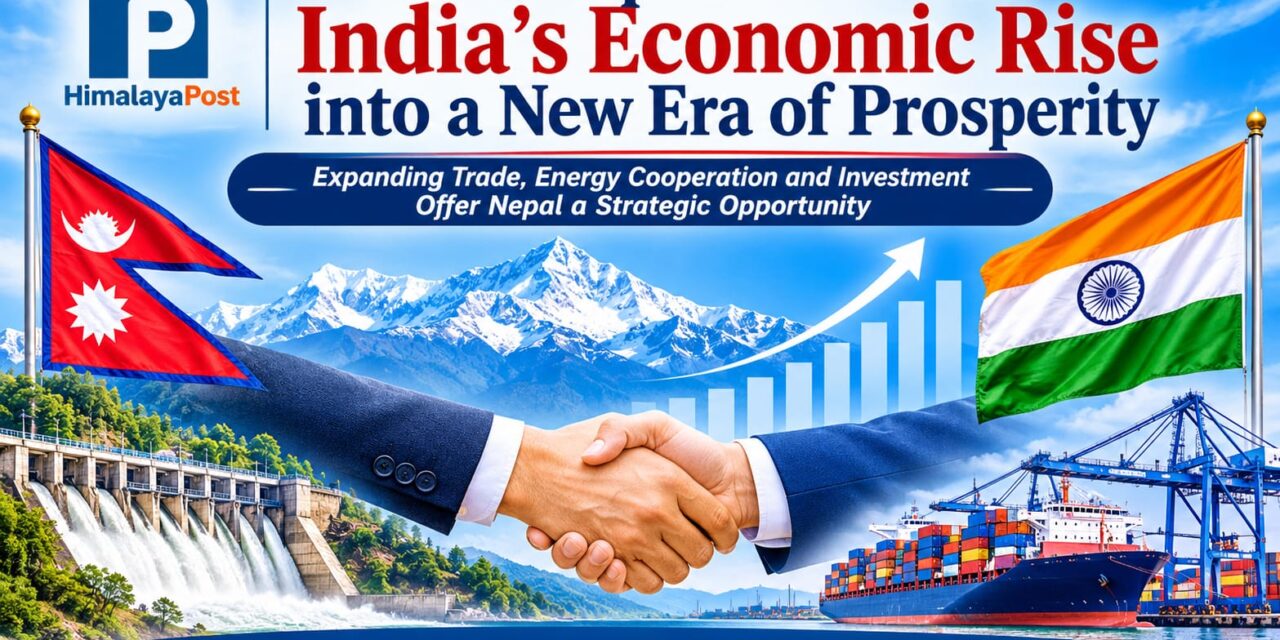
Kathmandu – India’s rapidly expanding economy, growing investment opportunities and rising regional energy demand present Nepal with significant opportunities to accelerate its economic development, strengthen bilateral trade and attract foreign investment.
As one of South Asia’s largest economies, India’s economic growth is creating opportunities beyond its borders. For Nepal, which shares deep geographical, historical, cultural and economic ties with India, this transformation could become an important driver of national prosperity.
India–Nepal merchandise trade reached approximately US$9.39 billion in FY 2025/26, accounting for around 62.3 per cent of Nepal’s total merchandise trade. India also absorbed approximately 81.1 per cent of Nepal’s merchandise exports during the same period, highlighting its importance as Nepal’s largest trading partner and principal export destination.
Hydropower and Regional Energy Cooperation
Energy cooperation remains one of the most promising areas of Nepal–India economic partnership.
India’s growing economy and increasing electricity demand offer Nepal an expanding market for its largely untapped hydropower potential. According to the Reserve Bank of India’s September 2026 Survey of Professional Forecasters, India’s real GDP growth was projected at 7.1 per cent for FY 2026/27.
At the 13th meeting of the Nepal–India Joint Steering Committee, held in Pokhara on July 15, 2026, both countries agreed to increase cross-border electricity transmission capacity through the Dhalkebar–Muzaffarpur and Dhalkebar–Sitamarhi 400 KV transmission lines.
The revised arrangement provides for up to 1,650 MW of electricity exports from Nepal to India and 1,400 MW of imports into Nepal, subject to operational arrangements.
Nepal has already begun generating substantial revenue from electricity exports. According to Nepal Electricity Authority data, the country earned approximately NPR 16.15 billion from electricity exports during the first three months of FY 2026/27.
Between mid-September and mid-October 2026 alone, Nepal exported approximately 634 million units of electricity to India, generating NPR 5.925 billion in revenue.
India has also facilitated Nepal’s electricity exports to Bangladesh through its transmission network. Nepal began exporting 40 MW of electricity to Bangladesh in 2024, using India’s power grid as a transit route.
Furthermore, following the August 2026 floods that damaged Nepal’s hydropower infrastructure, India approved emergency electricity exports of up to 654 MW to Nepal, helping address domestic electricity shortages.
These developments demonstrate that India is not only a major market for Nepal’s electricity but also an important partner in expanding Nepal’s access to regional energy markets.
New Investment Opportunities
Changes in India’s foreign direct investment framework have opened additional opportunities for eligible Nepali investors and businesses.
On March 10, 2026, India’s Union Cabinet approved amendments to the foreign investment policy governing investments from countries sharing land borders with India.
Under the revised framework, qualifying investors with non-controlling beneficial ownership of up to 10 per cent may invest through the automatic route, subject to applicable sectoral conditions and regulatory requirements.
The policy creates a new avenue for eligible Nepali businesses to explore investment opportunities in India’s expanding economy.
Meanwhile, India remains Nepal’s largest source of foreign investment. According to the Embassy of India in Kathmandu, Indian investments in Nepal are estimated at approximately US$800 million, accounting for nearly one-third of the country’s total foreign direct investment stock.
These investments span banking, insurance, telecommunications, education, electricity, tourism and infrastructure.
Nepal’s hydropower resources, tourism potential, agricultural diversity, young workforce and expanding information technology sector offer considerable opportunities for further investment cooperation.
Finance Minister Dr. Swarnim Wagle has also invited Indian investors to explore opportunities in clean energy, information technology, high-value agriculture and tourism.
However, Nepal needs to strengthen its investment environment through predictable policies, transparent taxation, efficient approval procedures and reliable infrastructure to translate these opportunities into concrete economic outcomes.
Tourism and Service Exports
Tourism is another sector where Nepal can benefit significantly from India’s expanding middle class and growing demand for international travel.
According to Nepal Tourism Statistics 2025, Nepal received 1,162,365 international visitors in 2025, representing a 1.3 per cent increase compared with 2024. India remained the largest source country for international visitors.
Destinations such as Pokhara, Nagarkot, Chitwan, Lumbini, Janakpur, Muktinath and the Kathmandu Valley offer diverse tourism experiences, including adventure, religious pilgrimage, cultural exploration and wellness tourism.
Nepal’s Buddhist heritage, Hindu pilgrimage destinations and shared cultural traditions with India provide a strong foundation for developing cross-border tourism circuits.
The country could also attract more Indian visitors seeking cooler destinations during periods of extreme summer temperatures in the Indian plains.
To capitalise on this opportunity, Nepal needs to improve road and air connectivity, hospitality services, healthcare facilities, sanitation, digital payment systems and tourism infrastructure.
Beyond tourism, information technology, education, healthcare, professional services and digital outsourcing could also become important areas for Nepal’s service exports to India.
Three Priorities for Nepal
Despite the considerable opportunities, Nepal must adopt a clear economic strategy to maximise the benefits of India’s growing economy.
First, both countries should strengthen technical and regulatory cooperation in hydropower, electricity transmission and regional energy trade. Nepal should focus on expanding transmission infrastructure, attracting investment in hydropower and developing long-term electricity export arrangements.
Second, Nepal should improve its investment climate and encourage reciprocal business engagement. Transparent policies, efficient approval mechanisms, reliable infrastructure and stronger institutional capacity are essential to attracting sustainable investment.
Third, Nepal and India should promote integrated tourism and service-export initiatives. Better cross-border transport facilities, coordinated tourism promotion and digital payment connectivity could help expand economic opportunities for businesses and communities in both countries.
Turning Economic Opportunities into National Prosperity
India’s economic rise represents more than the growth of a neighbouring country. It offers Nepal an opportunity to expand its markets, attract investment, develop clean energy, strengthen regional connectivity and generate employment.
The figures demonstrate the scale of the existing economic relationship: approximately US$9.39 billion in bilateral merchandise trade, an estimated US$800 million in Indian investment and NPR 16.15 billion in electricity export earnings during the first quarter of FY 2026/27.
However, geographical proximity and historical friendship alone cannot guarantee economic prosperity. Nepal needs political stability, consistent policies, institutional efficiency, infrastructure investment, skilled human resources and a competitive private sector.
The country must approach its relationship with India through pragmatic diplomacy, mutual respect and economic reciprocity rather than excessive dependence or unnecessary hesitation.
India can provide Nepal with access to markets, investment, technology and regional connectivity. Nepal, in turn, can contribute clean energy, tourism opportunities, strategic geographical access and a growing skilled workforce.
Ultimately, India’s economic rise could become a major accelerator of Nepal’s development. The extent to which Nepal benefits from this opportunity, however, will depend on its own vision, preparedness and ability to implement effective economic policies.