
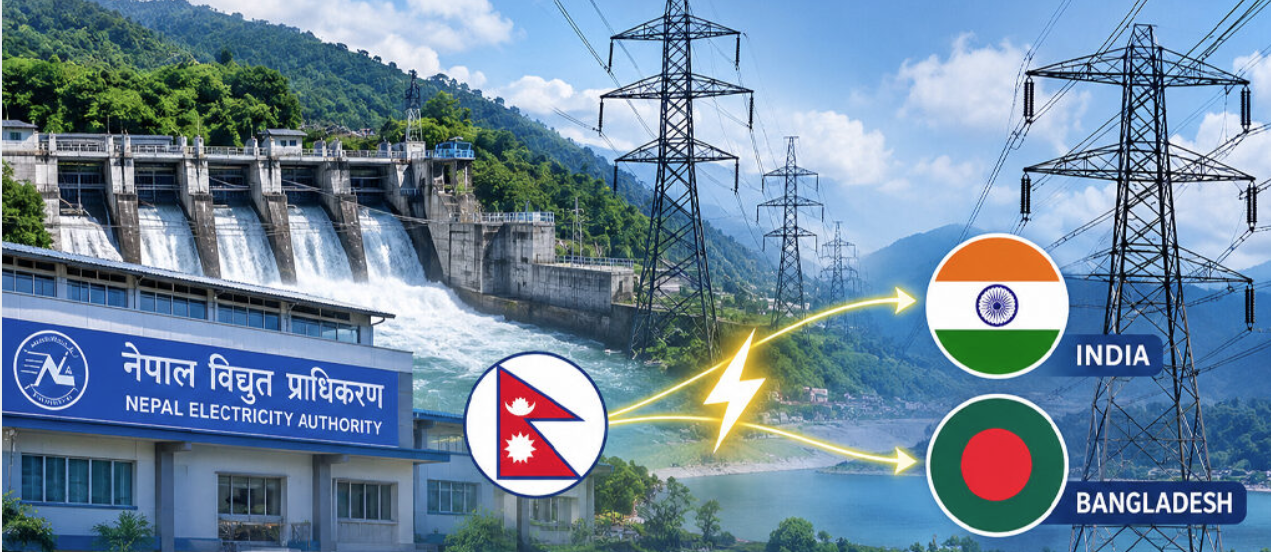
Kathmandu – Nepal’s electricity export earnings have increased despite floods disrupting several hydropower projects. The Nepal Electricity Authority (NEA) generated business worth Rs 5.925 billion from electricity exports to India in the month of Ashoj (mid-September to mid-October) of the current fiscal year 2026/27. Meanwhile, the export of 40 megawatts of electricity to Bangladesh has also resumed after being suspended due to flood damage.
According to the NEA’s Load Dispatch Centre, Nepal exported more than 633.98 million units of electricity to India during Ashoj. Revenue from these exports increased by Rs 962 million compared to the same month last year, when Nepal earned Rs 4.963 billion from electricity sales to India.
Electricity export earnings have also increased compared to the previous month. Nepal generated business worth Rs 5.0925 billion from electricity exports in Bhadra. This means export revenue rose by Rs 832.5 million in Ashoj compared to Bhadra.
During the first three months of the current fiscal year—Shrawan, Bhadra, and Ashoj—Nepal recorded total electricity export transactions worth Rs 16.1513 billion, according to the NEA.
During Ashoj, electricity was sold to the Indian states of Haryana and Bihar under bilateral power purchase agreements. The remaining electricity was traded through India’s Day-Ahead Market and Real-Time Market on a competitive basis. According to the NEA, approximately two-thirds of Nepal’s electricity exports to India during the month were made under bilateral agreements, while the remainder was sold through the Indian Energy Exchange.
Meanwhile, Nepal has resumed exporting 40 MW of electricity to Bangladesh after the supply was interrupted by flooding in the Trishuli River. Floods triggered by heavy rainfall in the Bhotekoshi River area of Rasuwa damaged the Trishuli and Chilime hydropower plants, disrupting the electricity supply arrangement.
The NEA stated that electricity exports to Bangladesh resumed on the evening of October 23, 2026 (Kartik 6), using India’s transmission network.
Under the revised arrangement, electricity generated by the Solu, Kabeli-1, and Lower Modi hydropower projects has been approved for export to Bangladesh and India’s Haryana state, replacing the previous supply sources from the Trishuli, Devighat, and Chilime hydropower plants.
Under a five-year agreement between the Nepal Electricity Authority and the Bangladesh Power Development Board, Nepal exports 40 MW of electricity to Bangladesh daily from June 15 to November 15 each year.
In another development, Nepal has received approval from India’s Central Electricity Authority to export an additional 31 MW of electricity. With this approval, the total capacity authorized for electricity exports to India has reached approximately 1,179 MW.
NEA Executive Director Dirghayu Kumar Shrestha said that although floods had halted production at some hydropower projects, Nepal had managed to maintain electricity exports through other operational plants. He described the resumption of exports to Bangladesh and the expansion of export capacity to India as important developments for Nepal’s electricity trade.
The increase in electricity exports is expected to help Nepal manage surplus power generated during the rainy season, strengthen cross-border electricity trade, and expand the country’s presence in regional energy markets. However, sustaining this growth will depend on reliable hydropower production, resilient infrastructure, and continued access to regional electricity markets.