
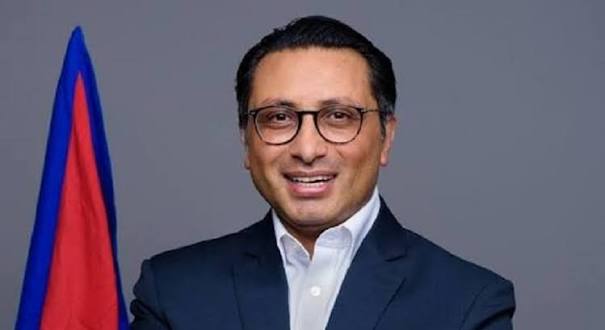
Kathmandu – Finance Minister Dr. Swarnim Wagle has said that Nepal managed youth dissatisfaction and the Gen-Z movement through democratic means, preventing the situation from descending into anarchy.
Speaking at the NDTV World Summit 2026 in New Delhi, India, Wagle claimed that the Rastriya Swatantra Party (RSP) successfully transformed street protests into political power through peaceful elections.
During a session titled “From Street Revolt to Power,” Wagle described Nepal as one of the youngest countries demographically in South Asia, noting that more than half of its population is under the age of 30.
He said young people who grew up with smartphones and social media, often referred to as digital natives, had become frustrated with the traditional political establishment.
“We had transformed from a highly promising multiparty democracy into a deplorable kleptocracy,” Wagle said, criticizing the power-sharing practices and self-serving interests of traditional political parties. He added that young people had grown increasingly fed up with the old political order.
Wagle recalled that street protests triggered by issues including the social media ban, followed by the tragic deaths of 19 young people, brought an end to the old political establishment.
According to him, a transitional government led by a former chief justice was formed for six months following the protests. The government subsequently conducted what he described as the fairest and most peaceful election in Nepal’s history.
Wagle said the political partnership between RSP Chairperson Rabi Lamichhane and Balen Shah, the party’s prime ministerial candidate, created an “electric combination” among voters seeking an alternative to traditional political parties.
“People were dissatisfied with the old system, but there was no credible alternative. When the RSP moved forward under the leadership of Balen Shah and Rabi Lamichhane, people trusted them,” said Wagle, who is also the party’s vice-chairperson.
He stated that, following the public mandate, the RSP had secured nearly a two-thirds majority in the lower house of Parliament and was leading 17 ministries in the federal government.
Comparing Nepal’s Gen-Z movement with youth-led movements in other countries, Wagle argued that Nepal’s movement had reached a safe and peaceful conclusion.
“Choosing the path of anarchy and violence results in the loss of public support,” he said, advising young people around the world that peaceful voting remains the ultimate means of achieving change and the true test of popular support, regardless of the level of public dissatisfaction.
Speaking about the performance of the government led by what he described as the world’s youngest prime minister, Wagle claimed that the administration had faced no allegations of corruption during its six months in office.
“We may not have as much experience in running a government as traditional politicians, and we may occasionally make minor mistakes. However, we do not have arrogance, and we are willing to correct our mistakes and move forward,” Wagle said.