Kathmandu- The electoral watershed of March 5, 2026, has opened a decisive new chapter in Nepal’s democratic journey. The emphatic rise of Rastriya Swatantra Party under the leadership of Balendra Shah is not merely a political transition—it is a public mandate for structural reform, accountable governance, and a reimagined national trajectory. At a moment when domestic transformation converges with regional recalibration, Nepal finds itself at the threshold of a strategic renaissance.
Crucially, Narendra Modi’s swift diplomatic outreach to the newly sworn-in government signals more than protocol. It reflects a deliberate and forward-looking reset in India–Nepal relations—one grounded in pragmatism, mutual respect, and shared regional ambition.
From Estrangement to Engagement
The contrast between the recent past and the emerging present is both stark and instructive. The preceding phase of bilateral relations was marked by an unusual cooling of diplomatic exchanges. High-level engagements dwindled, symbolic gestures were withheld, and traditional channels of communication appeared constrained. The absence of customary invitations and dialogue reflected a relationship under strain—one that had drifted from its historically robust foundations.
Yet, the post-2026 moment reveals a striking departure from that trajectory. India’s immediate engagement with the Shah administration underscores a mature diplomatic ethos—one that prioritizes Nepal’s democratic legitimacy over residual tensions. This recalibration is not reactive; it is strategic. It signals New Delhi’s recognition that a stable, forward-looking Nepal is indispensable to regional equilibrium.
In extending a hand of partnership without precondition, India has reframed the bilateral equation—from one of cautious distance to one of constructive convergence.
Beyond Borders and Politics
India–Nepal relations are not confined to statecraft; they are anchored in a civilizational continuum that predates modern diplomacy. The enduring concept of “Roti-Beti” relations captures this essence—an organic bond of shared sustenance, kinship, and cultural affinity.
This connection finds profound expression in a shared sacred geography. The spiritual axis linking Pashupatinath Temple with Varanasi, and Janakpur with Ayodhya, forms a continuous cultural landscape. These are not merely religious sites; they are living symbols of a unified civilizational memory that transcends political boundaries.
Equally significant is the 1,850-kilometer open border—an arrangement unique in the modern world. This frontier does not divide; it connects. Families, economies, and communities flow seamlessly across it, creating a deeply interwoven social fabric. In this sense, India and Nepal are not just neighbors; they are partners in a shared historical and human experience.
Converting Geography into Opportunity
If culture provides the foundation, economics offers the pathway to transformation. Nepal’s development aspirations are intrinsically linked to deeper engagement with India—its largest trading partner and a critical gateway to global markets.
At the heart of this partnership lies the hydropower sector. Nepal’s vast river systems position it as a potential energy powerhouse in South Asia. The ambitious vision of exporting up to 10,000 megawatts of electricity to India represents not just a commercial opportunity, but a strategic redefinition of Nepal’s economic identity—from landlocked to energy-linked.
Beyond energy, the scope for collaboration is expansive. Trade facilitation, cross-border investment, and supply chain integration can accelerate Nepal’s transition toward a diversified and resilient economy. India’s support in stabilizing essential sectors—particularly energy and agriculture—further underscores the depth of this partnership.
Nepal’s Opportunity for Quantum Progress
The current diplomatic climate presents Nepal with a rare and consequential opportunity. India’s proactive engagement, marked by generosity and strategic foresight, provides a platform upon which Nepal can build a new development paradigm.
However, opportunity alone is insufficient. The onus now lies with Nepal’s leadership to convert goodwill into tangible outcomes.
First, there is a need for strategic clarity. Nepal must identify priority sectors—energy, infrastructure, technology—and align them with long-term national goals. Second, negotiation capacity must be strengthened to ensure that partnerships are equitable, sustainable, and mutually beneficial. Third, institutional reform is essential. Leveraging India’s technical expertise in governance, digital systems, and capacity building can significantly enhance Nepal’s administrative efficiency.
The concept of “quantum success” is particularly instructive here. It implies not incremental progress, but transformative leaps—achievements that redefine the nation’s developmental trajectory. Realizing this vision requires not only external partnership but internal coherence, political stability, and policy consistency.
Toward a Shared Future
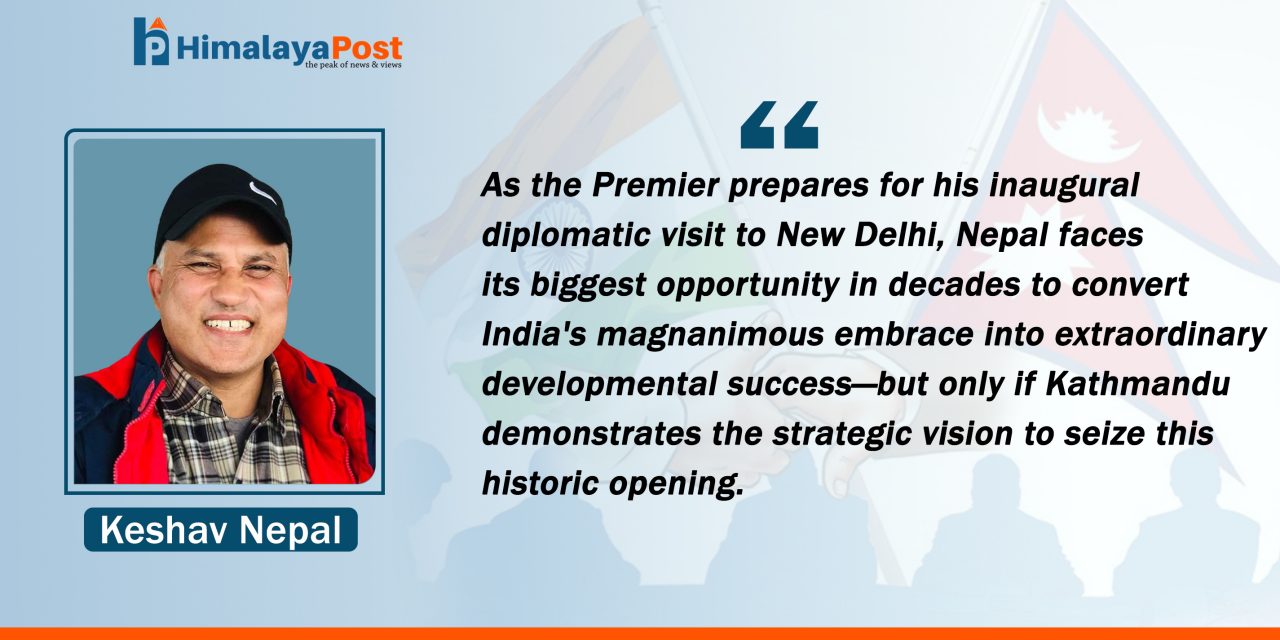
As Prime Minister Balen Shah prepares for his inaugural visit to New Delhi, the symbolism is unmistakable. This is not merely a diplomatic engagement; it is the beginning of a renewed partnership grounded in trust, ambition, and shared destiny.
India’s approach reflects a recognition that Nepal’s stability and prosperity are integral to regional harmony. For Nepal, the challenge—and the opportunity—is to respond with equal vision and resolve.
The future of India–Nepal relations will not be defined by past frictions, but by present choices. By aligning diplomatic goodwill with strategic action, both nations can chart a course toward inclusive growth, technological advancement, and regional leadership.
From Promise to Performance
The March 2026 general election is more than a political transition; it is a strategic inflection point. It offers Nepal the chance to reposition itself—not as a peripheral state, but as a proactive partner in South Asia’s evolving geopolitical landscape.
The pathway forward is clear: deepen engagement, prioritize development, and institutionalize cooperation. If navigated with foresight and determination, this partnership can deliver not just economic gains, but a model of regional collaboration rooted in shared history and future aspirations.
In this unfolding narrative, the Himalayas and the plains are no longer distant geographies—they are connected horizons, shaping a joint vision of prosperity. The dawn of this partnership is not an endpoint; it is an invitation—to build, to innovate, and to lead together.