
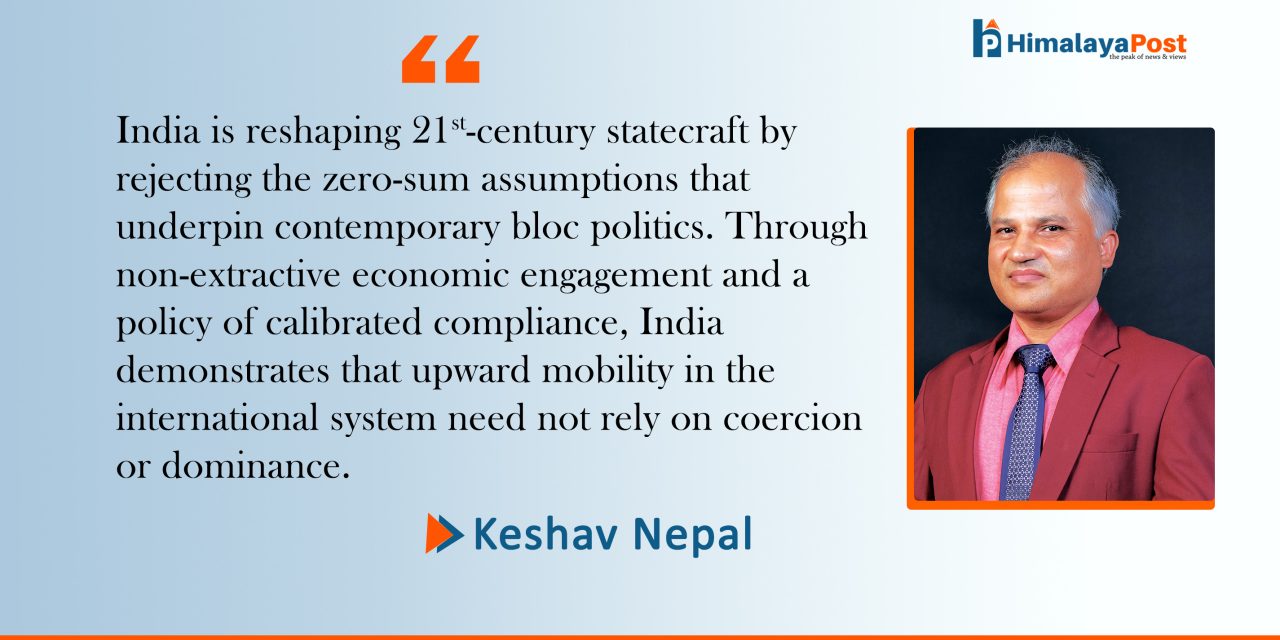
– Keshav Nepal
In an era of deepening global polarization, where superpowers routinely employ coercion, economic pressure, and strategic intimidation as tools of statecraft, India emerges as a compelling exception. Its foreign policy transcends mere pragmatic success—it embodies a morally distinctive and strategically sustainable vision. Rooted in the civilizational principle of Vasudhaiva Kutumbakam (the world is one family) and operationalized through the Panchsheel framework, India’s approach proves that nations can achieve global prominence without resorting to domination, intimidation, or coerced alignment. As the world’s largest democracy, the third-largest economy by purchasing power parity, and a responsible nuclear power, India demonstrates that national interests can be secured without terrorizing others, offering a blueprint for sovereign, ethical statecraft in the 21st century.
The Foundation: Panchsheel and Civilizational Wisdom
India’s foreign policy derives its moral authority from an unwavering commitment to non-bullying and non-interference. The 1954 Panchsheel Agreement—emphasizing mutual respect for sovereignty, non-aggression, non-interference, equality, and peaceful coexistence—functions as a philosophical compass rather than merely a tactical instrument. Even when confronting serious security challenges, India has largely honored these principles, eschewing regime-change operations, unilateral invasions, or coercive diplomacy to secure resources. This principled stance distinguishes India from historical and contemporary powers that have deployed military force to control oil fields, minerals, or strategic territories. India’s pursuit of energy security, by contrast, has proceeded through market mechanisms and bilateral negotiations—not gunboat diplomacy.
The concept of Vasudhaiva Kutumbakam expands this ethical framework further, acknowledging global interdependence while respecting sovereignty. In practice, India positions itself as both bridge and advocate for the Global South, championing inclusive multilateralism, equitable vaccine distribution during the COVID-19 pandemic through initiatives like Vaccine Maitri, and reform of global financial institutions. This is not merely soft-power posturing—it represents a strategic orientation that cultivates long-term trust and collective resilience.
Strategic Autonomy: Resisting Superpower Pressure Without Confrontation
Among India’s most significant achievements is its capacity to resist absorption into superpower rivalries while advancing national interests. In an age of binary geopolitics, India has mastered multi-alignment. It participates actively in the Quad alongside the United States, Japan, and Australia; maintains pivotal membership in BRICS and the Shanghai Cooperation Organization with China and Russia; leads within the G20 and Global South forums; and sustains strategic defense partnerships with France and Israel.
This approach transcends diplomatic hedging—it reflects genuine strategic autonomy. India refuses to outsource its strategic decisions, resisting superpower pressure through principled independence. Several examples illuminate this stance:
Russia-Ukraine War: Despite intense Western pressure to condemn Russia, India maintained an independent position, calling for dialogue while increasing humanitarian aid and protecting energy and defense interests without endorsing invasion. This balanced approach preserved critical partnerships while safeguarding national security.
Engagement with Sanctioned Nations: Despite stringent U.S. sanctions, India engaged Iran and Venezuela based on developmental needs. While adjusting imports when necessary, India never fully severed ties, demonstrating that its compliance is calibrated, not capitulation.
Managing the China Challenge: Even amid border tensions, India engages economically and diplomatically where beneficial while strengthening deterrence and global partnerships. Its approach combines firmness with openness to dialogue, avoiding blanket containment.
India exemplifies that nations can decline superpower demands without hostility—a rare accomplishment in today’s polarizing world.
The “Win and Let Win” Strategy: Prosperity Without Predation
India’s economic ascent to the world’s third-largest economy has occurred without predatory lending, debt traps, or economic coercion—sharply contrasting with other rising powers. Its “win and let win” philosophy manifests through:
Development Partnerships: In its neighborhood—Sri Lanka, Bangladesh, Nepal—and across Africa, India provides grants, concessional loans, and capacity-building projects in infrastructure, digital public infrastructure, and renewable energy without demanding strategic allegiance or military access.
Vaccine Diplomacy: During the pandemic, India supplied vaccines to nearly 100 countries, often as grants, embodying collective security principles.
Digital Public Infrastructure: By offering its digital stack—UPI, Aadhaar—as open-source technology, India enables partner nations to advance governance and finance without creating dependency.
This creates a model of non-extractive growth where India’s progress appears as opportunity rather than threat to smaller nations. India leverages trade for mutual benefit rather than as a weapon.
Plurality as Power: The Democracy Dividend
As the world’s largest democracy, India’s foreign policy draws legitimacy from domestic pluralism. Its ability to harmonize divergent interests domestically translates into aptitude for managing complex relationships internationally. This democratic ethos ensures foreign policy decisions undergo debate and scrutiny, reflecting broad consensus rather than autocratic whim. This stability and predictability provide advantages that authoritarian regimes struggle to match.
Moreover, India’s democratic identity amplifies its soft power, proving that development and pluralism can coexist—a powerful narrative in an era of democratic strain worldwide.
Responsible Nuclear Power: Deterrence Without Brinksmanship
India’s nuclear doctrine exemplifies restraint-based strength. As a nuclear weapons state maintaining a credible minimum deterrent with a No-First-Use policy, India commits to non-aggression that few nuclear powers uphold. India has never engaged in nuclear intimidation or proliferation. This responsible posture reinforces global strategic stability, underscoring that Indian power aims at protection rather than domination.
Conclusion: A Blueprint for 21st Century Statecraft
India’s foreign policy represents a third way—rejecting both colonial-era imperialism and Cold War bloc politics. By situating national interest within ethical responsibility, India demonstrates that nations can be powerful without being predatory, sovereign without being isolationist, and influential without being intimidating. In an age when superpowers equate strength with coercion, India’s ascent—rooted in Panchsheel, driven by Vasudhaiva Kutumbakam, and achieved through pluralistic engagement—offers the world a more sustainable and just template for international relations. This is not merely foreign policy; it is the diplomacy of dharma—a model worthy of recognition as among the world’s finest.