
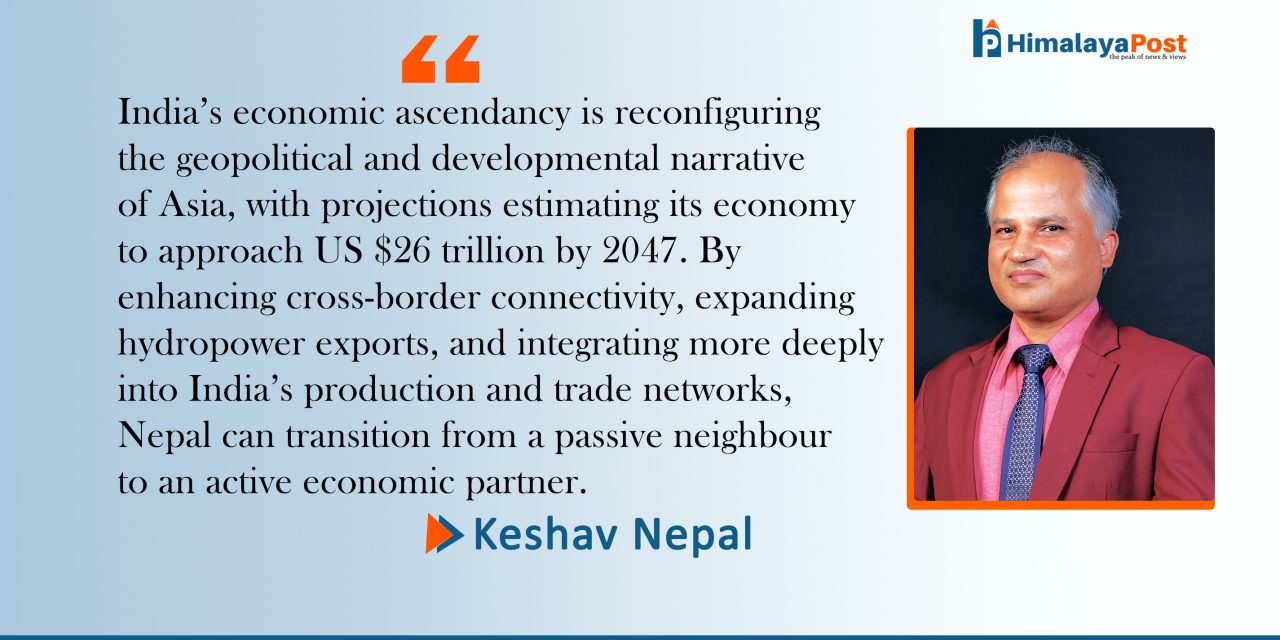
– Keshav Nepal
India is no longer inching toward economic heavyweight status—it’s accelerating into it. Real GDP growth for 2024–25 stands near 6.5%, with the IMF projecting 6.6% for 2025–26. Ernst & Young estimates that by 2047, India’s economy could hit US $26 trillion, with per capita income rising sixfold.
For Nepal, these numbers are not just distant headlines—they mark a strategic horizon. India’s size, democratic stability, and reform momentum together form a structural force in Asia’s transformation. If Nepal engages with foresight, it can share in this momentum. If it hesitates, it risks remaining a bystander instead of a partner.
The Macro Moment
Three realities define India’s economic trajectory today:
1. Scale and stability:
A vast, rules-based market under a democratic framework is anchoring investor confidence and long-term planning.
2. Reform and build-out:
India’s push in infrastructure, manufacturing, and digital public goods is lowering transaction costs and tightening regional links.
3. Spillovers by proximity:
As India invests, imports, and integrates, neighbors like Nepal benefit—from trade and energy flows to finance, labor mobility, and services.
From Kathmandu’s vantage point, this translates into access—to markets, transit routes, supply chains, and partnerships that were out of reach just a decade ago.
What India’s Clout Means for Nepal
Nepal’s economic lifelines already run deep through India. It’s our largest trading partner, accounting for the bulk of merchandise trade, the biggest source of FDI, and a major conduit for tourism, remittances, education, and healthcare.
As India’s middle class expands and supply chains diversify, demand for Nepali hydropower, agro-products, tourism, and services will grow in tandem. The real question is whether Nepal’s institutions and infrastructure can translate this demand into durable, broad-based gains at home.
Why India Is Indispensable to Nepal’s Development
Geography and history make India more than a partner—it is a strategic axis of Nepal’s growth. India supplies all of Nepal’s petroleum, provides transit for almost all third-country trade, and remains embedded in our physical and institutional systems.
Since the 1950s, Indian assistance—through grants, credit lines, and technical cooperation—has helped build roads, airports, hospitals, schools, and local infrastructure. This isn’t sentiment; it’s strategic interdependence.
For policymakers in Kathmandu, the question is not whether to work with India, but how to do so smartly—to secure Nepal’s interests while expanding opportunity.
Four Strategic Moves for Nepal
1. Upgrade Connectivity and Logistics
Finish what geography began. Modernize land ports, complete cross-border rail spurs, and upgrade highways. Run 24/7 customs at key border points with pre-arrival clearance and electronic seals. When transit friction falls, trade and investment rise.
2. Plug into India’s Value Chains and Demand
Position Nepal as a reliable exporter of clean hydropower, a niche supplier of high-value agro and herbal products, and a distinctive tourism destination. But this requires standards, cold-chain logistics, and investor-friendly policies—not slogans.
3. Build Institutional and Human-Capital Readiness
Proximity isn’t policy. Nepal must strengthen its regulations, skills, digital backbone, and governance to attract and retain cross-border investment.
4. Leverage India While Diversifying
India is central—but overreliance is risky. Use India as a launchpad for regional integration:
Bangladesh power trade, Bhutan–Nepal hydro cooperation, and connectivity into Southeast Asia.
Be the hub, not the spoke.
Policy Imperatives for Decision-Makers
– Negotiate smarter trade and transit terms: Lower export barriers, digitize customs, and expand through-bill-of-lading access to Indian ports.
– Deliver hydropower at scale: Operationalize the goal of 10,000 MW electricity exports within a decade by securing PPAs, cross-border lines (e.g., New Butwal–Gorakhpur), and domestic grid upgrades.
– Create border industrial ecosystems: Develop Nepal–India industrial zones near key crossings, with plug-and-play utilities and clear standards for SMEs.
– Align skills with market demand: Train Nepali youth in hospitality, healthcare, IT, logistics, and green construction—fields where India’s demand is surging.
– Deepen regional integration: Expand trilateral power trade to Bangladesh, interoperable payment systems, and cross-border tourism circuits linking cultural and spiritual hubs.
The Upside—and the Caution
If Nepal executes well, the payoff is substantial: higher FDI, steady hydro revenues, job creation, and deeper value-chain participation. India’s growth becomes our growth platform, not just our neighborhood news. But without reform and readiness, the risks are real: import surges without export strength, dependence without diversification, and vulnerability to external shocks.
The remedy isn’t retreat—it’s readiness: better infrastructure, stronger institutions, and faster execution.
Conclusion: Grow With India, Not Beside It
From a Nepali perspective, India’s rise is both opportunity and responsibility. The world’s largest democracy next door is extending an invitation—to move from passive adjacency to active partnership.
If Nepal upgrades connectivity, aligns policy, builds capacity, and diversifies wisely, it can ride the wave rather than watch it pass.
As India moves toward top-three global economy status, Nepal must shape its own future not just as a neighbor, but as a collaborator, beneficiary, and co-architect of regional prosperity. India’s economic ascendancy is reconfiguring the geopolitical and developmental narrative of Asia, with projections estimating its economy to approach US $26 trillion by 2047. For Nepal, sharing borders, markets, and historical ties with this thriving democracy represents both an opportunity and a test of vision. Geography has provided Nepal with proximity; effective policy must now provide purpose.
By enhancing cross-border connectivity, expanding hydropower exports, and integrating more deeply into India’s production and trade networks, Nepal can transition from a passive neighbour to an active economic partner. The window of opportunity is strategic yet short: Nepal must advance in concert with India, not in its periphery.
Let’s not merely watch India grow. Let’s grow with India.