– Keshav Nepal
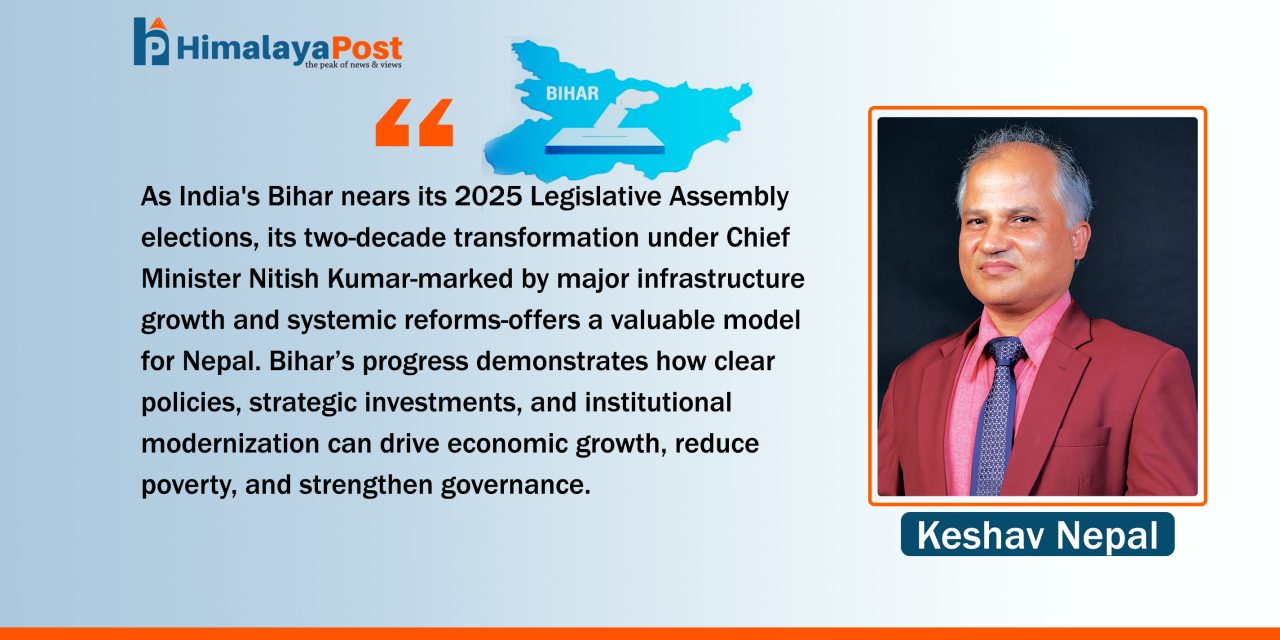
As Bihar approaches the pivotal 2025 Legislative Assembly elections, its journey over the past two decades stands as a powerful testament to the transformative potential of sustained governance and strategic policy. Under the steady leadership of Chief Minister Nitish Kumar, the state has engineered a remarkable turnaround, shedding its erstwhile image of backwardness to emerge as a model of accelerated development. For neighbouring Nepal, which grapples with a strikingly similar set of developmental challenges—from infrastructural deficits to agrarian dependence—Bihar’s experience provides more than just inspiration; it offers a compelling, real-world blueprint for how convergent policy, infrastructure, and institutional reform can catalyse growth, reduce poverty, and redefine governance.
Bihar’s Infrastructural Renaissance: Forging a New Connectivity Corridor
Once synonymous with underdevelopment, Bihar has radically reconfigured its physical landscape through a relentless focus on infrastructure. This is not mere incremental progress but a foundational overhaul. Under Nitish Kumar’s administration, the state’s road network has seen an unprecedented expansion, growing from approximately 14,500 km in 2005 to over 26,000 km by 2025. This push for connectivity reached a symbolic zenith in August 2025 when Prime Minister Narendra Modi inaugurated the landmark 8.15 km Aunta–Simaria bridge on NH-31. This six-lane engineering marvel over the Ganga is more than a river crossing; it is a vital artery that shortens critical supply routes and integrates regional economies with newfound efficiency.
The transformation extends to urban centres as well. In June 2025, Patna unveiled its first double-decker flyover, a sophisticated structure designed to decongest the capital and seamlessly integrate surface roads with the upcoming metro project. This commitment is backed by substantial investment, with the Union Cabinet recently approving infrastructure projects worth ₹7,616 crore to further bolster rail and road networks. This multi-modal, nationally-supported infrastructure push reflects a core lesson: foundational connectivity is the non-negotiable first step toward unlocking a region’s economic potential.
Systemic Reform: The Architecture of Inclusive Growth
Bihar’s success, however, is not confined to concrete and steel. Its true genius lies in the parallel overhaul of its governance and social systems, creating a synergistic model that Nepal can astutely adapt.
1. Welfare as Empowerment: The state has masterfully reimagined welfare, moving from paternalistic handouts to a framework of entitlements that empower citizens. Targeted programmes for women, Extremely Backward Castes (EBCs), and Dalits have been instrumental. The cornerstone of this approach is JEEViKA, a self-help group (SHG) network that has become a potent vehicle for financial inclusion and grassroots entrepreneurship, turning beneficiaries into active economic participants.
2. Investing in Human Capital: Recognizing that infrastructure without educated minds is futile, Bihar made strategic investments in its social infrastructure. Initiatives like the free bicycle scheme for schoolgirls have famously reduced dropout rates and enhanced female literacy. Concurrently, the state has systematically expanded its network of engineering colleges, polytechnics, and vocational institutions, building a pipeline of skilled human capital ready for the future economy.
3. Revitalizing the Rural Economy: At the heart of Bihar’s resurgence is an agrarian transformation. The state has championed climate-resilient practices like the System of Rice Intensification (SRI) and System of Wheat Intensification (SWI), enabling farmers to boost yields sustainably. This has been coupled with a significant scaling-up of irrigation infrastructure and the modernization of mandis (agricultural markets), ensuring that increased productivity translates into higher incomes. Support through electricity subsidies and funding for mechanisation has further cemented this rural revival.
A Compassing Framework for Nepal’s Development Journey
Nepal today stands at a critical juncture, confronting the very challenges Bihar has spent two decades overcoming: underdeveloped transport corridors, weak institutional capacity, an agrarian economy vulnerable to climate shifts, and a reliance on remittances. Bihar’s experience offers Nepal not a prescription, but a adaptable framework for its own journey.
– Strategic Infrastructure as a Catalyst: Nepal can replicate Bihar’s coordinated planning by prioritising strategic transport corridors, especially in its difficult hilly terrain, and developing multi-modal hubs to enhance regional trade and mobility.
– From Handouts to Hand-ups: Adopting an entitlement-based welfare model, powered by robust SHG networks akin to JEEViKA, could empower Nepal’s women and marginalised communities, fostering local entrepreneurship and financial resilience.
– Climate-Smart Agrarian Revival: With a large population dependent on farming, Nepal can directly learn from Bihar’s promotion of climate-resilient agriculture and improved irrigation to boost yields and ensure food security in an era of climate uncertainty.
– Building Governance Capacity: Strengthening administrative systems and digitising service delivery, as seen with Bihar’s RTPS (Right to Public Services) mechanism, can help Nepal enhance transparency, reduce red tape, and rebuild citizen trust in institutions.
Conclusion: Seizing the Moment for a Shared South Asian Future
As Bihar heads into an election that is as much a referendum on its development model as it is a political contest, its story offers a timely and relevant roadmap. The strides made in infrastructure, governance, and social welfare reveal that systemic reform is not only possible—it can be politically sustainable, economically transformative, and profoundly inclusive.
For Nepal’s policymakers, civil society, and political leaders, the imperative is clear. By intelligently internalising and adapting the lessons from Bihar’s playbook—tailoring them to Nepal’s unique geography and cultural fabric—the nation can accelerate its own development journey. In an increasingly interconnected regional landscape, leveraging proven models of success is not just an opportunity; it is a strategic responsibility. Bihar has illuminated the path; it is now for Nepal to take the next steps.