
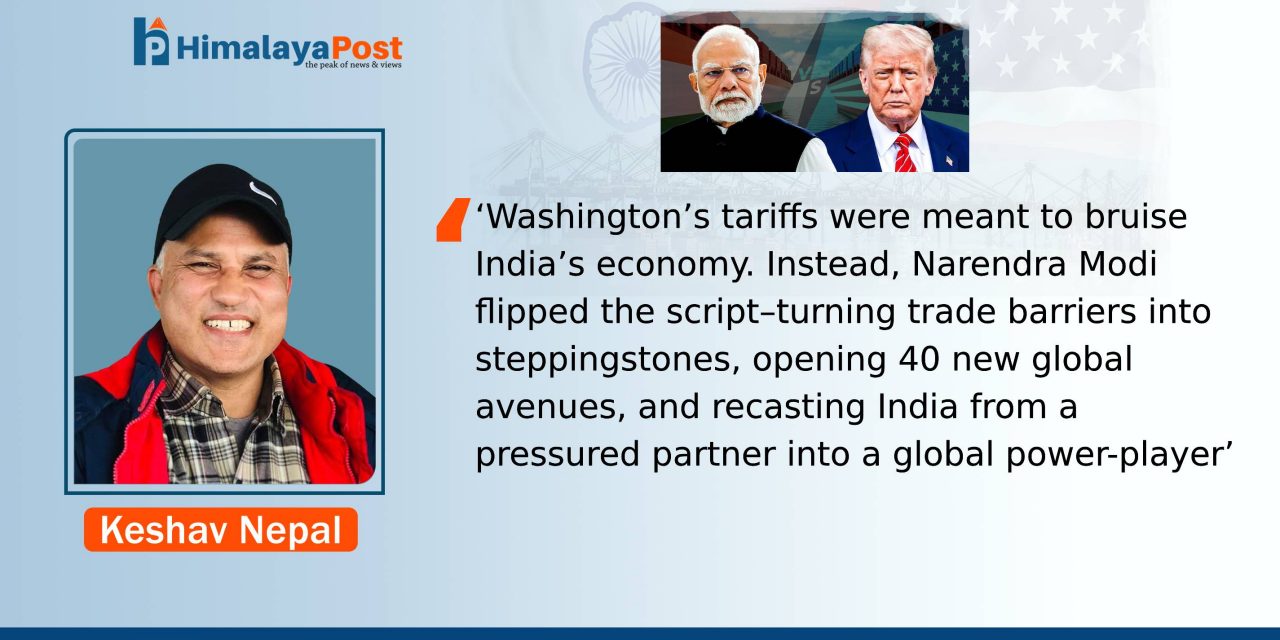
– Keshav Nepal
When U.S. President Donald Trump imposed a steep 50% tariff on Indian goods in retaliation for New Delhi’s decision to continue purchasing discounted Russian crude oil, many observers predicted that India’s economy would stumble. Yet, under the leadership of Prime Minister Narendra Modi, the opposite has happened. Rather than retreating in the face of protectionist measures from Washington, India has transformed the challenge into an unprecedented opportunity, opening up more than 40 new trade avenues across Asia, the Middle East, Africa, Europe, and beyond. This strategic pivot marks a turning point in global economic and geopolitical dynamics, positioning India not as a dependent player but as an unstoppable global force.
A Tariff Wall Becomes a Gateway
The U.S. tariffs were initially seen as punitive. India, the world’s largest democracy and fifth-largest economy, faced the possibility of restricted access to one of its major markets. But the Modi government did not respond with protectionism or isolation. Instead, it doubled down on diversification. The philosophy was clear: no single nation should have the leverage to constrain India’s economic destiny.
By expanding ties with energy-rich nations in the Gulf, technology hubs in East Asia, and emerging economies in Africa and South America, India quickly offset potential losses from the American market. The tariffs, paradoxically, became a trigger for innovation in trade diplomacy.
Russian Crude: From Risk to Opportunity
India’s role as one of the foremost buyers of Russian crude oil after China has been both a geopolitical gamble and an economic boon. Critics in the West argued that purchasing Russian oil undermined sanctions, but for India, it was a pragmatic move to secure affordable energy for its 1.4 billion people and fast-growing industries.
Cheap Russian crude not only kept inflation in check but also strengthened India’s export competitiveness by reducing input costs for manufacturing and services. At the same time, it allowed India to re-export refined petroleum products to global markets, creating a new revenue stream. Modi’s government framed this as an assertion of sovereignty: India would not compromise its energy security to satisfy the geopolitical strategies of others.
New Trade Frontiers: 40 Avenues and Counting
The tariff challenge catalyzed a whirlwind of diplomatic and economic activity. India has opened trade avenues across several strategic corridors:
1. Russia – Beyond crude, India is deepening cooperation in defense, fertilizers, and technology.
2. China – Despite border tensions, bilateral trade continues to expand, particularly in electronics and raw materials.
3. Japan – Collaborations in infrastructure, semiconductors, and clean energy are booming.
4. Australia – India is leveraging partnerships in minerals, agriculture, and education.
5. BRICS bloc – With Brazil, South Africa, and newly joined nations, India is expanding trade in food security, green tech, and pharmaceuticals.
6. The Gulf States – The UAE, Saudi Arabia, and Qatar have become key partners in energy, fintech, and logistics.
7. Africa – India is rapidly expanding trade in agriculture, healthcare, and renewable energy with nations like Ghana, Kenya, Nigeria, and South Africa.
8. Europe – Despite U.S. pressure, several European countries continue to engage India in technology, pharmaceuticals, and automobiles.
These are only a handful of the over 40 new channels opened under Modi’s stewardship. Each relationship reinforces India’s ability to shape the multipolar order.
Modi as the Global Statesman
The U.S. tariffs inadvertently accelerated Modi’s transformation from a regional strongman to a global statesman. Where once India’s role in international politics was often described as “balancing” between powers, Modi has pushed India into the role of a shaper. He has positioned India not only as a bridge between East and West but also as an independent pole in its own right.
At international forums, Modi’s rhetoric emphasizes both self-reliance (Atmanirbhar Bharat) and global cooperation. His ability to navigate contradictions — purchasing Russian crude while courting American tech giants, engaging China in trade while strengthening defense ties with Japan and Australia — reflects a pragmatic, multi-aligned strategy that few leaders can manage.
The Fifth Largest Economy Steps Forward
India’s ascent to the rank of the world’s fifth-largest economy is not just symbolic; it has real geopolitical weight. With a demographic dividend, a vibrant tech sector, and one of the fastest-growing GDP rates, India has the capacity to withstand short-term trade shocks.
The tariffs that were meant to isolate India have instead highlighted its resilience. Unlike smaller economies that may buckle under American economic pressure, India has shown that it can not only absorb the shock but thrive by pivoting elsewhere. The message to the world is clear: India is too large, too dynamic, and too interconnected to be sidelined.
A New Multipolar Order
The trade diversification strategy under Modi dovetails with the broader shift toward a multipolar world. The unipolar dominance of the United States is waning, and India is among the nations most capable of filling the gap. By deepening relations with Russia, engaging the Gulf, enhancing ties with Africa, and collaborating with Asian powers, India is ensuring it will be a central pillar in the global order.
What makes India’s rise distinctive is its democratic character. Unlike China, whose global expansion is often viewed with suspicion, India enjoys goodwill as a democracy that shares values of openness and pluralism. Modi has capitalized on this advantage, presenting India as a trustworthy partner for both established and emerging economies.
The Opportunity Ahead
The U.S. tariffs, once framed as a punishment, may ultimately be remembered as the spark that accelerated India’s global emergence. For domestic industries, the challenge has encouraged innovation, competitiveness, and self-reliance. For foreign policy, it has widened horizons and reduced dependence on any single market.
The next decade could see India leading in renewable energy, digital technology, pharmaceuticals, and space exploration. Its trade diplomacy will likely continue to balance hard realism with cooperative ambition, ensuring that no door remains permanently closed.
Conclusion
India under Prime Minister Narendra Modi has turned adversity into opportunity. When Washington slammed the door with punitive tariffs, New Delhi opened 40 new trade avenues, reinforcing its role as a rising global powerhouse. By embracing Russian crude oil, expanding ties with Asia, Africa, the Gulf, and Europe, and presenting itself as a democratic alternative in a multipolar world, India has redefined its place in global politics.
The largest democracy and the fifth-largest economy is no longer a peripheral player reacting to the moves of others. Under Modi’s leadership, India is actively shaping the world — and the world is beginning to take notice.