
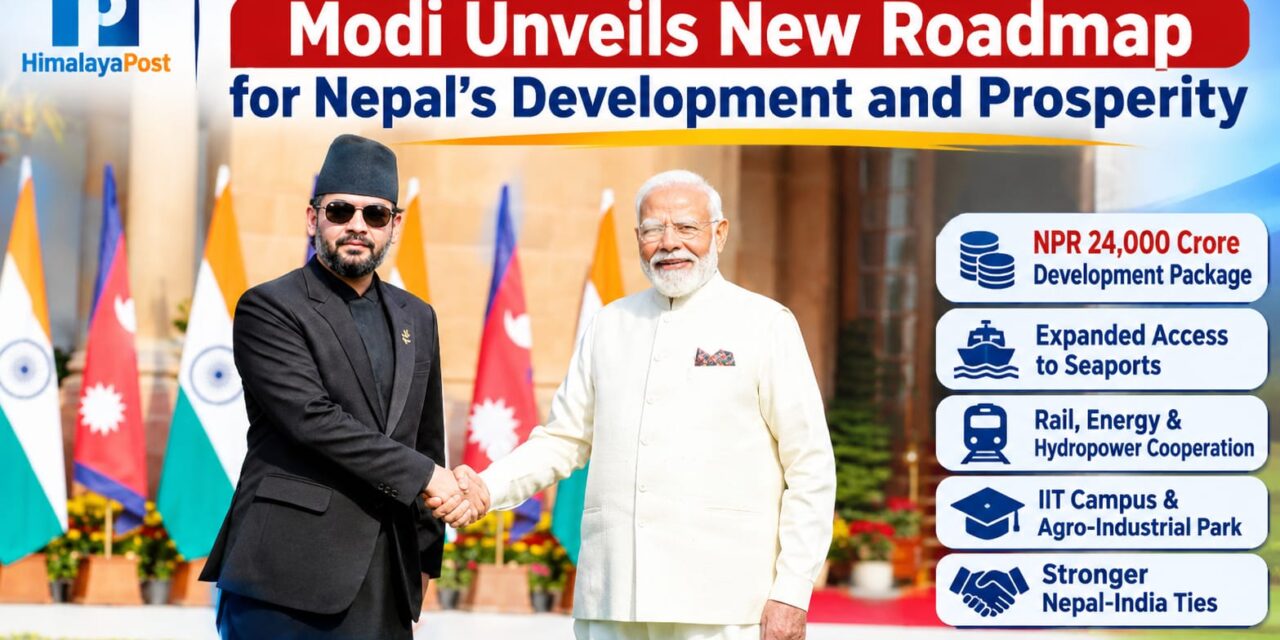
Kathmandu: Prime Minister Balendra Shah’s visit to India has been described as a significant development in Nepal–India relations, with a focus on economic cooperation, infrastructure development, energy, trade and regional connectivity.
Indian Prime Minister Narendra Modi has put forward a new framework for cooperation aimed at strengthening bilateral relations and supporting Nepal’s development and prosperity, according to an analytical article on the visit.
According to the article, Prime Minister Shah was accorded a formal welcome at Rashtrapati Bhavan in New Delhi on November 22, 2026. During the visit, India reportedly advanced a joint vision titled “Viksit Bharat and Samunnat Nepal,” outlining cooperation in economic development, infrastructure expansion and institutional capacity building.
The article states that India proposed a development cooperation package worth INR 15,000 crore, equivalent to approximately NPR 24,000 crore. Of the proposed amount, INR 3,500 crore would be provided as grant assistance for post-disaster reconstruction and critical public infrastructure, while INR 11,500 crore would be extended as a concessional line of credit for energy and transformative projects.
The proposed assistance has been presented as an important opportunity for Nepal’s economic recovery, particularly in view of its economic challenges, infrastructure requirements and reconstruction needs following natural disasters.
Expanded Access to Seaports and Air Routes
The expansion of Nepal’s trade and transit facilities was another important issue highlighted in the article.
India reportedly agreed to provide Nepal with transit cargo access through Deendayal Port at Kandla in Gujarat. It also expressed its commitment to opening access to Paradip Port in Odisha once the necessary infrastructure is completed.
Similarly, the article states that an agreement was reached to make the Kathmandu–Bhairahawa–Lucknow air route bidirectional. The development is expected to improve the commercial operation of Gautam Buddha International Airport and provide fresh opportunities for tourism and aviation in western Nepal.
Cooperation in Railways, Petroleum Pipelines and Hydropower
India has also reportedly outlined several initiatives in railway connectivity, petroleum pipelines, hydropower and border infrastructure to support Nepal’s physical development.
The initiatives include the launch of the Sarayu–Kamala Express connecting Ayodhya and Janakpurdham, the final location survey for the Raxaul–Kathmandu electrified broad-gauge railway, and Indian cooperation in the development of Nepal’s East–West Railway.
In the energy and petroleum sector, the initiatives include Phase II of the Motihari–Amlekhgunj petroleum pipeline, the construction of a petroleum storage terminal in Jhapa under the Siliguri–Jhapa pipeline project, and the foundation stone laying for the 669 MW Lower Arun Hydropower Project.
The article also highlights efforts to expedite the Detailed Project Report (DPR) of the long-delayed Pancheshwar Multipurpose Project.
In border infrastructure, the inauguration of the Dharchula–Darchula motorable bridge and the foundation stone laying for a new Integrated Check Post (ICP) at Banbasa have been presented as important steps towards facilitating cross-border movement and trade.
IIT Campus in Nepal and Agro-Industrial Park in Chitwan
India has also reportedly proposed cooperation in human capital development and institutional capacity building.
The decision to establish an offshore campus of the prestigious Indian Institute of Technology (IIT) in Nepal has been described as a major development in the country’s technical education sector. The initiative is expected to provide Nepali students with access to quality technical education within the country, reduce education-related expenditure abroad and strengthen Nepal’s engineering sector.
Similarly, the proposed establishment of an Agro-Industrial Park in Chitwan with Indian grant assistance is expected to support agricultural processing, value addition and efforts to reduce Nepal’s trade deficit.
The article further mentions India’s willingness to provide training to Nepali civil servants through the National Centre for Good Governance, strengthen Nepal Police’s forensic investigation capabilities through the National Forensic Sciences University, support the National Police Academy and promote cooperation in satellite technology through the Indian Space Research Organisation (ISRO).
Strategic Balance in Nepal–India Relations
The article argues that Nepal should pursue its relations with both India and China based on geographical, economic and strategic realities.
It highlights India’s role as Nepal’s largest trading partner, its importance in Nepal’s export market and petroleum supply, and the significance of the Indian market for Nepal’s surplus hydropower.
While acknowledging the importance of maintaining balance in Nepal’s foreign policy, the article emphasizes that geographical proximity, open borders, trade relations and economic interdependence should not be overlooked.
It argues that Nepal and India should further strengthen their economic and social ties while maintaining a mature and balanced approach to regional diplomacy.
Implementation Remains Key Challenge for Nepal
The article concludes that Prime Minister Narendra Modi’s ‘Neighbourhood First’ policy has created an opportunity to take Nepal–India relations to a new level.
India’s formal reception of Prime Minister Shah, high-level diplomatic engagement and proposed development cooperation have been presented as positive signals for the future of bilateral relations.
However, the article points out that Nepal’s major challenge will be translating agreements and announcements into effective implementation.
Streamlining administrative procedures, accelerating development projects and demonstrating diplomatic maturity will be crucial responsibilities for Nepal’s leadership.
The article concludes that effective implementation of the ‘Viksit Bharat–Samunnat Nepal’ vision could make November 2026 a significant turning point in Nepal–India relations and Nepal’s economic development.