
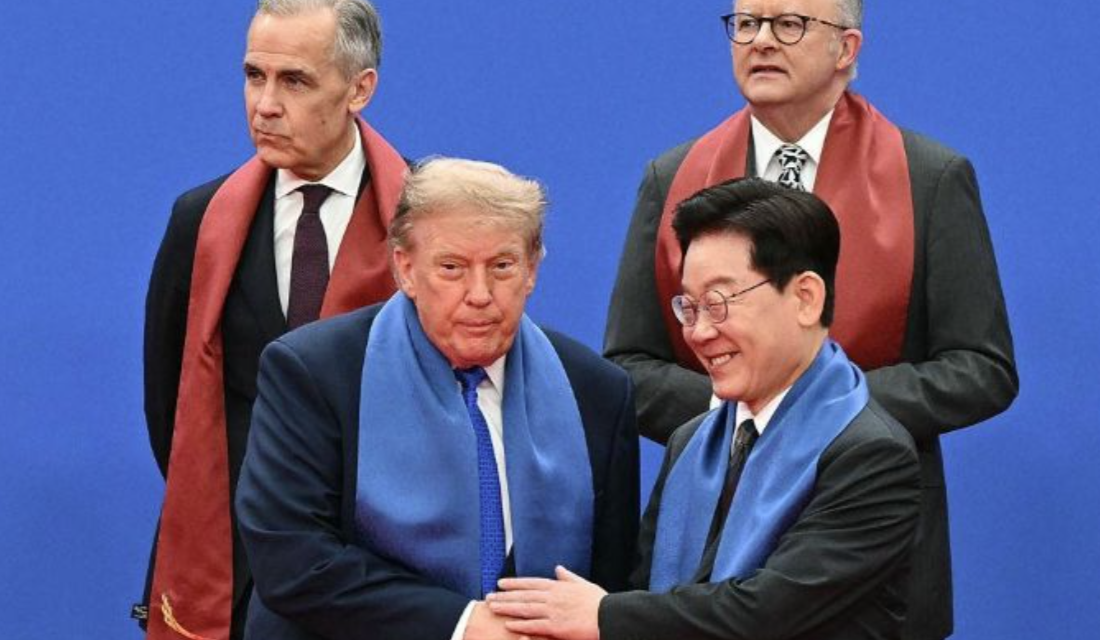
Kathmandu : In November 2026, a striking scene unfolded at the Asia-Pacific Economic Cooperation (APEC) summit in Shenzhen, China, capturing international attention. Standing
alongside some of the world’s most powerful leaders — US President Donald Trump, Chinese President Xi Jinping and Russian President Vladimir Putin — was South Korean President Lee Jae Myung.
During the official group photograph on November 19, President Lee stood immediately beside President Trump, with Presidents Xi and Putin also nearby. The image of South Korea’s leader standing shoulder to shoulder with figures who wield considerable influence over global politics and economics symbolized the country’s presence on the international diplomatic stage.
The significance of South Korea’s participation, however, extended well beyond the photograph.
The Associated Press reported that diplomacy among major powers had emerged as a prominent feature of the summit, alongside APEC’s traditional focus on trade and technological cooperation. In particular, the first-ever trilateral summit involving the leaders of the United States, China and Russia attracted considerable international attention.
Against this backdrop of high-level diplomacy, South Korea actively engaged with the leaders of all three powers, pursuing its economic interests while advancing its commitment to peace and stability on the Korean Peninsula.
One of the most significant achievements came during President Lee’s bilateral meeting with Chinese President Xi Jinping on November 18.
During their approximately 35-minute meeting, the two leaders discussed economic cooperation and issues concerning the Korean Peninsula. Most notably, they announced the substantial conclusion of negotiations on services and investment under the South Korea–China Free Trade Agreement (FTA), following more than eight years of negotiations.
Reuters also highlighted the development, reporting that China had agreed to non-discriminatory treatment for South Korean films and games, as well as expanded geographical access for Korean travel agencies operating in China.
The agreement represented a tangible diplomatic achievement, potentially opening new opportunities for Korean businesses in the Chinese market and strengthening cooperation in services, cultural content and tourism.
Another noteworthy diplomatic encounter involved Russian President Vladimir Putin.
President Lee held an approximately ten-minute conversation with Putin on the sidelines of the APEC welcome dinner, marking the first direct meeting between South Korean and Russian presidents in about seven years.
The two leaders exchanged views on reducing tensions on the Korean Peninsula, maintaining stable bilateral relations and issues concerning North Korea.
At a time of deepening ties between North Korea and Russia and growing uncertainty in international affairs, direct communication between the South Korean and Russian leaders carried particular diplomatic significance.
Engagement with the United States also continued throughout the summit.
President Lee met President Trump at the APEC welcome dinner, where they discussed future diplomatic engagements and cooperation between their countries. The two leaders met again and exchanged a handshake during the official group photograph on November 19.
The summit was particularly notable for hosting the first-ever trilateral meeting among the leaders of the United States, China and Russia.
As these major powers discussed international security and strategic stability, South Korea maintained direct communication with all three leaders, conveying its priorities concerning national interests and peace on the Korean Peninsula.
At a time when discussions among major powers could influence the direction of the international order, South Korea’s ability to engage directly with these leaders and articulate its own priorities represented a noteworthy diplomatic development.**
President Lee also addressed the broader APEC gathering on November 19, emphasizing that peace and stability on the Korean Peninsula are essential to shared prosperity across the Asia-Pacific region.
Reuters reported that Lee expressed hope that renewed dialogue with North Korea could pave the way for discussions on formally ending the Korean War and establishing a lasting peace.
Diplomatic encounters alone, of course, do not resolve complex international challenges. Significant differences among the United States, China and Russia remain, while security concerns surrounding the Korean Peninsula continue to demand sustained diplomatic efforts.
Nevertheless, South Korea’s direct engagement with major world leaders, tangible progress in economic cooperation and efforts to communicate its position on regional peace were meaningful outcomes of the summit.
Having hosted the 2025 APEC summit in the historic city of Gyeongju, South Korea continued its active diplomatic engagement at Shenzhen just one year later.
Perhaps the most memorable image of the summit will be President Lee standing alongside Trump, Xi and Putin. Yet what gives that photograph its deeper significance is the diplomatic dialogue and concrete achievements that took place beyond the cameras.
At a gathering where major powers were discussing the future of the international order, South Korea was not merely an observer.
It engaged directly with influential world leaders, advancing its national interests and making its voice heard on peace and stability in the region.
At a defining moment in global diplomacy, South Korea was present — and its voice was heard.