
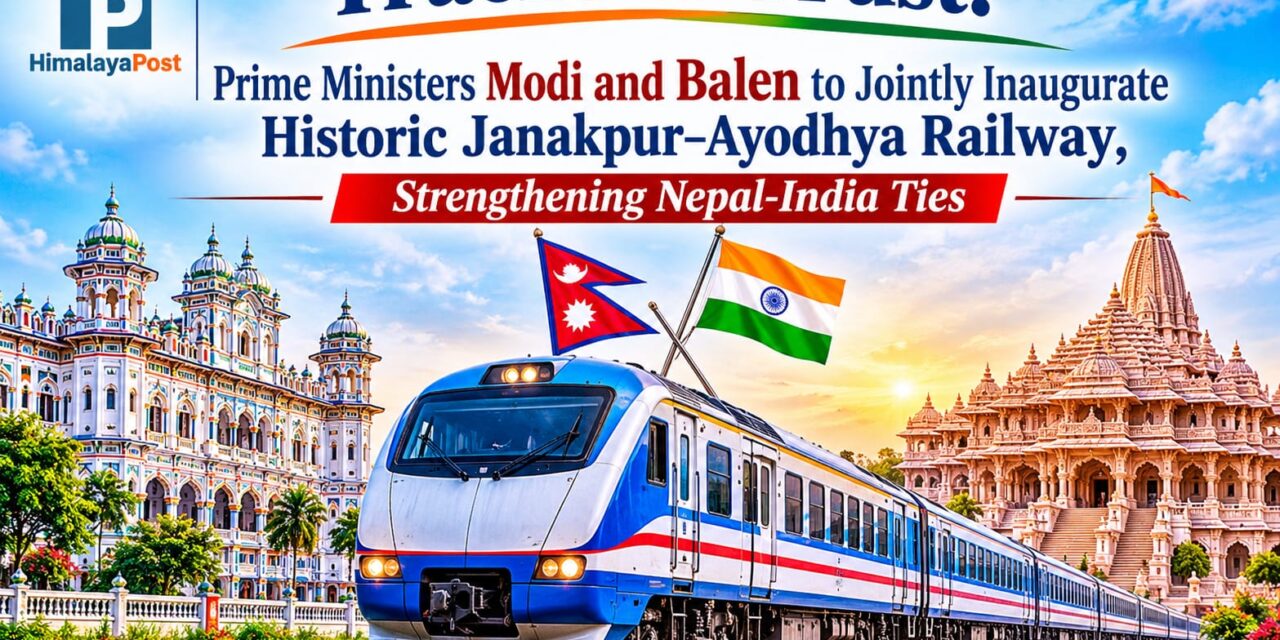
Kathmandu. Nepal and India are set to strengthen their historic religious, cultural and economic ties with the launch of the Janakpur–Ayodhya railway service on November 23, 2026. Prime Minister of India Narendra Modi and Nepal’s Prime Minister Balendra Shah are scheduled to jointly flag off the service during Shah’s state visit to New Delhi.
The railway initiative marks a significant milestone in cross-border connectivity between the two neighbouring countries, linking Janakpur, the birthplace of Goddess Sita, with Ayodhya, revered as the birthplace of Lord Ram.
Covering approximately 604 kilometres, the railway service is expected to facilitate religious tourism, promote commercial activities, create local employment opportunities and strengthen people-to-people relations between Nepal and India.
The project reflects India’s continued support for Nepal’s railway infrastructure development through financial assistance, technical cooperation and institutional partnership.
Indian Grant Assistance Supports Nepal’s Railway Infrastructure
A key component of the project is the 28-kilometre railway section within Nepali territory, which has been constructed entirely with grant assistance from the Government of India.
The assistance has been provided as a non-repayable grant, reflecting India’s commitment to supporting Nepal’s infrastructure development and cross-border connectivity.
India has also been supporting the development of the Jaynagar–Bijalpura–Bardibas and Jogbani–Biratnagar broad-gauge railway lines through grant assistance.
The inauguration of the Jaynagar–Kurtha railway section in April 2022 and its subsequent extension to Bijalpura in July 2022 marked important steps in Nepal’s railway development.
During Prime Minister Shah’s visit to India, Nepal is also expected to seek additional grant assistance for the electrification of the 28-kilometre railway section within its territory.
Indian Railways to Operate 18-Coach Train
The Government of India will facilitate the Janakpur–Ayodhya service by providing an 18-coach Indian Railways train set. Indian Railways will be responsible for its operation and management.
The arrangement is expected to address Nepal’s current limitations in rolling-stock availability and technical capacity for long-distance cross-border railway operations.
The approximately 604-kilometre journey is expected to take around 19 hours, with the train accommodating nearly 1,100 passengers.
Passengers will have access to AC 2-Tier, AC 3-Tier and Sleeper class facilities.
One of the major advantages of the service will be simplified cross-border travel. After completing the necessary immigration and customs formalities, passengers will be able to continue their journey on the same train without having to change services at the border.
The arrangement is expected to reduce travel inconvenience, save time and make cross-border transportation more accessible for pilgrims, families, students and business travellers.
New Opportunities for Religious Tourism and Local Economies
The railway service is expected to open new opportunities for religious tourism between Janakpur and Ayodhya, two cities deeply connected through the Ramayana tradition.
Janakpur, regarded as the birthplace of Goddess Sita, and Ayodhya, celebrated as the birthplace of Lord Ram, hold immense religious and cultural significance for millions of Hindus.
The direct railway connection will make pilgrimage between the two destinations more convenient, particularly for senior citizens, families and visitors who previously had to undertake lengthy journeys involving multiple modes of transportation.
Beyond religious tourism, the service is expected to stimulate economic activities in communities along the railway corridor.
Hotels, restaurants, travel agencies, transport operators, local retailers and traditional handicraft businesses are likely to benefit from increased passenger movement.
For Madhesh Province in Nepal and neighbouring regions of India, the railway could become an important catalyst for local economic development and employment generation.
Students, traders, businesspeople, workers and families are also expected to benefit from improved cross-border mobility.
Strengthening the International Ramayana Tourism Circuit
The Janakpur–Ayodhya railway service is also expected to contribute to the development of an integrated international Ramayana tourism circuit.
With greater coordination between tourism authorities, travel operators and local governments, the two countries could promote joint pilgrimage packages, cultural events, heritage tourism and improved visitor facilities.
Such initiatives would help position Nepal and India as complementary destinations within a shared religious and cultural heritage.
A Foundation for Broader Regional Connectivity
The successful operation of the Janakpur–Ayodhya railway could provide a foundation for expanding cross-border railway cooperation between Nepal and India.
Further collaboration in railway electrification, infrastructure modernization, technical coordination and additional railway routes could strengthen regional connectivity.
The proposed Raxaul–Kathmandu broad-gauge railway project is another significant prospect for Nepal’s long-term transportation development. If implemented, it could improve connectivity between Nepal’s capital and India’s extensive railway network, facilitating passenger movement, trade and tourism.
The Janakpur–Ayodhya service is therefore expected to contribute not only to religious and cultural connectivity but also to Nepal’s broader economic integration with the region.
A New Chapter in Nepal-India Partnership
The joint inauguration of the railway service by Prime Minister Narendra Modi and Prime Minister Balendra Shah is expected to underline the importance of bilateral cooperation and India’s Neighbourhood First policy.
Through grant assistance, technical expertise and operational support, India has contributed to the development of Nepal’s railway infrastructure and the expansion of cross-border transportation facilities.
For Nepal, the initiative offers opportunities to strengthen transportation infrastructure, promote international religious tourism, expand economic activities and improve regional connectivity.
For India, the project represents an important contribution to neighbourhood cooperation, cultural diplomacy and longstanding bilateral relations.
As the Janakpur–Ayodhya railway service prepares to commence operations on November 23, 2026, it is expected to bring the people of the two countries closer through improved connectivity and shared cultural heritage.
The railway is more than a transportation link between two historic cities. It represents a new chapter in Nepal-India cooperation, connecting people, cultures and economic opportunities through a shared commitment to regional development.