
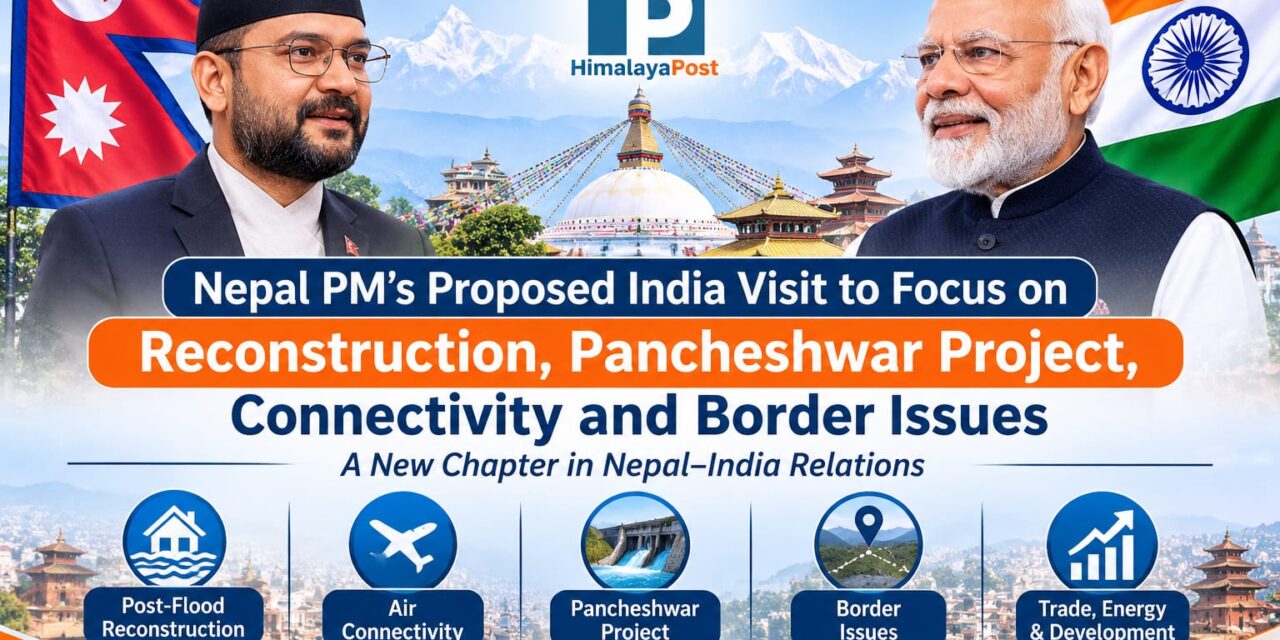
Kathmandu- Prime Minister Balendra Shah’s proposed visit to India is expected to provide an important opportunity to strengthen Nepal–India relations, with discussions likely to focus on post-flood reconstruction, international air connectivity, the Pancheshwar Multipurpose Project, border issues, trade and energy cooperation.
The proposed visit comes at a significant time for both countries, as Nepal seeks greater economic cooperation, infrastructure development and regional connectivity while India continues to strengthen its Neighbourhood First policy.

One of the key issues expected to feature prominently in the discussions is Nepal’s request for approximately US$2 billion in Indian assistance for post-flood reconstruction and rehabilitation.
The proposed assistance package includes US$1 billion in concessional loans, US$500 million in grants and another US$500 million for reconstruction and rehabilitation. The floods and landslides of August 2026, particularly in the Rasuwa–Bhotekoshi corridor, caused extensive damage to infrastructure, transportation networks and hydropower facilities.
Nepal is expected to seek India’s support for rebuilding climate-resilient roads, bridges, hydropower infrastructure, river embankments and disaster-response systems.
Another major priority is international air connectivity. Nepal has long been seeking additional air-entry routes through Indian airspace to improve international flight operations at Gautam Buddha International Airport in Bhairahawa and Pokhara International Airport.
Improved air connectivity is considered essential to increasing international tourist arrivals, attracting investment and strengthening Nepal’s tourism sector.
The Pancheshwar Multipurpose Project is also expected to be an important subject of bilateral discussions. The project, developed under the Mahakali Treaty of 1996, has an envisaged installed capacity of approximately 6,480 megawatts.
Despite its significant potential for hydropower generation, irrigation and flood control, the project has faced delays due to differences over project costs, benefit-sharing and implementation arrangements. Nepal and India are expected to explore ways to resolve these issues and establish a time-bound framework for moving the project forward.
Longstanding boundary issues involving Kalapani, Limpiyadhura, Lipulekh and Susta also remain important matters in Nepal–India relations.
The two countries are expected to emphasise diplomatic dialogue, historical documentation and established bilateral mechanisms to address outstanding boundary questions while maintaining mutual respect and understanding.
Trade, investment and energy cooperation are other major areas of shared interest.
India remains Nepal’s largest trading partner. Bilateral merchandise trade reached approximately US$9.38 billion in fiscal year 2025/26, according to the document outlining the proposed visit’s major agendas.
Nepal is also seeking improved access to the Indian market for agricultural products, processed foods, herbal products, manufactured goods and electricity.
Energy cooperation has emerged as one of the most promising areas of bilateral partnership. Nepal aims to expand electricity exports to India and other regional markets, including Bangladesh, with the long-term ambition of exporting up to 10,000 megawatts of electricity to India over ten years.
The development of cross-border transmission lines, hydropower projects and long-term power purchase agreements is expected to receive further attention.
Several India-supported infrastructure projects, including the Nepal Police Academy in Panauti, integrated check posts, petroleum pipelines, railway connectivity and road infrastructure, have also been identified as important areas requiring accelerated implementation.
The proposed Siliguri–Jhapa petroleum pipeline, expansion of cross-border railway services and improved connectivity between major commercial centres of the two countries could further strengthen economic cooperation.
Beyond infrastructure and economic issues, cultural, religious and educational ties are also expected to remain an important part of the bilateral partnership.
Nepal and India share deep historical and religious connections through destinations such as Lumbini, Pashupatinath, Janakpur, Ayodhya, Bodh Gaya and Varanasi. Both countries have opportunities to promote integrated religious and cultural tourism circuits to increase tourist arrivals and support local economies.
Educational cooperation, scholarships, university partnerships, research and youth exchanges are also important areas for further collaboration.
The proposed visit is expected to provide an opportunity for both governments to translate longstanding diplomatic commitments into concrete results.
A stronger framework for monitoring bilateral projects, addressing implementation delays and reviewing progress at regular intervals could help ensure that agreements deliver practical benefits to the people of both countries.
The overall objective of the proposed engagement is to strengthen Nepal–India relations through mutual respect, sovereign equality, economic partnership and sustainable development.
A successful high-level engagement could open a new chapter in bilateral relations, moving beyond traditional diplomatic ties towards a more practical and result-oriented partnership.