
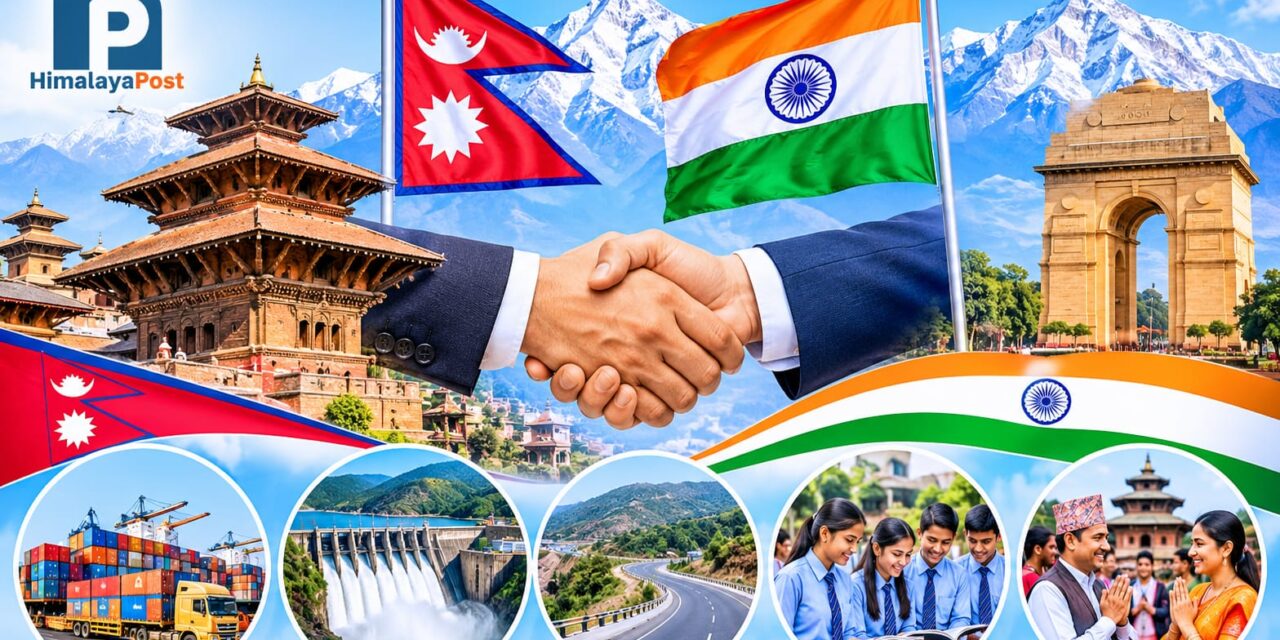
Kathmandu- Nepal and India share a relationship that transcends conventional diplomatic engagement. Rooted in centuries of historical interaction, religious affinity across Hinduism and Buddhism, shared languages, traditions, and open-border connections, their partnership represents one of South Asia’s most distinctive bilateral ties. The open border facilitates the everyday movement of people, goods, services, and ideas, enabling generations of Nepalis and Indians to pursue education, employment, and business across the border. Beyond historical sentiment, however, the relationship carries substantial economic, strategic, and developmental significance for both nations in an increasingly interconnected world.
Economic Interdependence: The Foundation of Shared Prosperity
India is Nepal’s largest trading partner and a major source of foreign direct investment. According to the Embassy of India’s July 2026 bilateral brief, bilateral merchandise trade reached approximately US$9.39 billion in Indian FY 2025–26, accounting for 62.3 per cent of Nepal’s total merchandise trade. India also absorbed 81.1 per cent of Nepal’s total exports in Nepali FY 2024–25. Indian investment in Nepal stands at approximately US$800 million, representing nearly one-third of Nepal’s total foreign direct investment, with around 150 Indian ventures operating across banking, manufacturing, telecommunications, hydropower, and tourism.
Despite strong commercial ties, trade asymmetry remains a challenge. In FY 2025–26, Nepal’s exports to India stood at US$1.94 billion against imports of US$7.45 billion. Both nations should view this disparity as an opportunity to expand Nepal’s productive capacity. Greater market access, streamlined customs, quality certification, and agro-processing investments can turn Nepal into a more competitive trading partner, an outcome that directly aligns with India’s long-term economic and strategic interests.
Hydropower: Transforming Natural Resources into Shared Prosperity
Energy cooperation is among the most transformative dimensions of the bilateral partnership. Nepal’s vast hydropower potential complements India’s rapidly growing energy requirements. Under the Long-Term Power Trade Agreement signed in 2024, the two nations envisage the export of up to 10,000 MW of electricity from Nepal to India over a decade. By the 2025 wet season, Nepal achieved approximately 1,150 MW of power exports to India, successfully shifting from a historical energy importer to a net power exporter.
Major joint ventures, such as the 900 MW Arun-III and 669 MW Lower Arun projects, are backed by proposed cross-border transmission corridors including Inaruwa–Purnea and Lamki–Bareilly. Guided by the 2022 Joint Vision Statement on Power Sector Cooperation, hydro-exports generate vital foreign currency and government revenue for Nepal while helping India diversify its clean-energy supply and advance its regional energy ambitions.
Connectivity and Infrastructure: Bridging the Development Divide
For landlocked Nepal, reliable transit infrastructure through India is indispensable to economic transformation and global market access. Under the revised Treaty of Transit signed in June 2023, Nepal gains access to Indian road, rail, inland waterway, and port networks. Bilateral connectivity has been significantly enhanced through operational cross-border railways, Integrated Check Posts at Birgunj, Biratnagar, and Nepalgunj, the Hulaki/Terai Roads project, and the upcoming India-Nepal LPG Pipeline Project connecting Motihari to Sarlahi.
The Motihari–Amlekhgunj petroleum pipeline, inaugurated in September 2019 as South Asia’s first cross-border petroleum pipeline, has substantially reduced transit costs and secured Nepal’s fuel supply. Supported by approximately US$750 million in Indian development Lines of Credit since 2006, future priorities must focus on faster project implementation, integrated border logistics, cross-border railways, and digital connectivity to lower the cost of doing business.
Development Partnership & Humanitarian Solidarity
India’s development footprint extends deeply into grassroots cooperation, encompassing 598 High Impact Community Development Projects across Nepal valued at approximately NPR 15.83 billion in health, education, drinking water, and rural infrastructure. Following the catastrophic April 2015 earthquake, India launched Operation Maitri and pledged US$1 billion in reconstruction assistance, funding 50,000 houses, 70 schools, 125 health facilities, and major heritage sites across the country.
Disaster diplomacy remains a critical pillar of bilateral support given the shared vulnerability of the Himalayan region to climate hazards. In response to the heavy rainfall and landslides of late 2024 and late 2025, India supplied humanitarian aid and prefabricated steel bridges for eastern Nepal. During the devastating Bhote Koshi disaster of August 2026, the Indian Air Force airlifted over 130 tonnes of relief materials via eight special flights and deployed 54 expert personnel. Furthermore, following flood damage to Nepal’s hydro infrastructure, India approved emergency electricity exports of up to 654 MW to Nepal through December 2026.
Education, Tourism, and Digital Integration
People-to-people ties form the most enduring foundation of the bilateral relationship. India offers approximately 1,500 annual scholarships to Nepali nationals across medical, engineering, agriculture, and IT fields, complemented by professional training under the Indian Technical and Economic Cooperation program. In tourism, India remains the primary source country for visitors to Nepal, presenting immense potential for joint pilgrimage circuits linking sites such as Lumbini, Bodh Gaya, Sarnath, Kushinagar, Ayodhya, and Janakpur. Financial integration has also advanced with the June 2026 interoperability launch between India’s Unified Payments Interface and Nepal’s National Payments Interface for cross-border remittances.
Managing Differences through Dialogue and Shared Vision
A mature relationship acknowledges that differences over border demarcation, trade deficits, transit logistics, and water management will occasionally arise. Issues concerning Kalapani, Lipulekh, and Limpiyadhura require constructive diplomatic engagement rooted in historical evidence and mutual understanding. With over 40 active bilateral institutional mechanisms, both countries possess the necessary framework to resolve disputes while adhering to the principle that sovereign equality and economic asymmetry are not mutually exclusive. Cooperation without domination, friendship without conditionality, and partnership without compromising sovereignty remain the essential guiding tenets.
To navigate evolving global challenges such as climate change, energy transitions, and digital transformation, the future bilateral agenda should focus on accelerating trade expansion, cross-border energy grids, transport infrastructure, educational exchanges, climate resilience, and tourism circuits. By combining Nepal’s clean energy potential and strategic location with India’s economic scale and technological capabilities, both nations can build a prosperous future. Nepal and India are neighbours by geography, partners by necessity, and collaborators by destiny.