
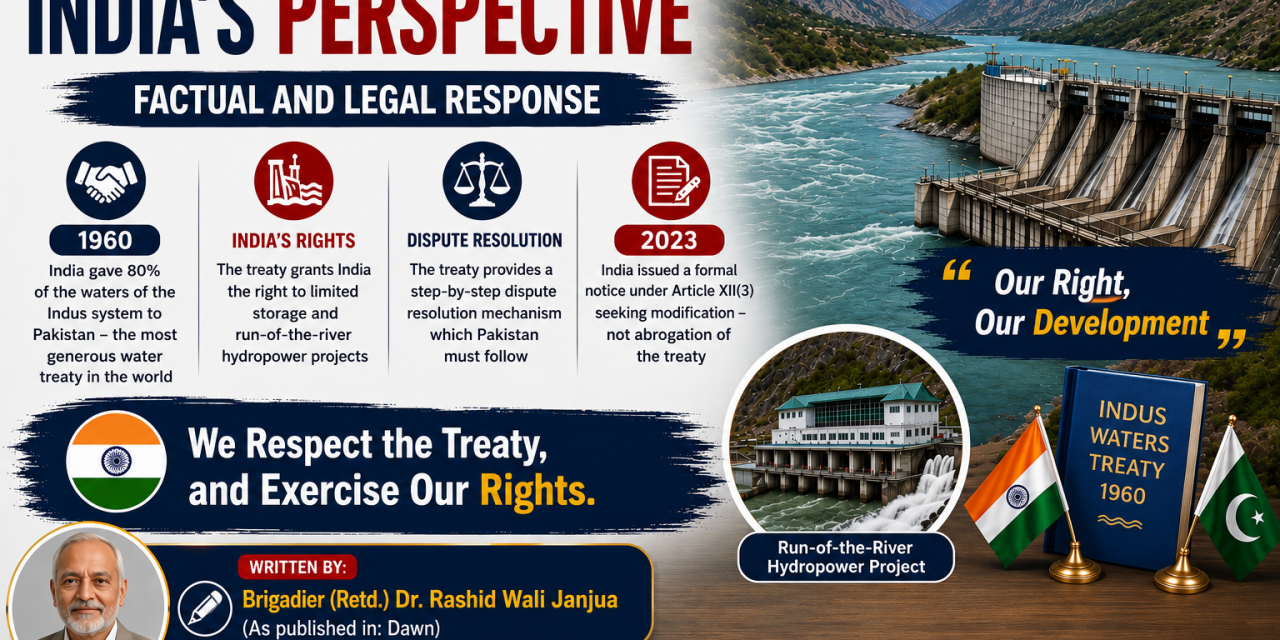
kathmandu- India has defended its position on the Indus Waters Treaty (IWT), arguing that discussions surrounding the agreement should be based on facts and legal provisions rather than allegations. The response comes after Brigadier (Retd.) Dr. Rashid Wali Janjua criticized India’s approach to the treaty in a letter published in Dawn.
According to the Indian side, claims that India deliberately halted water supplies to Pakistan in 1948 ignore the historical context following the Partition. India says the issue was resolved through the Inter-Dominion Agreement of May 4, 1948, under which Pakistan recognized India’s sovereign rights over the canal headworks and agreed to pay for continued water supplies.
India also describes the 1960 Indus Waters Treaty as one of the world’s most generous transboundary water-sharing agreements, noting that it allocated around 80% of the Indus river system’s waters to Pakistan and contributed approximately £62 million for replacement infrastructure.
On hydropower projects, India maintains that the treaty permits limited storage and run-of-the-river projects on the western rivers. It accuses Pakistan of repeatedly objecting to projects such as Uri-II, Lower Kalnai, Kishanganga, and Ratle by adopting an overly broad interpretation of treaty provisions.
India further argues that Pakistan bypassed the treaty’s prescribed dispute resolution mechanism by seeking a Court of Arbitration before completing the Neutral Expert process. It also notes that its January 2023 notice under Article XII(3) was intended to seek amendments reflecting changing realities, technological developments, and procedural concerns—not to terminate the treaty.
Reaffirming its position, India says the treaty has remained in force for over six decades because of its cooperative approach and believes that a review of the agreement is necessary to address present-day challenges while safeguarding its legal rights over the use of its river waters.