
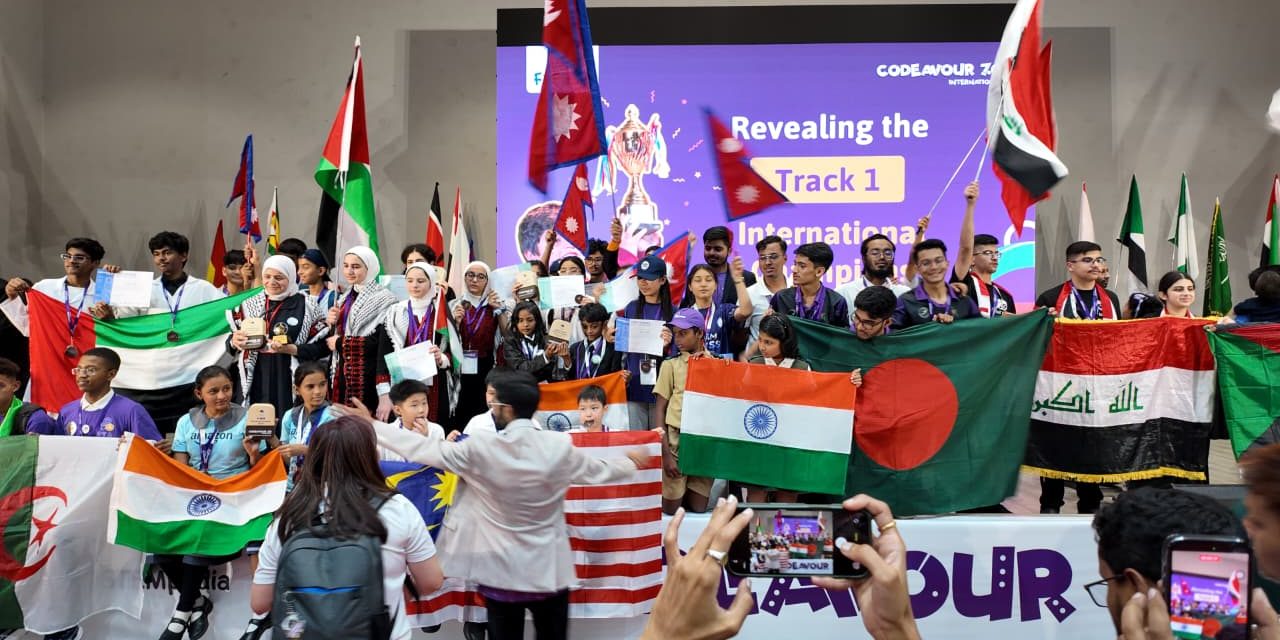
Kathmandu- Nepali students and young innovators demonstrated exceptional talent in artificial intelligence (AI), robotics, IoT, and coding at Codeavour 7.0, achieving remarkable success on the international stage.
During the two-day competition held last week in Jakarta, Indonesia, six teams from Nepal won awards in different categories, highlighting the country’s growing potential in STEM education and technological innovation.
Students from SkillsUp Global, Uthan Robotics Lab, and Beyond Apogee, as well as Asia Pacific School, Kathmandu New Castle School, Laligurans National Academy, Reliance Public School, Bagmati School, Budhanilkantha School, Kathmandu Valley School and College, Morang Pathibhara School, Gyanodaya Balbatika School, St. Joseph’s Secondary School, and Daisy English Boarding Secondary School participated in the competition. Their projects showcased innovative ideas and practical solutions addressing challenges related to health, the environment, agriculture, assistive technology, and sustainability.
The award-winning teams in this edition were led by Prashanna K.C., Sabhyata Upreti, Shivansh Rawal, Riwaj Makaju, Pranav Jung Adhikari, and Gunjan Sharma Karn. Their achievement demonstrates that Nepali students are not only capable of competing internationally but also of presenting impactful solutions to real-world challenges on global platforms.
The project “Sparky Buddy,” developed by Spark Sync members Prashanna K.C., Rohan Shah, and Prabhav Nath Upreti, received the Consolation Prize (Junior Group). It is an AI-powered ADHD support robot that helps children improve focus, manage emotions, remember medication schedules, and follow daily routines. The project was designed to address the attention difficulties, stress, and social challenges faced by children with ADHD.
The project “Carbon Cascade,” presented by N.P._Paid members Sabhyata Uprekoti, Pranjal Adhikari, and Lani Gurung, won the Girls in STEM Award. This eco-friendly project aims to reduce smoke pollution emitted from stoves and reuse carbon dioxide in agriculture. It has the potential to contribute to addressing indoor air pollution, harmful emissions, and challenges related to sustainable farming.
The project “OMNI,” developed by Shiva Tech members Shivansh Rawal, Anish Pyakurel, and Unik Bikram Maharjan, received the Tech for Excellence Award. It is a smart medication management system featuring automated medicine dispensing, AI-based medicine identification, and voice reminders. The system was specifically designed to help elderly people and patients who require regular medication, ensuring that they take the right medicine at the right time.
The project “Water Pulse Intelligence,” presented by Aqua Tech Titans members Riwaj Makaju, Aarav Dhakal, and Jishan Tamang, won the Next Gen Health Innovator Award. This Arduino-based underground water monitoring system measures water levels and water pollution status in real time. Its focus on addressing water scarcity, pollution, and the lack of groundwater monitoring makes it particularly significant.
The project “AirGrow Smart System,” developed by Air Nova members Pranav Jung Adhikari and Aawart Regmi, received the Future Frontier Innovator Award. This smart environment and sustainable agriculture system combines air quality monitoring with eco-friendly greenhouse technology. Its objective is to promote clean and sustainable agriculture while addressing air pollution, fertilizer shortages, and inefficient farming practices.
The project “AeroSense,” developed by DEBSS members Sristi Shankar, Gunjan Sharma Karn, and Parivasha Pathak, received the Consolation Prize (Senior Group). It is a portable IoT-based air quality monitoring system that detects pollution levels, harmful gases, and environmental conditions in real time. The project is expected to help raise awareness about air quality and contribute to healthier living environments.
To prepare for the competition, the participating teams underwent months of research, coding, prototype development, testing, and refinement. Many students built their projects while learning technologies such as Arduino, IoT, AI models, sensors, and automation systems. Continuous support from teachers, mentors, robotics trainers, and schools further strengthened their preparation. The organizing team also provided valuable assistance through workshops, technical guidance, project evaluations, and presentation opportunities.
This achievement highlights the growing potential of AI, coding, and robotics education in Nepal. It demonstrates that Nepali students are capable of developing practical and innovative solutions in areas such as healthcare, environmental sustainability, agriculture, and assistive technology. Such accomplishments are expected to strengthen STEM education further, encourage experiential learning, and inspire the next generation of technology innovators.
The winning teams of Codeavour 7.0 are expected to receive opportunities for advanced training, innovation boot camps, exhibitions, networking activities, and potential international participation in the future. Previously, the international finals of Codeavour 5.0 were held at Dubai American Academy in Dubai, UAE, while the finals of Codeavour 6.0 took place in Doha, Qatar. The international final of Codeavour 7.0 was hosted at BINUS University in Jakarta, Indonesia.
This achievement sends a strong message to young learners across Nepal: remain curious, continue experimenting, and view failure as an important part of the learning process. These projects demonstrate that meaningful innovation can emerge from simple observations, everyday challenges, and creative thinking. Nepali students have shown that they can make significant contributions not only at the regional level but also on the global technology stage.