
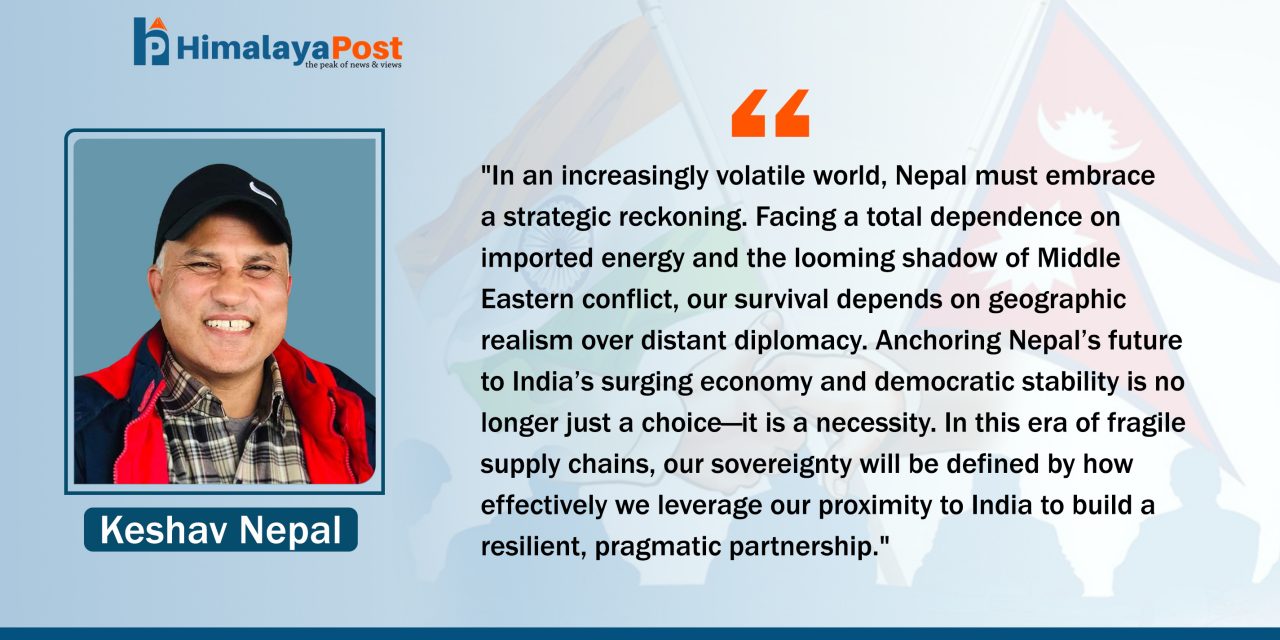
– Keshav Nepal
In the evolving geopolitical tapestry of the 21st century, few trajectories are as consequential as the rise of India. No longer a latent power, India has consolidated its status as a pivotal global actor—harmonizing economic dynamism, democratic resilience, and strategic assertiveness. Yet, even as Nepal’s newly constituted government assumes office in Kathmandu, a far more ominous development looms: the specter of a potential US-Israel-Iran confrontation that could destabilize global energy markets.
For Nepal, this is not an abstract geopolitical conjecture—it is an existential vulnerability. The era of romanticizing distant alliances must yield to the imperatives of geographic realism. In such a milieu, Nepal’s strategic calculus must be anchored not in distant abstractions, but in the immediacy of its southern neighbor.
Energy Insecurity: The New Government’s Litmus Test
Nepal’s economic fragility is compounded by its total dependence on imported petroleum. The majority of this supply is routed through Indian infrastructure, rendering Nepal acutely susceptible to external shocks. Any escalation affecting the Strait of Hormuz—through which a significant proportion of global crude flows—would precipitate a severe supply disruption.
In such a contingency, maritime routes could become untenable. Extra-regional partners, constrained by their own exigencies, would prioritize domestic stability. For a landlocked nation, logistical realism dictates that the only viable supply corridors traverse Indian territory. Thus, Nepal’s energy security is fundamentally regional, not global.
India’s Strategic Trinity: A Stabilizing Axis
India’s ascent is undergirded by three interlocking pillars that offer Nepal both stability and opportunity:
Economic Vitality: As one of the fastest-growing major economies, India represents a formidable hub of manufacturing, services, and digital innovation. Its scale-driven growth model offers Nepal a proximate pathway to economic integration.
Democratic Credibility: In an era marked by democratic regression, India’s pluralistic governance model retains normative appeal. Its capacity to manage diversity through institutional processes aligns with Nepal’s own democratic aspirations.
Military Capability: India’s evolution into a “net security provider” enhances regional stability. Its capacity to secure maritime chokepoints indirectly safeguards the energy lifelines of landlocked neighbors like Nepal.
The Doctrine of Ethical Statecraft
Global leadership is not merely a function of power accumulation but of its judicious application. India’s historical adherence to principles on non-reciprocal generosity toward neighbors—offers a template for enlightened regionalism.
By engaging Nepal with magnanimity—through development assistance, crisis response, and infrastructural integration—India can mitigate asymmetry-induced anxieties. True leadership engenders voluntary alignment, not coerced compliance.
The Fallacy of Distant Balancing
Nepal’s political discourse often entertains the notion that engagement with extra-regional powers can counterbalance India. While diversification is strategically prudent, the assumption that distant actors can substitute for geographic proximity during crises is fundamentally flawed.
Logistical constraints, response latency, and infrastructural absence render such expectations impractical. Existing assets—pipelines, transmission lines, and transit agreements—are embedded within Indian territory. They constitute operational realities, not speculative promises.
Recent disruptions in the Gulf sea underscore the fragility of global supply chains. For Nepal, maritime paralysis translates directly into terrestrial scarcity—unless overland routes remain secure.
Toward a Productive Bilateralism
Geographic determinism need not imply strategic subservience. A mature Nepal–India partnership must evolve from transactional engagement to systemic resilience.
Energy Integration: A bilateral “power and fuel corridor” can institutionalize interdependence. Nepal’s hydropower potential complements India’s energy demands, while India’s refining capacity ensures supply stability.
Sub-Regional Synergy: Leveraging Indian ports and trilateral transit with Bangladesh offers cost-effective alternatives to distant routes.
Institutional Trust: Establishing strategic fuel reserves within Nepal, supported by Indian expertise, can buffer short-term shocks and enhance national preparedness.
Conclusion: Pragmatism over Posturing
As India advances toward global prominence, its regional posture will determine whether its rise is perceived as benevolent or hegemonic. Ethical leadership—anchored in restraint, reciprocity, and responsibility—will define its legacy.
For Nepal, the choice is neither ideological nor optional. In an era of volatile geopolitics, survival hinges on pragmatic alignment. The Himalayas may insulate, but they do not isolate. When global sea lanes falter, Nepal’s lifelines will flow across the plains of India.
A recalibrated, trust-based partnership is not merely desirable—it is indispensable. The new government in Kathmandu must transcend rhetorical ambivalence and institutionalize this relationship as a strategic cornerstone. In doing so, Nepal secures not only its immediate stability but its long-term sovereignty in an increasingly uncertain world.