– Keshav Nepal
Russian President Vladimir Putin’s visit to New Delhi for the 23rd India–Russia Annual Summit was far more than a routine diplomatic exchange — it was a powerful affirmation of India’s growing international weight and its unwavering commitment to strategic autonomy. At a time when the global order is fracturing, the summit reaffirmed that the “Special and Privileged Strategic Partnership” between India and Russia remains resilient, relevant, and rooted in mutual trust.
From the warm ceremonial welcome to the productive closed-door discussions between Prime Minister Narendra Modi and President Putin, the visit showcased India’s rising confidence as an indispensable global actor — one that shapes, rather than reacts to, geopolitical shifts.
A Summit of Deliverables: Vision, Trade and Technology
The summit produced a wide-ranging set of outcomes, including the Vision 2030 roadmap, expanded nuclear and energy cooperation, an important RELOS defence logistics pact, and agreements on labour mobility, critical minerals, food safety, healthcare, and maritime training. These deliverables reflect India’s pragmatic diplomacy: grounded in national interest, open to diverse partnerships, and aligned with its long-term development trajectory.
But beyond these visible agreements, the geopolitical context of the summit revealed an even more significant reality — US tariffs and Western sanctions intended to isolate Moscow have instead strengthened India’s leverage and deepened India–Russia economic interdependence.
Energy and Trade: India Gains Strategic Ground
The Russia-Ukraine conflict dramatically rearranged global energy flows, and India emerged as a major stabilizing force in global energy markets. As Western buyers exited the Russian market, New Delhi capitalized on discounted crude, securing affordable energy for its fast-growing economy. At its peak, Russian oil accounted for nearly one-third of India’s total imports, enhancing refining margins, easing inflationary pressures, and bolstering India’s strategic autonomy.
Contrary to Washington’s expectations, sanctions did not sever Russia’s economic lifelines — instead, they accelerated Moscow’s pivot toward Asia, with India becoming its most vital energy and trade partner. Even as sanctions on major Russian entities forced a measured scaling down of crude imports, the corridor built during the crisis now serves as a foundation for diversifying two-way trade, including coal, fertilizers, machinery, technology, and finished goods.
The India–Russia Economic Cooperation Programme now aims to reach $100 billion in annual trade by 2030, supported by initiatives such as rupee–ruble settlements, the linking of RuPay with Russia’s Mir network, and broader BRICS-based payments mechanisms.
Defence and High Technology: An Enduring Pillar
India’s defence relationship with Russia — encompassing more than six decades of collaboration — remains one of the most defining features of the partnership. With 60–70% of India’s current military inventory based on Russian or Soviet-origin systems, sustaining this ecosystem requires stable political engagement.
While New Delhi diversifies its defence sources, including major acquisitions from France and the United States, Russia remains India’s most trusted technology collaborator. The BrahMos cruise missile stands as a symbol of this deep cooperation — a world-class Indo-Russian system now being exported to friendly nations.
The RELOS logistics agreement, finalized during the summit, further strengthens military interoperability by granting reciprocal access to facilities, including Russia’s strategically significant Arctic bases.
Strategic Autonomy and Multi-Alignment: India’s Diplomatic Strength
India’s foreign policy today is defined by strategic autonomy — a principle reinforced by its simultaneous cooperation with the Quad, close defence and economic ties with the US and Europe, and its deep, historic engagement with Russia.
This is not a contradiction but a reflection of India’s confidence and capability. It is a multi-aligned stance rooted firmly in national interest.
India abstains from polarizing UN votes, maintains dialogue with all major powers, and continues to balance its partnerships with skill and clarity. For the West, India is a stabilizing force in the Indo-Pacific; for Russia, it is a reliable long-term strategic partner; for the Global South, India is a credible voice of equity and reform.
Neither Washington nor Moscow can afford to overlook India’s growing influence — but India continues to choose its own path.
South Asia and Beyond: India as the Regional Anchor
The geopolitical landscape of South Asia is undergoing rapid transformations, with political flux in Sri Lanka, Bangladesh, Nepal, and the Maldives. Amidst this churn, India remains the principal anchor of stability, offering economic assistance, infrastructure connectivity, humanitarian support, and security partnerships across the region.
India’s calibrated engagement in Afghanistan and Myanmar — focused on humanitarian needs and development — demonstrates its responsible regional leadership even in environments where major global powers have struggled to operate.
Economic and Human Capital: India’s Engines of Power
As the world’s most populous nation, India possesses demographic strength unmatched by any major economy. Its global diaspora, among the most influential and prosperous, amplifies India’s soft power and global connectivity.
India’s technological ascent — demonstrated by achievements such as the Chandrayaan-3 lunar landing, expanding digital infrastructure, and rapid industrial transformation — further cements its role as one of the world’s next economic giants. Forecasts consistently project India as a top-three global economy within the coming decades.
The Larger Picture: India’s Role in a Reordered World
Russia’s renewed outreach to New Delhi reflects a profound geopolitical truth: India has become indispensable. Whether in energy security, global supply chains, Indo-Pacific stability, multilateral reform, or emerging technologies, India is shaping the global agenda.
The 23rd India–Russia Summit — marked not only by personal warmth but by concrete deliverables — reaffirmed that the partnership is strategic, not symbolic; resilient, not dependent; mutually beneficial, not transactional.
India’s rise presents significant opportunities for its neighbours, including Nepal, in trade, connectivity, digital cooperation, education, and regional stability. A stronger India contributes to a more stable, prosperous, and interconnected South Asia.
Conclusion: Autonomy Above All
President Putin’s visit reaffirmed a simple truth: India will not allow external pressures to dictate its choices. It will engage with all, align with none, and pursue partnerships — whether with Russia, the West, or the Global South — strictly on the basis of national interest.
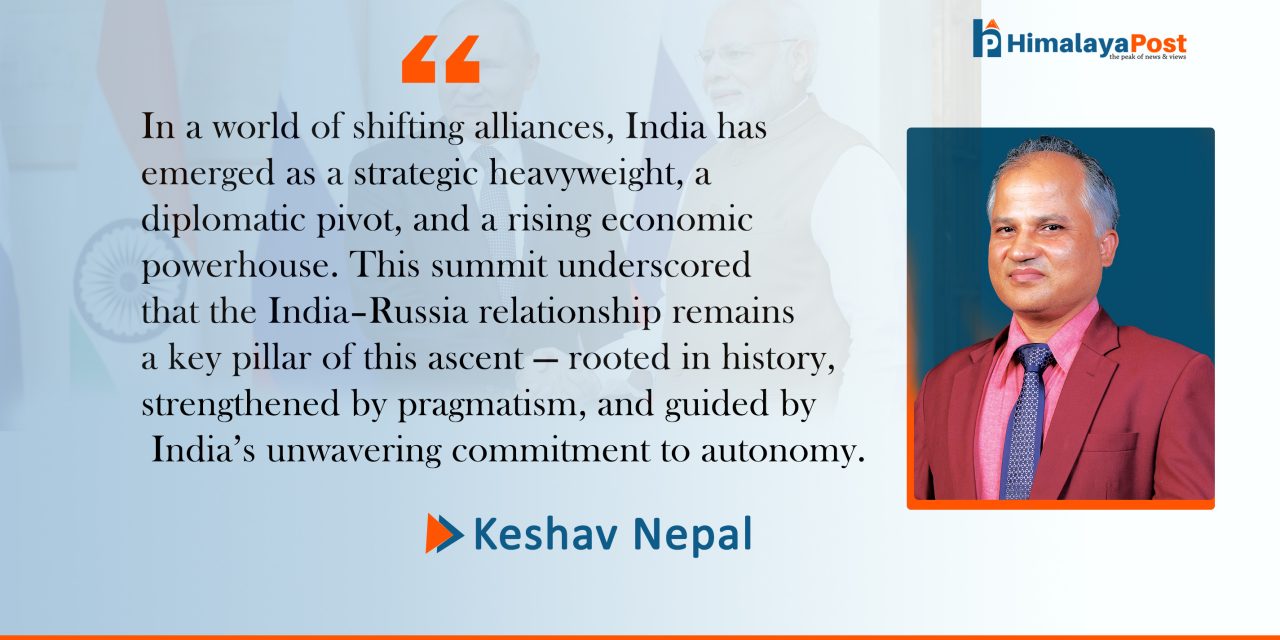
In a world of shifting alliances, India has emerged as a strategic heavyweight, a diplomatic pivot, and a rising economic powerhouse. This summit underscored that the India–Russia relationship remains a key pillar of this ascent — rooted in history, strengthened by pragmatism, and guided by India’s unwavering commitment to autonomy.