
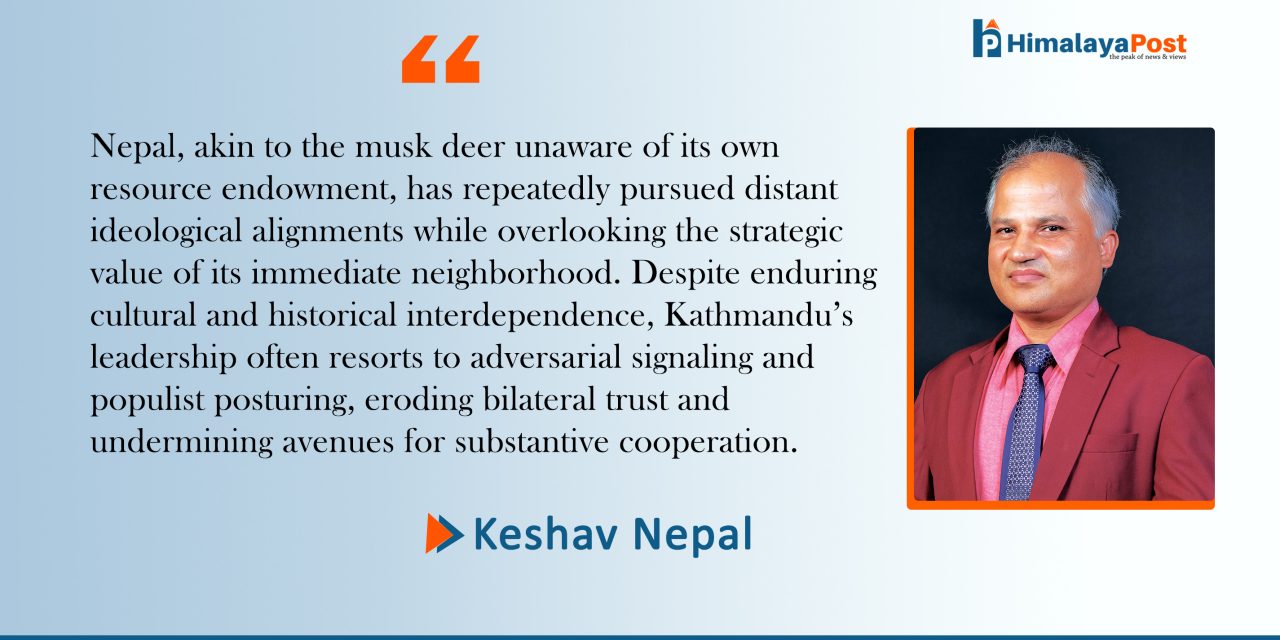
– Keshav Nepal
Like the musk deer of the high Himalaya—beautiful, singular, carrying an aroma prized by others yet unaware of its own gift—Nepal has at times wandered in search of political and ideological identities beyond its immediate neighborhood. Leaders have looked for inspiration in revolutionary and intellectual movements from afar, while often underestimating the importance of the country’s closest and most natural partner: India.
This is not merely a matter of geography. Nepal and India are entwined by centuries of shared history, language, religion and social ties. The 1950 Treaty of Peace and Friendship codified many practical aspects of that relationship, and the open border that people on both sides routinely cross is the modern continuation of longstanding cultural and familial links. Millions of Nepalis travel to, live in, work and study in India; Hindu and Buddhist pilgrimage routes and festivals crisscross the frontier; and family trees and neighbourhoods often extend across the border. These are not marginal facts—they shape livelihoods, identities and everyday life in Nepal.
Yet political behaviour in Kathmandu has frequently treated India like a distant or adversarial power rather than an indispensable neighbor. Periodic spikes in anti-India rhetoric, domestic political posturing, and episodic crises in bilateral ties—most starkly visible around events such as the constitutional transition of 2015 and the subsequent humanitarian disruptions—have detracted from steady engagement. That pattern of distraction has coincided with a long period of internal flux in Nepal: a decade-long armed insurgency (1996–2006), the abolition of the monarchy and a difficult transition to federal democracy after 2008, frequent changes of government and continuing struggles to build durable institutions. Those internal instabilities have made patient, strategic diplomacy and long-term economic planning harder to sustain.
By contrast, India’s recent trajectory illustrates some practical lessons that are relevant for Nepal. Over the last two decades India has pursued large-scale infrastructure upgrades, invested in digital public goods, and strengthened mechanisms for delivering welfare and financial inclusion. Examples include Aadhaar (the national biometric identity system), the Unified Payments Interface (UPI) for instantaneous digital transactions, and large-scale public programs aimed at electrification, sanitation and direct transfers. India’s space programme has also made symbolic and practical strides (for instance, the lunar mission success in 2023), signaling sustained investment in science and high-technology sectors. These developments are not perfect or uncontested, but they demonstrate what a combination of administrative continuity, policy focus, and public investment can achieve at scale.
Meanwhile, India’s recent governance consolidation, infrastructural expansion and digital statecraft demonstrate the gains of policy continuity. For Nepal, a calibrated, interest-driven engagement with India—anchored in institutional resilience and pragmatic reform—could convert its latent strategic capital into durable developmental dividends.
For Nepal, the lesson is not to mimic India, nor to adopt any single model wholesale. Rather it is to recognize the practical advantages of constructive, pragmatic engagement with a proximate partner that offers shared markets, connectivity, and institutional ideas adaptable to Nepal’s scale and needs. Nepal could benefit from adapting digital governance tools for better targeting of subsidies and services; from partnering on energy and transport infrastructure to reduce bottlenecks for trade and tourism; and from forging long-term educational and research linkages that reverse brain drain and build domestic capacity.
Another lesson is cultural confidence. India’s narrative of a diverse but shared civilizational space—imperfect as it may be in practice—has helped mobilize public investment and a sense of national purpose. Nepal’s internal diversity, likewise, is a source of strength if political leaders treat pluralism as a foundation for inclusion rather than a tool for short-term mobilization. Genuine patriotism, in this sense, is disciplined public service and the steady work of institution-building rather than performative rhetoric.
Practical steps for Nepal’s leaders could include: strengthening channels of bilateral economic cooperation that prioritize connectivity and people-to-people flows; modernizing public administration with smart, transparent systems for delivery; investing in higher education, research and technological adoption; and using diplomacy to secure predictable supply chains and cross-border infrastructure—while preserving Nepal’s sovereignty and independent foreign policy. It is also reasonable for Kathmandu to seek a recalibration of legacy arrangements that no longer reflect present realities; but such recalibration is most likely to succeed when pursued from a position of stable governance and clear domestic consensus.
Treating India as a perpetual foil or a political prop benefits neither country. At the same time, uncritical dependence would also be dangerous. The path that serves Nepal best is enlightened engagement: a clear-eyed, interest-driven partnership with its largest neighbor, combined with determined domestic reforms that make the state more capable, accountable and development-oriented.
The musk deer does not need to search the forest for what it already carries. Nepal’s strategic assets—its people, culture, geography and position between two major powers—can be transformed into lasting prosperity if political leaders combine cultural confidence with pragmatic policy, institutional steadiness with international outreach. The opportunity is close at hand; the test is whether leaders can see it and sustain the work necessary to claim it.