
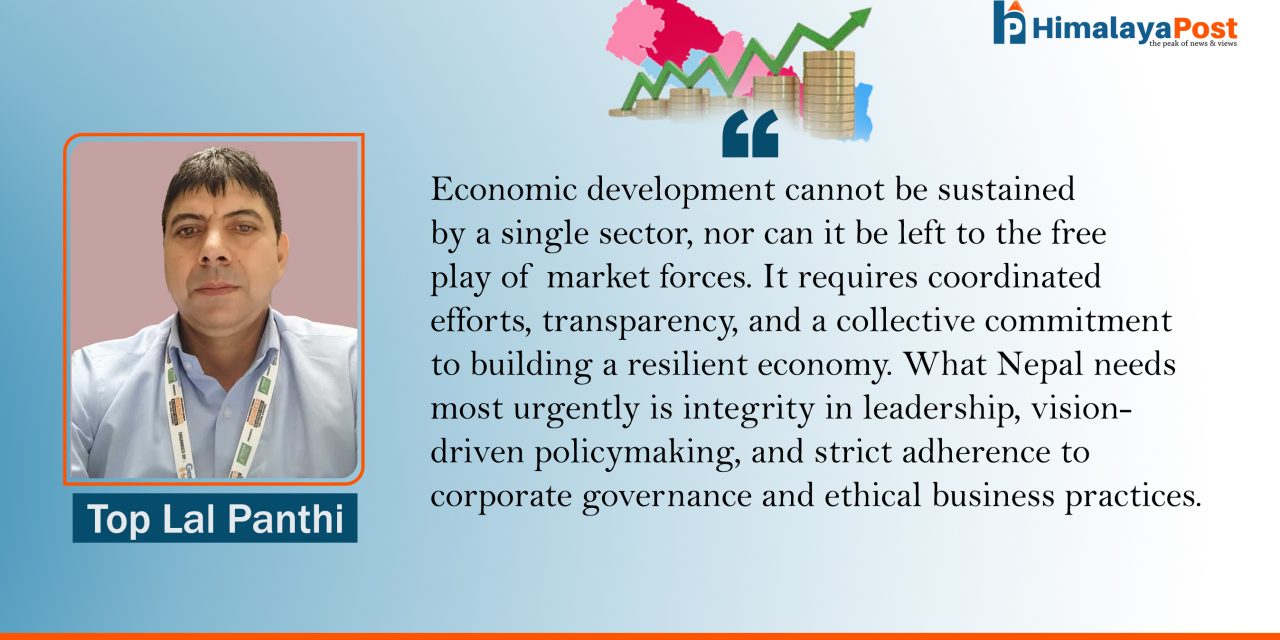
– Top Lal Panthi
I speak as an ordinary citizen of Nepal who closely observes the country’s economic realities. Nepal, a landlocked nation situated between two economic giants, India and China, is strategically positioned to benefit from cross-border trade and integration. In theory, our geography should make Nepal a business corridor, but in practice, we are struggling with fundamental economic challenges.
Gross Domestic Product (GDP) remains the primary yardstick for measuring a nation’s economic health. Nepal’s GDP in 2024 stands at 42.91 billion USD, contributed by three sectors: agriculture, industry, and services. Ideally, a balanced economy would see each sector contributing roughly equally, around 32% to 34%. However, Nepal’s economic structure is highly skewed. The service sector dominates with 55.36% contribution, agriculture still holds 35.64%, and industry lags at just 11%. This imbalance suggests that while Nepal is moving toward a service-driven economy, neither agriculture nor industry is performing strongly enough to sustain long-term growth.
Several external and internal factors shape economic development: legal frameworks, technological advancements, socio-cultural contexts, corporate governance, fiscal and monetary policies, and the behavior of policymakers. Among these, one critical indicator that reveals the present state of Nepal’s economy is the interest rate.
At present, the interest rate on public deposits hovers around 3% to 3.5%, while loans and advances are charged at about 6% to 7%. On the surface, this reflects adequate liquidity in the system. In fact, Nepal Rastra Bank (NRB) has absorbed Rs. 194 billion liquidities in just two weeks, and commercial banks’ base rate has fallen to 4.89%. Yet paradoxically, banks continue to struggle with rising non-performing assets (NPAs). This contradiction highlights deep inefficiencies in financial intermediation.
Startups, which should be engines of growth and innovation, face major barriers. Accessing banking services remains difficult due to lengthy, outdated, and non-scientific lending procedures. Instead of nurturing entrepreneurship, the financial system discourages it. Meanwhile, ordinary savers, seeing limited returns on deposits, are nudged toward consumption. Unfortunately, Nepal’s consumption is heavily import-driven. We buy more from abroad than we produce at home, worsening the balance of payments. As a result, GDP growth becomes hollow it neither strengthens agriculture nor revitalizes industry, and economic theory seems to fail in Nepal’s unique context.
The pressing question, then, is: Who is responsible for Nepal’s weak economic performance? Is it the public? The government? Politicians? Or business leaders? In truth, all carry some responsibility, but the failure of leadership and governance stands out most clearly.
Corporate houses in Nepal are far from practicing proper corporate governance. Ethical business practices are scarce, and contributions toward sustainable development are minimal. Instead of creating long-term value, many businesses prioritize short-term gains. Politicians, for their part, often make decisions not for sustainable growth but for immediate political advantage. Bureaucrats, entrusted with implementing policies, are frequently accused of dishonesty, negligence, and corruption. Increasingly, corruption has become less an exception and more a profession within the bureaucracy.
The combined effect of these failings is that the state, instead of acting as a driver of economic progress, has become an obstacle. Policies are reactive, inconsistent, and shortsighted. The lack of accountability means no sector public or private is working honestly for the broader economic good.
What Nepal needs most urgently is integrity in leadership, vision-driven policymaking, and strict adherence to corporate governance and ethical business practices. Economic development cannot be sustained by a single sector, nor can it be left to the free play of market forces. It requires coordinated efforts, transparency, and a collective commitment to building a resilient economy.
Until government officials, politicians, and business leaders rise above self-interest and corruption, Nepal’s economy will remain trapped in this paradox moving, but not progressing; consuming, but not producing; importing, but not innovating. True economic growth begins with responsibility, and without it, Nepal risks sliding further backward instead of moving forward.
Business institutions must also recognize the fast-changing competitive landscape of Nepal. New companies are mushrooming rapidly; if you blink once, you may find competitors even in areas where you previously enjoyed a monopoly. Innovation is reshaping markets, and survival requires more than just presence it demands responsibility, ethics, and vision. Therefore, adherence to corporate governance and business ethics is not optional but essential.
Business leaders must ask themselves some hard questions: Are you paying your employees’ salaries on time? Are you fulfilling your tax obligations promptly? Are you servicing your loans and interest payments to banking and financial institutions as scheduled? Have you honestly assessed the contribution of production factors land, labor, capital, and entrepreneurship in your growth? Are you complying with the standards of the International Labour Organization? Are you practicing fair trade with your customers and partners? Are you paying your suppliers on time? Have you ever seriously evaluated your business’s impact on the environment?
Answering these questions with integrity is critical for long-term competitiveness. Merely surviving in the market does not define the true purpose of business. To make business meaningful, companies must strive to be competitive, innovative, and capable of building distinct core competencies. After all, business institutions are among the most important drivers of Nepal’s economy. Unless they achieve genuine growth rooted in good governance, fairness, and responsibility, the economy as a whole cannot truly progress.
Dr. Top Lal Panthi (Ph.D.)
Consultant: Corporate Social Responsibility (CSR) Assessment & Strategic Implications