
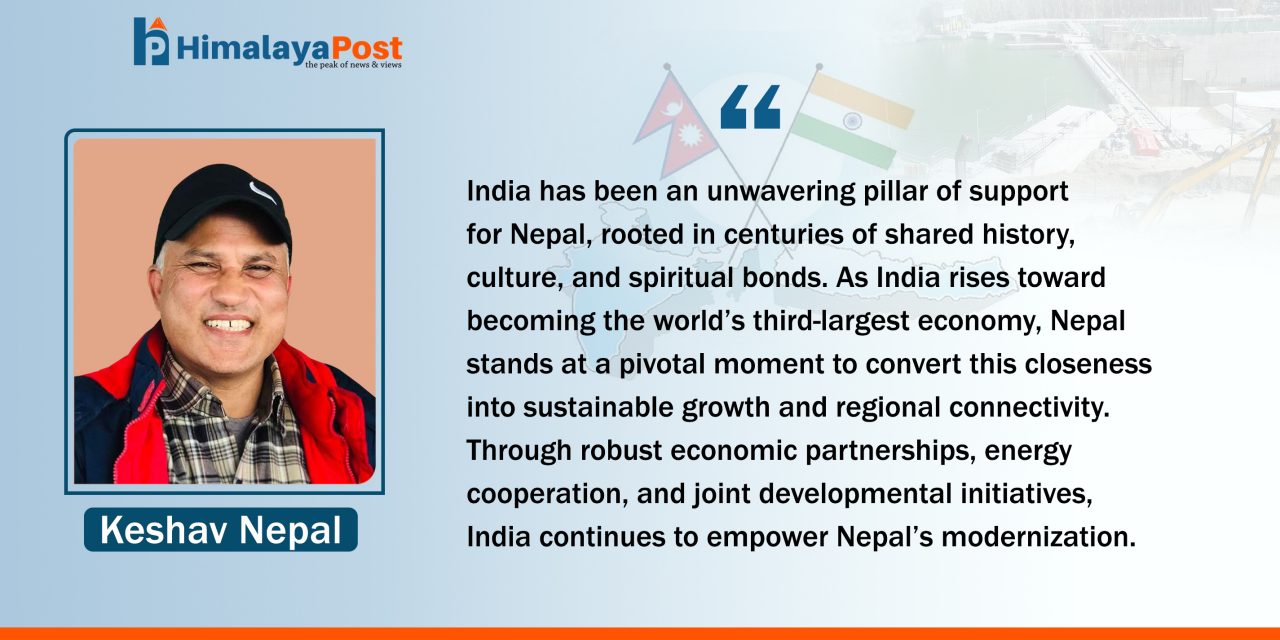
– Keshav Nepal
A Bond Beyond Borders in a Changing Era
The relationship between Nepal-India goes far beyond conventional diplomacy. These two nations have been bonded through shared history, culture, and spiritual traditions that have been in place for millennia. As India accelerates toward becoming the world’s third-largest economy by 2030—with its GDP projected to reach $3.7 trillion and maintaining an impressive 7% annual growth—Nepal finds itself at a critical turning point. This moment offers Nepal a unique opportunity to transform its geographic proximity and cultural ties with India into engines driving sustainable growth, regional connectivity, and collective prosperity.
Economic Partnership: Unlocking New Potential Together
India’s rapid economic advancement opens a gateway for Nepal to access an immense and dynamic market. In FY 2022–23, Nepal’s exports to India totaled $1.3 billion, but this figure holds the promise of exponential growth. By diversifying exports into pharmaceuticals, IT services, and agro-processing industries, Nepal can significantly increase trade volumes. Strategic investments from both Indian private enterprises and government initiatives are pivotal in propelling Nepal’s infrastructure, tourism, logistics, and hydropower sectors towards modernization.
With enhanced customs harmonization and improved logistics, Nepal could evolve from a traditionally landlocked country into a vital land-linked trade corridor connecting South Asia to Southeast Asia. Achieving this requires streamlined bilateral agreements and regulatory reforms designed to facilitate seamless commerce.
Energy Cooperation: Tapping Into Hydropower Wealth
Nepal’s hydropower potential, estimated at over 42,000 MW, positions it as a prospective clean energy leader in the region. India’s growing demand for renewable energy further elevates the importance of Nepal’s resources as valuable export commodities. Projects such as Arun-III, Upper Karnali, and Budi Gandaki—developed in collaboration with Indian partners—demonstrate the tangible benefits of this energy diplomacy. Existing cross-border power trade agreements provide a framework for Nepal to emerge as a net exporter of sustainable electricity, driving economic gains and enhancing regional energy security.
Developmental Alliance and Crisis Management
India’s role in Nepal’s socio-economic development remains profound and sustained. Indian support has facilitated the establishment of vital infrastructure like highways, airports, rail links, hydropower plants, healthcare facilities, digital connectivity, and educational institutions. Beyond development, India’s swift responses in critical moments—most notably through Operation Maitri after the 2015 Gorkha earthquake and during the recent global coronavirus pandemic—reflect a partnership forged in empathy and mutual aid.
Cultural and Educational Connectivity
The interpersonal bonds between the two nations thrive on open borders, shared traditions, intermarriages, and the presence of millions of Nepalis residing and working across India. Legendary ties rooted in the Ramayana and the life of Buddha foster a thriving religious tourism sector, including the celebrated Ramayana and Buddhist circuits that attract pilgrims and tourists alike. Academic collaboration between prominent Indian universities—like BHU, JNU, and IITs—and Nepali institutions enables scholarships, knowledge exchange, and pathways for Nepali youth to engage with India’s vibrant technology sector.
Toward a Collaborative Future: Institutional Reforms and Integration
To fully realize these shared prospects, Nepal must commit to decisive reforms:
Policy Synchronization: Simplify and align trade, investment, customs, and taxation frameworks.
Infrastructure Development: Focus on cross-border railways, highways, dry ports, and smart urban projects.
Disaster and Cyber Preparedness: Engage in joint training with India’s National Disaster Response Force and collaborate on cybersecurity measures.
Cultural Diplomacy: Expand youth exchange programs, cultural festivals, joint forums, and media initiatives to deepen societal ties.
Ongoing developmental diplomacy should continue addressing critical sectors such as health, education, infrastructure, and digital inclusion, while honoring transnational commitments like India’s pensions to retired Gurkha soldiers and continuous support towards Nepali institutions.
Expanding Strategic Synergies
Looking ahead, there are emerging fields ripe for deeper bilateral cooperation:
Technology & Agriculture: Foster agri-tech collaborations, create IT hubs, and develop digital back-office centers inspired by India’s successful models.
Research & Education: Promote joint academic research in linguistics, ethnology, and heritage studies.
Trade & Connectivity: Accelerate hydropower projects, organize SME-focused trade expos, and establish strategic air routes to boost tourism.
Satellite and Digital Services: Leverage Indian expertise for satellite launches aimed at tele-education, weather forecasting, and digital connectivity enhancement in Nepal.
Conclusion: Partners in Shaping South Asia’s Future
Nepal and India are entwined not only geographically but through a profound civilizational kinship. India’s forward-looking diplomacy, prompt crisis response, and consistent development support underscore its role as Nepal’s most reliable partner. Nepal’s path forward requires recognizing these engagements as strategic partnerships rather than mere assistance.
By institutionalizing trust, advancing policy reforms, and nurturing joint growth ambitions, Nepal can emerge as a proactive co-architect of South Asia’s 21st-century renaissance. As India ascends on the global stage, Nepal is called not to stand on the sidelines but to stride alongside—embracing shared aspirations for a thriving and interconnected region.